

Key Takeaways
- Darkness reduces effective vision range to as little as 160–250 feet on low-beam headlights.
- Fatigue and night driving are closely linked, compounding reaction time and judgment impairment.
- Pedestrians and cyclists are disproportionately at risk during nighttime hours.
- Depth perception and peripheral vision both deteriorate significantly in low-light conditions.
- Speed should be adjusted so stopping distance never exceeds the distance illuminated by headlights.
Night Driving Risk Profile
Night driving risk profile refers to the distinct combination of perceptual, physical, and environmental hazards that make driving after dark statistically more dangerous than driving in daylight. Even on familiar roads, darkness reduces how far and how clearly a driver can see, slows hazard recognition, and compounds the effects of fatigue. These factors together elevate crash risk even when traffic volume is lower.
Research consistently shows that crash fatality rates per mile driven are significantly higher at night than during the day, largely because reduced visibility limits stopping distances relative to the driver's actual sight range — a condition sometimes called 'overdriving your headlights.'
Why Darkness Fundamentally Changes the Driving Task
Driving is a visually dominated task — estimates suggest that roughly 90% of the information a driver uses comes through sight. When light disappears, so does much of that informational foundation. The road ahead narrows to whatever your headlights can reach, and everything beyond that cone of light becomes unknown territory.
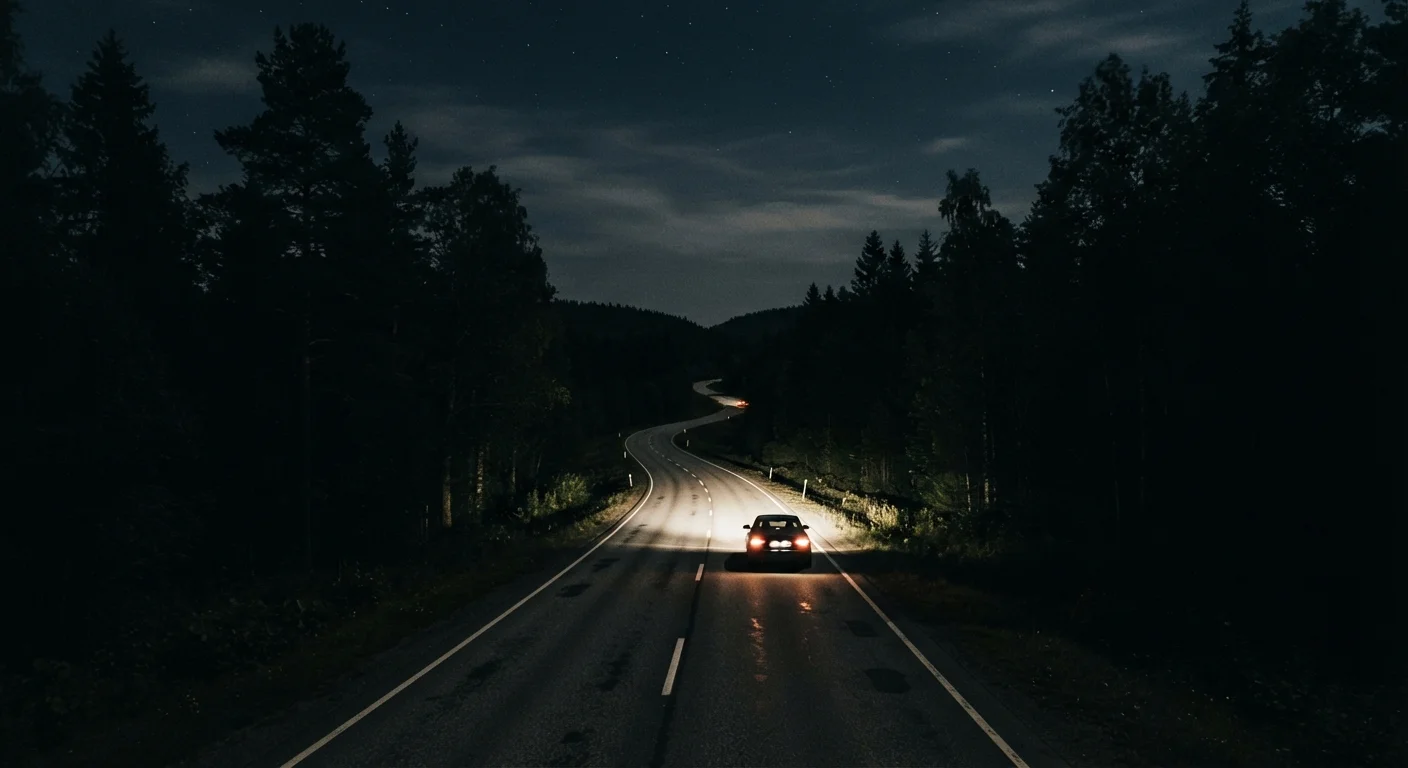
Low-beam headlights illuminate roughly 160 feet of road. At 60 mph, a vehicle covers about 88 feet per second — meaning a driver has less than two seconds to perceive a hazard, decide, and brake before reaching it. On high beams, that margin improves, but high beams must be dimmed for oncoming traffic, creating repeated cycles of reduced visibility at precisely the moments when another vehicle is approaching.
This dynamic — where stopping distance can easily exceed illuminated distance — is known as overdriving your headlights. It's one of the most underappreciated hazards in everyday driving. Speed and road conditions interact directly with this problem: the faster you drive, the wider the gap between what you can see and what you'd need to stop safely.
Adjust Speed to Match Your Sight Distance
A useful rule of thumb: you should always be able to stop within the distance your headlights illuminate. If your low beams cover 160 feet, your speed should allow a full stop within that range. On dark, unlit roads, this often means driving well below the posted speed limit — which reflects legal maximums, not safe targets for all conditions.
The Perceptual Penalties of Low Light
Human vision does not scale down gracefully in darkness. Several specific perceptual capabilities degrade in ways that directly affect driving performance:
- Peripheral vision narrows. The cells responsible for detecting motion at the edges of your visual field (rod cells) work differently in low light than the central cone cells used during the day. At night, you may miss movement that would register clearly in daylight.
- Depth perception diminishes. Judging the distance and speed of approaching vehicles or roadside objects becomes harder. This affects lane changes, gap acceptance at intersections, and reactions to pedestrians.
- Glare recovery slows. After oncoming headlights pass, the eye needs time to readjust. For younger drivers this takes a second or two; for older drivers it can take significantly longer.
- Color and contrast sensitivity drop. Hazard cues that rely on color — brake lights aside — become less reliable. Road markings, curb edges, and non-illuminated objects are harder to distinguish.
These aren't failures of attention — they're the biological limits of human vision operating outside its optimal conditions. Understanding this helps explain why even experienced, careful drivers face greater risk after dark. See also our article on blind spots and mirror geometry, which covers additional visibility limitations every driver should understand.
Night Vision Varies Significantly by Age
Drivers over 60 may need up to 10 times more light to see as clearly as a younger driver in the same conditions, according to vision research. Glare recovery and contrast sensitivity both decline with age. Older drivers who notice increasing difficulty with night driving may benefit from a vision assessment with an eye care professional.
Fatigue, Vulnerable Road Users, and Compounding Risks
Night driving rarely arrives alone as a risk factor. Two additional hazards consistently accompany it.
Driver fatigue follows a circadian rhythm — the body's natural pressure to sleep is strongest between roughly midnight and 6 a.m., and again in the early afternoon. Driving during these windows, especially after a long day, can impair reaction time and judgment in ways that rival mild intoxication. Fatigue is also self-obscuring: tired drivers often underestimate how impaired they are. For a deeper look at this risk, our piece on driver fatigue covers the warning signs and strategies for managing it.
Pedestrians and cyclists are disproportionately killed in nighttime crashes despite lower overall traffic volumes. Many are wearing dark clothing and may be moving unpredictably. They generate no headlight signature and may appear at the very edge of a driver's illuminated range with almost no warning time.
New and younger drivers face a compounded version of these risks. Research into why new drivers crash more identifies nighttime driving as one of the highest-risk contexts — which is why many graduated licensing programs specifically restrict unsupervised night driving during early licensure stages.
~3x
Higher fatality rate per mile driven at night
According to the National Safety Council, traffic fatality rates per mile driven are roughly three times higher at night than during the day.
76%
Pedestrian fatalities that occur in the dark
The National Highway Traffic Safety Administration (NHTSA) has reported that the large majority of pedestrian traffic fatalities occur in dark conditions.
160 ft
Typical low-beam headlight range
Standard low-beam headlights illuminate approximately 160 feet of road ahead — less than two seconds of sight distance at highway speeds.
Practical Adjustments That Reduce Nighttime Risk
Acknowledging night driving's risks isn't about avoidance — it's about calibration. Several evidence-informed habits meaningfully reduce exposure to the hazards described above:
- Reduce speed so that your stopping distance stays within your headlight range. This may mean driving well below the posted limit on unlit rural roads.
- Increase following distance. The standard two-second gap used during the day is insufficient at night; three to four seconds gives more reaction time when visibility is reduced.
- Keep your windshield clean. Interior film and exterior grime scatter light and dramatically increase glare. A clean windshield costs nothing but has a measurable effect on nighttime clarity.
- Ensure headlights are aimed correctly. Improperly aimed headlights reduce your effective illumination range and can blind oncoming drivers. Many service centers can check alignment quickly.
- Recognize fatigue early and stop. If you notice lane drifting, difficulty focusing, or missing exits, pull over safely. No destination is worth the risk of drowsy driving.
Night driving on freeways and urban roads each carry distinct hazard profiles — our overview of motorway vs. urban road hazards addresses how those environments differ, including after dark. Similarly, when darkness combines with wet or icy conditions, the risk multiplies — see our guide to driving in adverse conditions for environment-specific strategies.