

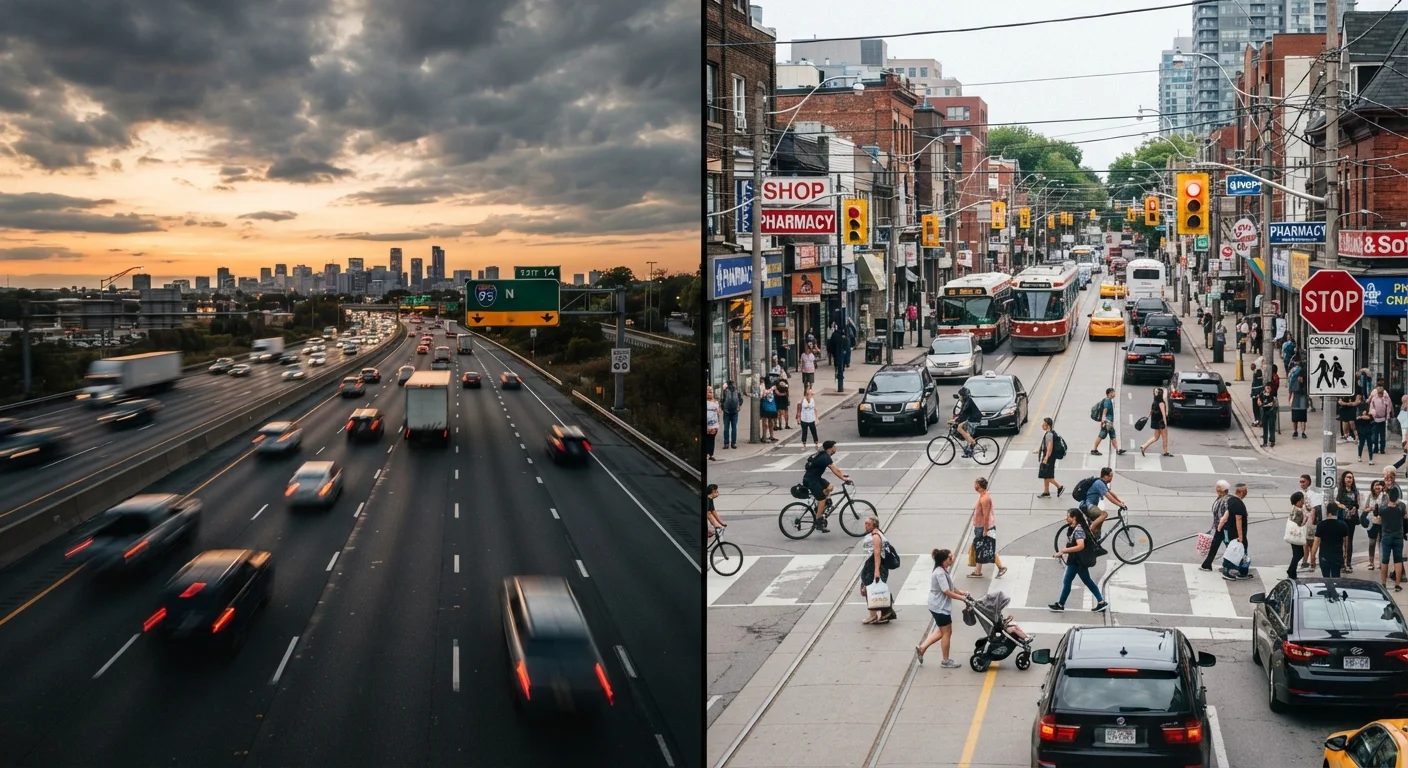
Key Takeaways
- Motorway crashes are less frequent but far more severe due to high speeds and limited reaction time.
- Urban driving demands near-constant hazard scanning because threats emerge from all directions at low speeds.
- Lane discipline, following distance, and merge technique are the core skills for motorway safety.
- Pedestrians, cyclists, and unpredictable stop-start traffic define the primary risks on city roads.
- Both environments require drivers to actively adjust speed and focus — not just follow posted limits.
- Preparation and awareness before entering each environment significantly reduces crash risk.
Option A
Motorway Driving
The high-speed, high-stakes environment.
Best for: Covering long distances efficiently, though it demands consistent attention and strong lane discipline at sustained speeds.
Option B
Urban Road Driving
The complex, constantly shifting environment.
Best for: Short-distance travel through populated areas, requiring constant hazard scanning, frequent decisions, and awareness of vulnerable road users.
If you drive long highway commutes regularly
Motorway Driving (with focused technique)
Understanding motorway-specific risks — lane discipline, following distance, and fatigue — is essential for anyone covering sustained high-speed miles.
If you drive primarily in cities or suburbs
Urban Road Driving (with hazard awareness training)
Urban environments require a broader scan pattern and quicker decision-making; building those habits deliberately makes city driving significantly safer.
If you are a new or recently licensed driver
Urban Road Driving (start here, then progress)
Most new drivers encounter urban roads first; mastering low-speed hazard perception before motorway exposure is the safer developmental path.
Why the Environment Changes Everything
Two drivers. Same car. Same licence. But place one on an interstate at 70 mph and the other on a city grid at rush hour, and they are managing almost entirely different sets of risks. Speed, road layout, road users, and legal rules all diverge sharply between motorways and urban roads — and so must the driver's approach.
Neither environment is inherently more dangerous than the other in every respect. Motorway crashes are statistically less frequent but tend to produce more severe outcomes. Urban crashes happen more often but usually at lower speeds. Understanding each environment on its own terms is what separates confident, adaptable drivers from those who default to one style regardless of context.
For a grounding in how posted speed limits relate to actual safe speeds in either environment, see our guide to speed limits and road conditions.
| Criterion | Motorway Driving | Urban Road Driving |
|---|---|---|
| Typical speed range | 55–75 mph | 15–45 mph |
| Primary hazard type | High-speed rear-end, lane merge | Intersection conflict, vulnerable users |
| Decision frequency | Lower — long, predictable stretches | Very high — constant new inputs |
| Crash severity when it occurs | Typically higher | Typically lower |
| Key technique required | Lane discipline, following distance | Hazard scanning, anticipation |
| Fatigue risk | Higher (monotony) | Lower (constant engagement) |
| Pedestrian/cyclist exposure | Minimal to none | High and constant |
| Signage complexity | Moderate — motorway-specific signs | High — mixed sign types |
Motorway Hazards: Speed, Distance, and Fatigue
At motorway speeds, the margin for error shrinks dramatically. A vehicle travelling at 70 mph covers roughly 103 feet per second. A momentary lapse in attention — checking a mirror, adjusting climate controls — can mean the car travels nearly the length of a basketball court before the driver's eyes return to the road.
The primary motorway hazards cluster around three areas:
- Following distance: Most drivers underestimate how much space they need. The two-second rule (keeping a minimum two-second gap to the vehicle ahead) is a baseline under ideal conditions; wet or reduced-visibility conditions require significantly more. See how adverse conditions change stopping distances.
- Lane discipline and merging: Poor merging technique — cutting in late, failing to match the flow of traffic — is a leading cause of motorway incidents. Smooth, early lane changes with proper signalling reduce conflict.
- Fatigue and monotony: Uniform scenery and sustained speeds can cause driver alertness to drop faster than most people expect. Taking breaks every 90–120 minutes on long trips is a well-established safety practice.
If something does go wrong at speed, the correct response is rarely instinctive. Emergency manoeuvre techniques are worth understanding before you need them.
~50%
Of fatal US crashes occurring on rural roads
According to the NHTSA, rural roads — many of which include high-speed stretches — account for roughly half of all traffic fatalities despite carrying less total traffic volume.
103 ft/sec
Distance covered per second at 70 mph
A straightforward physics calculation illustrating why reaction time and following distance are especially critical at motorway speeds.
~40%
Of US traffic fatalities at or near intersections
The NHTSA has consistently reported that a significant share of fatal crashes involve intersection-related conflicts, a defining feature of urban road environments.
Urban Road Hazards: Complexity, Unpredictability, and Vulnerable Users
Urban driving imposes a different cognitive load. Speeds are lower, but the number of variables multiplies: traffic signals, give-way junctions, crosswalks, cyclists filtering through traffic, delivery vehicles double-parked, children near schools, and pedestrians stepping off curbs without looking. Each of these demands a separate mental response, often in rapid succession.
Key urban hazards include:
- Vulnerable road users: Pedestrians and cyclists are statistically over-represented in urban collision data. They are harder to see, move unpredictably, and have no crash protection. Wider scanning habits — checking further ahead, monitoring curb lines, watching for cyclists in mirrors before opening doors — are essential.
- Intersection conflicts: Many urban crashes occur at or near intersections. Right-of-way misunderstandings, obscured sightlines, and drivers running late amber lights are common contributors. Roundabout rules and give-way etiquette are a particularly common source of confusion.
- Distraction density: Urban environments are visually noisy — signage, storefronts, GPS prompts, other drivers — and that clutter competes for attention. Keeping phone use entirely off while driving and pre-setting navigation before moving is more important in urban settings than almost anywhere else.
Darkness compounds all of these risks. Night driving introduces additional perceptual challenges that affect urban roads more than motorways, where lighting is often more consistent.
School Zones and Reduced Speed Areas
Many US cities designate school zones with significantly reduced speed limits during arrival and dismissal windows — often 15–25 mph. These limits are legally enforceable and frequently monitored by speed cameras. Fines in school zones are typically doubled in most states. Always check posted signs for active times, as the zone speed may not apply outside those hours.
Adapting Your Driving Style for Each Environment
The most effective drivers treat the transition between environments as a deliberate mental reset — not a seamless continuation of whatever they were doing before.
Before motorway entry: Check mirrors and tyre pressure if conditions allow. Plan your route before moving so navigation doesn't pull attention at 70 mph. When joining from an on-ramp, match the speed of motorway traffic before merging — not after. Understand the relevant motorway-specific road signs before you encounter them at speed.
Before urban driving: Lower your speed expectation and raise your scan frequency. Look further ahead than the vehicle directly in front. Anticipate rather than react — if a ball rolls into the street, a child often follows. Give cyclists at least three feet of passing clearance where possible, and more on narrow streets.
New drivers navigating either environment for the first time benefit from understanding how licensing systems structure exposure to each. Graduated licensing programmes typically delay unsupervised motorway access for good reason — high-speed environments benefit from experience built at lower speeds first.
This article provides general driving safety information for educational purposes. Always follow your local traffic laws and consult official highway codes for jurisdiction-specific rules. Driving conditions vary widely; apply judgment appropriate to your specific situation.