

Key Takeaways
- Graduated licensing systems (GLS) reduce crash risk by introducing driving privileges in stages rather than all at once.
- Most US states use a three-stage model: learner permit, restricted licence, then full licence.
- Key restrictions commonly include night driving limits and passenger caps during intermediate stages.
- Evidence consistently links stronger GLS programmes to lower crash rates among teen drivers.
- International systems vary widely in structure, duration, and enforcement rigor.
Our Verdict
No single graduated licensing system is universally perfect, but the evidence clearly favours programmes that combine longer supervised driving periods, meaningful nighttime and passenger restrictions, and consistent enforcement. Stricter, multi-stage systems have the strongest track record for reducing early-driver crash risk.
| Best for | Recommended |
|---|---|
| Teen drivers in their first year behind the wheel | Three-stage GLS with extended learner period |
| Parents seeking to understand supervised practice requirements | State-specific GLS with logged supervised hours |
| Adult new drivers seeking lower-risk entry to full licensing | Age-differentiated GLS programmes that adjust requirements by applicant age |
Why Graduated Licensing Exists
New drivers — particularly teenagers — face a disproportionately high crash risk in their first months on the road. Inexperience, overconfidence, and exposure to high-risk situations combine to make early driving statistically dangerous. Graduated licensing systems (GLS) were developed to address this by phasing in driving privileges as skills and judgement develop, rather than granting full independence after a single test.
Research published by organisations including the Insurance Institute for Highway Safety (IIHS) has consistently found that states with stronger GLS laws see measurably lower crash rates among teenage drivers. The core logic: limiting exposure to the highest-risk scenarios — night driving, peer passengers, highway speeds — during the earliest phase of driving reduces the likelihood of a serious crash before experience has accumulated.
Building safe habits in the first year is far easier when the learning environment itself is structured to reduce unnecessary risk from the outset.
50%
Crash reduction in strong GLS states
IIHS research has found that comprehensive GLS laws are associated with crash rate reductions of up to 50% among 16-year-old drivers compared to states with minimal requirements.
120 hrs
Supervised hours required in New South Wales
Australia's New South Wales requires learner drivers to log 120 supervised hours, one of the highest requirements of any jurisdiction globally.
3x
Relative crash risk for new drivers
Newly licensed teen drivers are estimated to be roughly three times more likely to be involved in a fatal crash than more experienced adult drivers, according to highway safety data.
The US Three-Stage Model
Most US states follow a three-stage framework, though the specific requirements vary considerably from state to state.
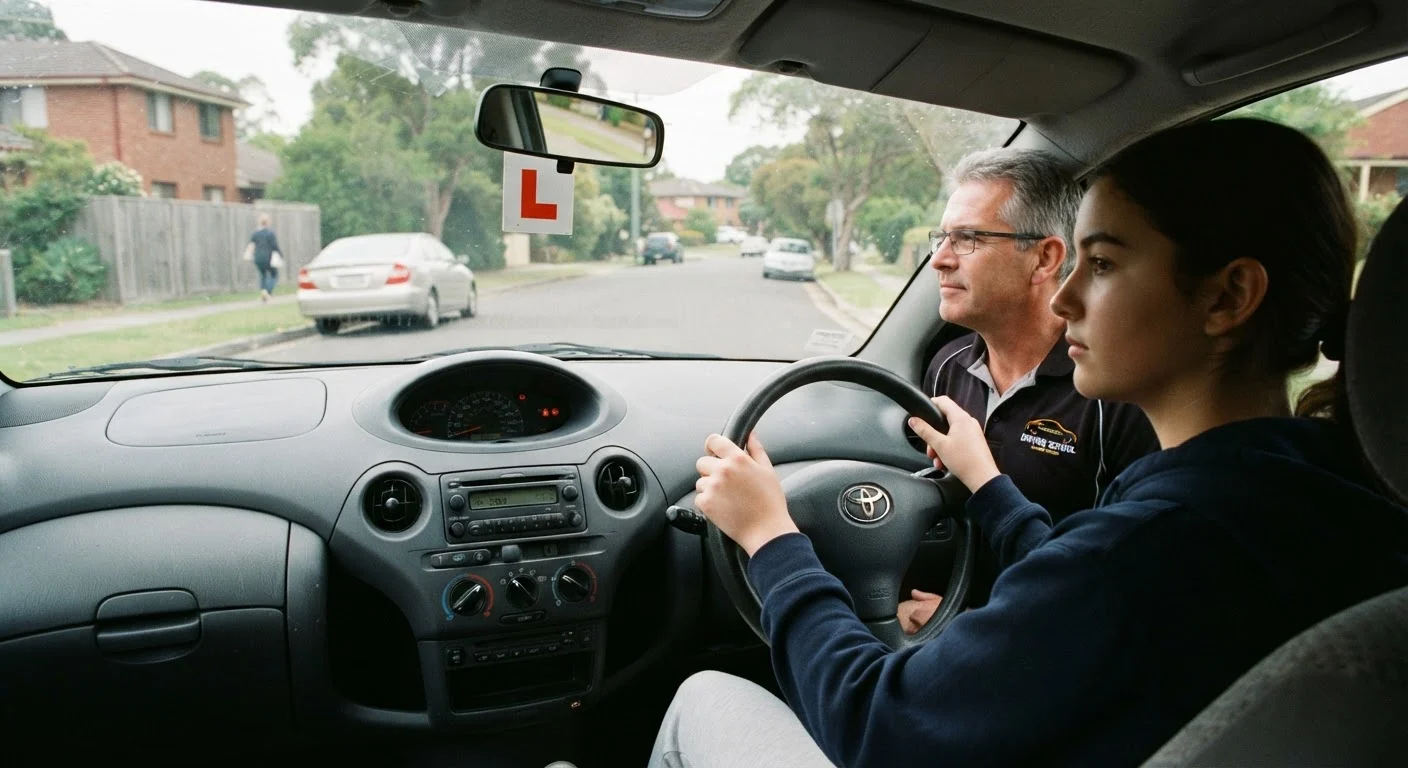
- Stage 1 — Learner Permit: The driver must be supervised by a licensed adult at all times. Most states require a minimum number of supervised driving hours, typically ranging from 40 to 65 hours, often including a mandated nighttime component.
- Stage 2 — Provisional or Restricted Licence: The driver may operate independently but faces restrictions, most commonly on nighttime driving (often prohibited between 11 p.m. and 5 a.m.) and on carrying non-family passengers under 21. This stage typically lasts 6–12 months.
- Stage 3 — Full Licence: All restrictions lift, usually when the driver reaches 17 or 18 and has maintained a clean record.
The strength of each state's programme depends heavily on how strictly these stages are defined and enforced. States with longer learner periods, lower nighttime curfews, and stricter passenger limits consistently outperform those with looser rules. Night driving carries a distinct risk profile that makes early-stage nighttime restrictions particularly well-supported by crash data.
| US (Typical 3-Stage) | Australia (NSW) | Canada (Ontario) | UK (No Formal GLS) | |
|---|---|---|---|---|
| Supervised hours required | 40–65 hours | 120 hours | ~12 months at G1 | None mandated |
| Number of licence stages | 3 | 3 (L, P1, P2) | 3 (G1, G2, G) | 2 (Learner, Full) |
| Nighttime driving restriction | Yes, in Stage 2 | Yes, on P1 | Yes, at G1/G2 | No restriction post-test |
| Passenger limits | Yes, in Stage 2 | Yes, on P1 | Yes, at G1 | None |
| Minimum total GLS duration | ~1–2 years | ~4 years | ~2 years | No minimum |
| Evidence of crash reduction | Strong (with strict rules) | Very strong | Moderate to strong | Limited (no GLS) |
How Other Countries Approach Early Driver Licensing
International approaches to graduated licensing reveal a range of philosophies around what it means to be a competent new driver.
Australia operates one of the most rigorous GLS frameworks globally. Learners must log 120 supervised hours (including 20 at night) before progressing. The intermediate stage — the Provisional licence — is split into two tiers (P1 and P2) lasting a combined minimum of three years, with restrictions on passenger numbers, speed limits below the general limit, and zero blood-alcohol tolerance.
Canada varies by province but generally mirrors the US three-stage approach, with Ontario's system among the more detailed, requiring a minimum 12 months at the G1 (learner) stage before progressing.
United Kingdom takes a different approach: there is no formal graduated system. Learners must pass a theory test and a practical test, but there are no mandatory supervised hours or post-test restrictions. However, debate around introducing a formal GLS has been ongoing given the data on newly-qualified driver crashes.
Different road environments present different hazards, which is one reason why programmes that expose learners to varied conditions tend to produce more adaptable drivers.
What the Evidence Shows — and Where Gaps Remain
The research base for GLS effectiveness is substantial. Studies consistently show reductions in crash involvement among 16- and 17-year-olds in jurisdictions with comprehensive GLS laws. However, some programmes show a displacement effect: crashes that were previously occurring at 16 shift to 18 once restrictions lift, suggesting that restrictions delay rather than fully eliminate risk if they do not build genuine skill.
This points to an important limitation. Restrictions alone do not teach driving. A well-designed system pairs limits with structured learning — varied road exposure, hazard perception training, and feedback-driven practice. Developing a defensive driving mindset is a skill that formal instruction and supervised practice can actively cultivate, not just a by-product of restricted access.
Make Supervised Hours Count
Simply logging the required hours is not enough — the quality of supervised practice matters significantly. Aim to include varied conditions: residential streets, rural roads, highways, night driving (where permitted and supervised), and adverse weather where safely possible. Deliberate, varied exposure builds the hazard-recognition skills that protect new drivers once restrictions lift.
For parents and new drivers navigating a GLS, understanding the specific requirements of their state or country — minimum hours, restriction timelines, and violation consequences — is the essential starting point. Requirements are set by licensing authorities and are updated periodically, so verifying current rules through your state's DMV or equivalent body is always advisable.