

Key Takeaways
- Speed limits are legal maximums set for ideal conditions, not guaranteed safe speeds for all situations.
- Wet, icy, or foggy conditions dramatically reduce stopping distances and vehicle control.
- Visibility directly limits how fast you can safely react — if you can't see far, you can't stop in time.
- Many U.S. states enforce a 'basic speed law' allowing tickets for unsafe speeds below the posted limit.
- Reducing speed in poor conditions is a legal and practical responsibility, not just a suggestion.
- Adjusting your speed to match conditions protects you, passengers, and everyone else on the road.
Posted Speed Limit vs. Safe Speed
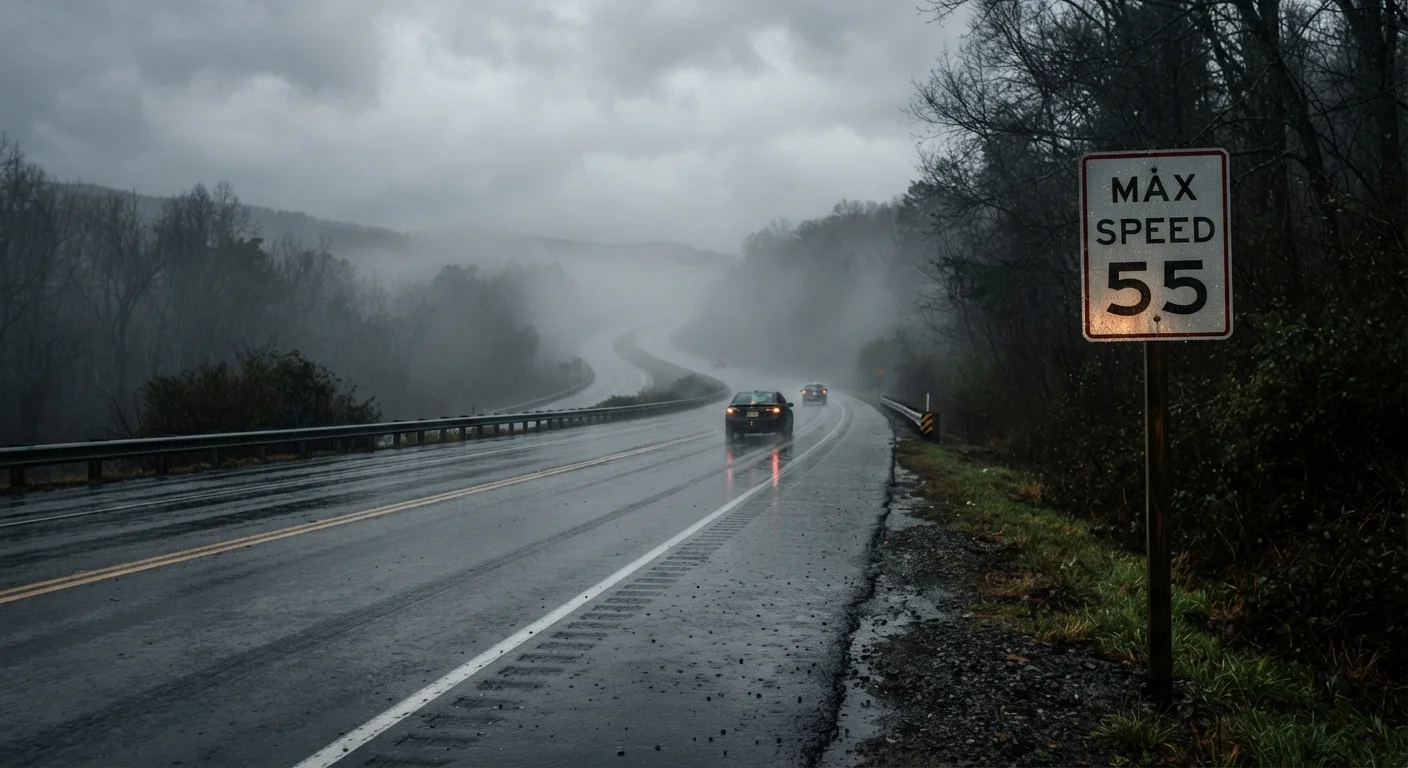
A posted speed limit is the maximum speed legally permitted on a given road under normal conditions. It is not a recommended target for all situations. Safe speed is the speed at which a driver can maintain full control given the actual conditions present — including weather, visibility, road surface, traffic, and the driver's own alertness.
Under the 'basic speed law' recognized in many U.S. states, drivers can be cited for traveling at a speed that is unsafe for conditions even when below the posted limit.
What Speed Limits Actually Mean
Speed limit signs communicate a legal boundary, not a universal safety guarantee. Engineers and transportation agencies set posted limits based on road geometry, expected traffic volume, and conditions as observed under normal, dry-pavement, daylight circumstances. When conditions deviate from that baseline — as they frequently do — the posted number becomes less useful as a guide to safe driving.
This distinction matters more than most drivers appreciate. A 55 mph limit on a rural two-lane road was determined with clear skies and good visibility in mind. On a foggy morning with reduced sight lines, that same road may only be safely navigable at 35 or 40 mph. The sign hasn't changed, but the physics have.
Most U.S. states codify this reality through what is commonly called the basic speed law — a legal principle requiring drivers to travel at a speed that is reasonable and prudent for actual conditions, regardless of what the posted limit says. Driving at the speed limit is not an automatic legal defense if conditions made that speed unsafe.
How Conditions Change the Equation
Several factors can push the gap between the posted limit and a genuinely safe speed from narrow to significant. Understanding each one helps drivers make better real-time judgments.
Weather and Road Surface
Wet pavement reduces tire traction and extends stopping distances considerably. Ice is more extreme — even at relatively low speeds, braking and steering become unreliable. Snow, slush, and standing water all introduce their own hazards. See our guide to driving in rain, fog, and ice for a detailed breakdown of how each condition demands specific adjustments.
Visibility
Safe driving speed is inseparable from sight distance. If you cannot see an obstacle until it is 100 feet ahead, your safe speed is whatever allows you to stop within 100 feet — which is far less than highway speeds. Fog, heavy rain, glare, and darkness all compress your effective visibility. Night driving presents a particularly consistent challenge because headlights provide only a fraction of daytime sight range.
Traffic and Road Type
Dense traffic, narrow lanes, unmarked intersections, and pedestrian activity all increase the risk associated with any given speed. The same speed that is routine on an open freeway may be reckless on a busy suburban arterial. Motorway and urban roads present fundamentally different risk profiles even when posted limits are similar.
Use Your Speedometer as a Starting Point
Instead of matching the posted limit by default, treat your speedometer as a ceiling check — confirming you haven't exceeded the legal maximum — while using your eyes and judgment to determine where below that ceiling is genuinely safe. This mental reframe encourages active condition monitoring rather than passive speed-setting.
The Physics of Stopping Distance
One reason the gap between posted limits and safe conditions is so consequential is the physics of stopping distance. Stopping distance has two components: reaction distance — the distance traveled while the driver perceives a hazard and applies the brakes — and braking distance — the distance needed for the vehicle to come to a full stop once brakes are applied.
Crucially, braking distance increases with the square of speed. A vehicle traveling at 60 mph does not need twice the stopping distance of one at 30 mph — it needs roughly four times as much. On wet or icy surfaces, that braking distance extends further still because friction between tires and road is reduced.
4x
Increase in braking distance when speed doubles
Because braking distance scales with the square of speed, doubling your speed quadruples the distance needed to stop — a non-linear relationship that surprises many drivers.
~1.5 sec
Typical driver reaction time before braking
At 60 mph, a 1.5-second reaction time means a vehicle travels approximately 132 feet before brakes are even applied — nearly half the length of a regulation football field.
3x+
Greater stopping distance on ice vs. dry pavement
Transportation safety research consistently shows that stopping distances on ice can be three to twelve times longer than on dry pavement, depending on speed and tire condition.
Following distance is the related discipline. A tight gap that seems manageable in dry conditions becomes dangerously inadequate when surfaces are wet. Our explainer on the two-second rule outlines why this simple principle is consistently underused and how to apply it properly.
Practical Speed Judgment in Real Conditions
Applying this knowledge behind the wheel requires developing an active habit of reading conditions rather than defaulting to the speed limit as a set-and-forget number. A few principles can guide that process:
- Match speed to sight distance. You should always be able to stop within the distance you can clearly see ahead of you. If visibility is reduced, your speed should reflect it.
- Anticipate surface changes. Bridges, shaded patches, and intersections often freeze before open road does. Overpasses can be icy when surrounding pavement is not.
- Account for your own state. Driver fatigue slows reaction time significantly. A tired driver's effective stopping distance — due to delayed reaction — is longer than an alert driver's even at the same speed.
- Recalibrate continuously. Conditions evolve on a single trip. What was appropriate ten miles back may not be appropriate now.
Impairment Also Affects Speed Judgment
Fatigue, illness, and distraction all slow reaction time and impair the judgment needed to accurately assess safe speed. A driver who is tired or unwell may not recognize that conditions require a lower speed until it is too late. Addressing your own state before adjusting for road conditions is part of complete safe driving practice.
Speed choice is ultimately a judgment call that no sign can make for you. Posted limits establish a legal ceiling; your own assessment of conditions, visibility, and vehicle capability determines where below that ceiling it is actually safe to operate.