

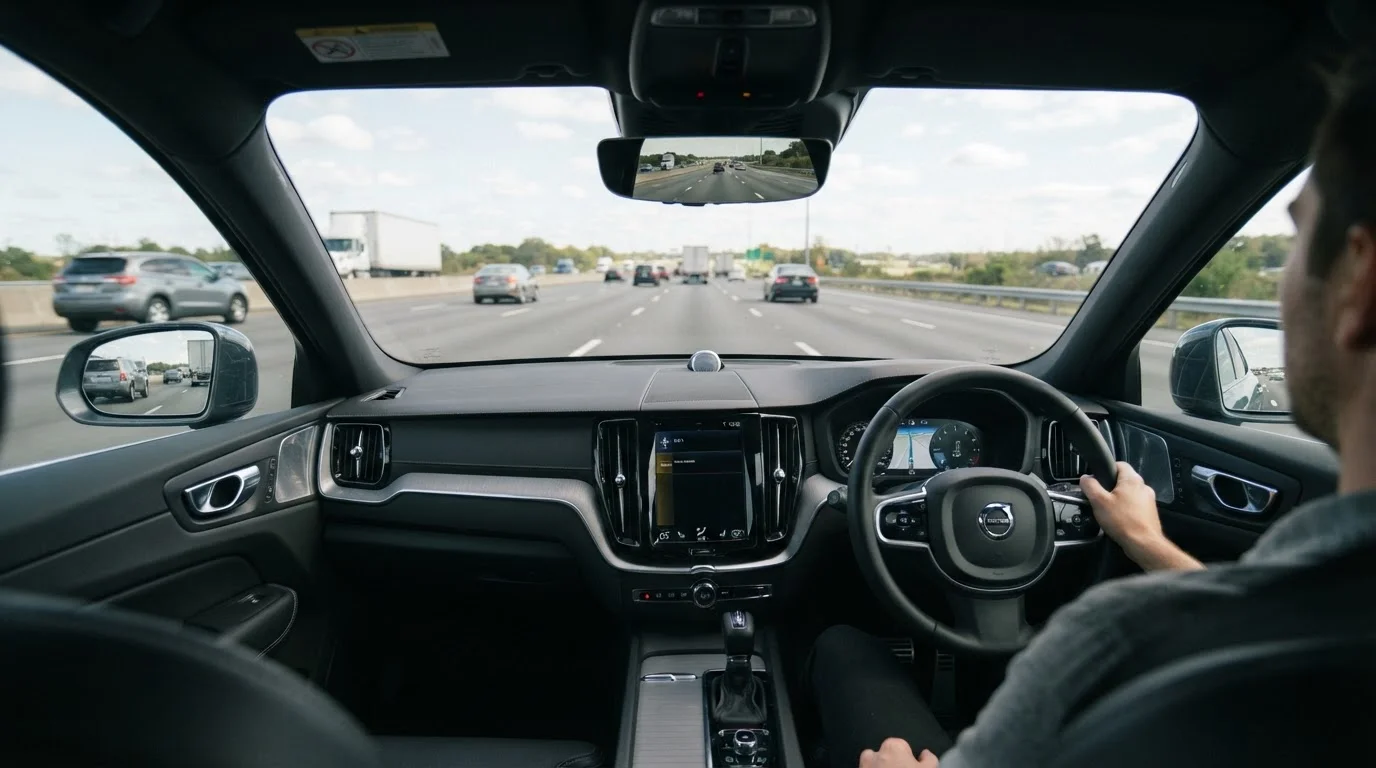
Key Takeaways
- Every vehicle has multiple blind spots that mirrors alone cannot eliminate.
- Mirror angle matters: most drivers set mirrors too close to the car's own body, shrinking visible coverage.
- A shoulder check — briefly turning your head — remains the most reliable blind spot verification.
- Larger vehicles such as trucks and SUVs have significantly larger and more numerous blind spots than sedans.
- Blind spot monitoring systems assist but do not replace proper mirror setup and physical checks.
- Other road users — cyclists, motorcyclists, and pedestrians — are most vulnerable to being hidden in your blind zones.
Blind Spot
A blind spot is any area around your vehicle that you cannot see using your mirrors alone, without physically turning your head. Every car has multiple blind spots determined by the vehicle's body shape, pillar placement, and mirror positioning. They are not fixed — they shift depending on how your mirrors are adjusted and where other vehicles are in relation to yours.
The primary rear-quarter blind spots typically extend from roughly the B-pillar (the structural post between the front and rear doors) rearward along each side of the vehicle, at an angle that mirrors cannot capture without modification or driver movement.
Why Geometry Creates Gaps in Your Vision
No matter how attentive a driver you are, your car's physical structure conspires against full visibility. Mirrors reflect only what falls within their angle of view. Body pillars block sight lines. The car itself takes up space that its own driver cannot see around.
The result is a patchwork of visible and invisible zones surrounding every vehicle. The invisible ones — blind spots — are predictable, not random. They follow from the geometry of where the mirrors are mounted, which direction they face, and how your body sits relative to the windows.
Understanding this geometry does not require engineering knowledge. It requires knowing roughly where the gaps are on your specific vehicle and developing habits that account for them every time you make a lateral move — a lane change, a merge, a turn from a junction.
Blind Spots Vary by Vehicle Type
The location and size of blind spots differ meaningfully between vehicle types. A compact sedan's blind zones are smaller and closer to the body than those of a pickup truck or large SUV. If you regularly drive different vehicles — a personal car and a work van, for example — take a moment to re-orient yourself to each vehicle's unique blind zone geometry before driving.
For drivers navigating situations where visibility is already reduced, such as rain or fog, blind spots compound the risk significantly. See our guide to driving in adverse conditions for additional safety strategies.
The Science of Mirror Coverage — and Its Limits
Your rearview mirror gives a centered, narrow window directly behind the car. Your two side mirrors, angled outward, extend that coverage toward each lane beside you. In theory, the three mirrors together cover a wide arc behind and to each side. In practice, the coverage is not seamless.
The critical gap is the rear-quarter zone — the diagonal slice behind each rear door, running from roughly the B-pillar back toward the rear bumper. At standard mirror angles, this is exactly where another vehicle can sit, fully outside mirror coverage, while traveling at the same speed as you.
The fix is simpler than most drivers realize: angle your side mirrors slightly further outward. The goal is for each mirror to pick up where the rearview mirror ends. You should see only a sliver of your own car in each side mirror — not a wide strip. Most factory-default settings angle mirrors too inward, optimizing for a view of the driver's own vehicle rather than the adjacent lane.
~840,000
Annual US crashes linked to blind spots
The National Highway Traffic Safety Administration (NHTSA) has estimated that hundreds of thousands of crashes per year in the US involve blind spot-related lane-change and merge errors.
~20%
Of rear-view angle blocked by A-pillars
Studies on forward visibility have found that modern thick A-pillars can obscure a meaningful forward arc, with the precise figure varying by vehicle design and driver seating position.
2–3x
Greater rear blind zone in SUVs vs. sedans
Consumer safety research indicates that full-size SUVs and pickups typically have rear blind zones two to three times larger than those of standard passenger sedans.
The Shoulder Check: Your Most Reliable Tool
Even perfectly adjusted mirrors leave a residual gap. The shoulder check — turning your head approximately 45 degrees toward the relevant rear quarter before changing lanes — closes that gap directly. It takes less than a second and is the single most effective habit a driver can build around blind spot management.
The shoulder check is especially important at highway speeds, where vehicles close distances rapidly. A car entering your blind zone and a lane change initiated without a check can combine in less time than it takes to react. This is not a theoretical concern: rear-quarter blind spot collisions are a consistent contributor to highway crash statistics.
Always Check Your Shoulder Before Merging
Before any lane change or merge, signal first, check your mirrors, then do a quick 45-degree head turn toward the rear quarter you're moving into. This takes under a second and catches what mirrors cannot. Make it a non-negotiable part of every lateral move, regardless of what any monitoring system shows.
Cyclists and motorcyclists are disproportionately at risk here. Their narrow profile means they can be completely absent from your mirrors while being physically present alongside your car. A shoulder check that would catch a car will catch a motorcycle or bicycle too. See also how darkness amplifies these risks at night, when riders are harder to spot even in direct view.
A-Pillars, Front Corners, and the Blind Zones Drivers Forget
Rear-quarter blind spots get most of the attention, but they are not the only hazard zones. The A-pillars — the structural posts on either side of your windshield — create a forward blind spot that can mask a cyclist, pedestrian, or small vehicle when you are approaching an intersection or turning. Thicker A-pillars on modern vehicles (required for rollover protection) have made this a growing concern.
Front corner blind spots exist directly ahead of each headlight. They matter most in tight parking lots, when pulling forward near pedestrian walkways, and when nosing into traffic from a blind junction.
Reversing blind spots extend directly behind the trunk. Backup cameras reduce but do not eliminate this zone — the camera has its own angle of view and cannot see what is immediately below the bumper or far to each side. Physical head turns while reversing remain necessary.
Awareness of these additional zones matters particularly when navigating complex traffic situations. Our roundabout rules guide covers how lane positioning and sight lines interact in multi-lane junctions.
Technology Assists, But Does Not Substitute
Blind spot monitoring systems, now common on many vehicles, use radar or ultrasonic sensors to detect vehicles in the rear-quarter zones and alert the driver — usually via a light in the mirror housing or an audible warning. They are genuinely useful and can catch situations a driver might miss.
However, every system has limits. Detection ranges vary. Some systems struggle to flag fast-closing vehicles, motorcycles in certain positions, or very slow-moving objects. Sensor coverage does not match mirror coverage exactly, meaning the technology's own blind zones exist. Drivers who rely exclusively on these systems without shoulder checking are making an assumption the technology cannot fully support.
The practical approach: use blind spot monitoring as a supplementary alert layer, not a replacement for adjusted mirrors and shoulder checks. When all three are in use together, your overall blind spot risk is substantially reduced — though never zero.
This article is for general informational purposes. Always observe local traffic laws and consult official driver training resources for guidance specific to your jurisdiction.