

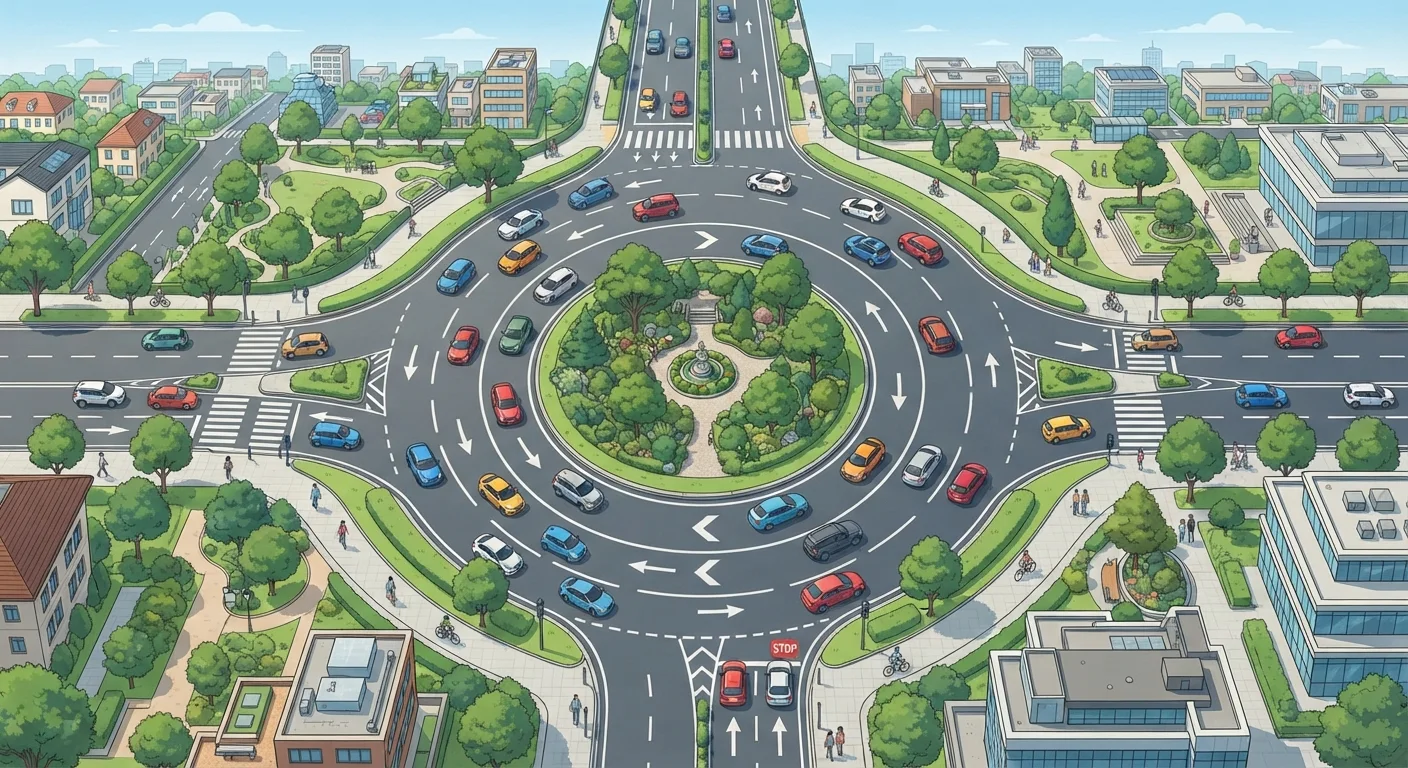
Key Takeaways
- Vehicles already in a roundabout always have priority over those entering.
- Lane choice before entering determines your exit — changing lanes inside is dangerous.
- Signaling your exit helps other drivers anticipate your movement and prevents near-misses.
- Give-way lines are legal requirements, not suggestions — stopping short of them is mandatory when traffic is present.
- Pedestrians retain the right of way at marked crossings on roundabout approaches.
Why Roundabouts Cause So Much Confusion
Roundabouts are statistically safer than traditional signalized intersections — they eliminate the high-speed right-angle crashes associated with traffic lights. Yet they remain a consistent source of driver anxiety and minor collisions in the U.S., largely because many drivers were trained at a time when roundabouts were rare and the rules were not drilled as thoroughly as other road skills.
The confusion is compounded by inconsistency: roundabout designs vary from single-lane neighborhood traffic circles to complex multi-lane junctions. A driver who handles one type confidently can be caught off guard by another. Understanding the underlying rules — not just one layout — is what builds genuine competence.
~40%
Reduction in all injury crashes
The Federal Highway Administration has found that converting conventional intersections to roundabouts reduces all injury crashes by roughly 40% on average.
~75%
Reduction in fatal and incapacitating crashes
The same FHWA research indicates fatal and serious-injury crashes drop by approximately 75% when roundabouts replace traditional intersections.
~3,700
Roundabouts in the U.S.
The number of modern roundabouts in the United States has grown significantly since the 1990s, according to FHWA estimates, yet driver familiarity has not kept pace.
The Core Rules and Where Drivers Go Wrong
Every roundabout in the U.S. operates on a single foundational principle: entering traffic yields to circulating traffic. The give-way line (the dashed line at each entry) is the legal boundary. You must not cross it unless the way is clear. This is not optional courtesy — it is the law in every state that has adopted modern roundabout standards.
Assuming entry traffic has priority over circulating traffic.
Why it happens: Drivers accustomed to traditional stop-sign intersections often apply the same first-come, first-served logic at roundabouts.
Choosing the wrong lane before entering a multi-lane roundabout.
Why it happens: Drivers focus on what is immediately ahead rather than where they need to exit, leading to last-second lane changes inside the roundabout.
Failing to signal when exiting the roundabout.
Why it happens: Many drivers learned to signal on entry but were never clearly taught to signal left as they pass the exit before theirs.
Stopping inside the roundabout to let entering vehicles in.
Why it happens: Well-meaning drivers try to be courteous, but this misapplication of politeness disrupts traffic flow and can cause rear-end collisions.
Ignoring pedestrian crossings on roundabout approach roads.
Why it happens: Drivers concentrate on the give-way line and circulating vehicles, mentally filtering out the marked crossing just before it.
Changing lanes inside a roundabout without checking mirrors and blind spots.
Why it happens: Drivers realize late they are in the wrong lane and instinctively steer toward the correct exit without checking adjacent lanes.
Signaling habits are also worth reviewing in the context of broader distracted driving awareness: cognitive overload at complex junctions is a real factor, and drivers who are mentally occupied with navigation are less likely to execute correct signals or lane discipline.
Lane Discipline: The Skill That Prevents Most Near-Misses
On multi-lane roundabouts, poor lane choice is the leading cause of side-swipe incidents. The principle is straightforward: the lane you enter in should be the lane that logically leads to your intended exit. Cutting across lanes mid-roundabout puts you in a vehicle's blind spot with almost no warning distance for either driver.
Never Change Lanes Inside a Roundabout
Weaving between lanes once you have entered the circle is one of the most dangerous moves a driver can make at a roundabout. Vehicles in adjacent lanes are frequently in your blind spot, closing distances are short, and reaction time is minimal. If you realize you are in the wrong lane, stay in it, take the next available exit safely, and re-approach. A slight detour is far preferable to a collision.
Before approaching any unfamiliar roundabout, slow down enough to read the directional signs posted on the central island and at the entry. These signs are part of the standard road sign vocabulary — if reading junction signs confidently is a challenge, a visual reference to road signs can sharpen that skill quickly.
Maintaining steady speed and clear signaling is also directly connected to safe following distances. Abrupt braking inside a roundabout is a predictable consequence of poor lane planning — and the two-second following distance rule applies at roundabout entries just as it does on any road.