

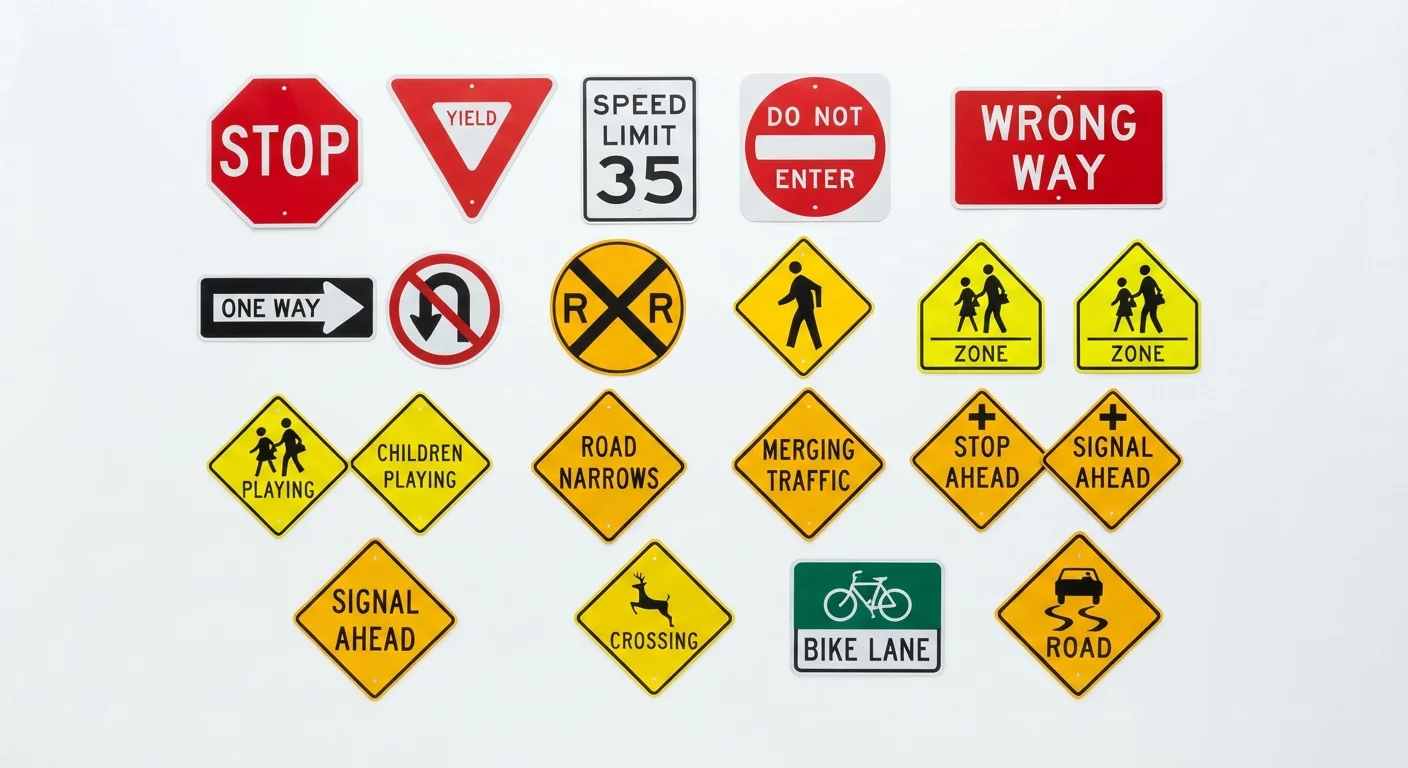
The Three-Category System Behind Every Road Sign
Every road sign in the United States falls into one of three broad categories: regulatory, warning, or guide/informational. The Federal Highway Administration's Manual on Uniform Traffic Control Devices (MUTCD) establishes the shapes, colors, and meanings that states use as their baseline. Understanding this system means you're not memorizing hundreds of individual signs — you're learning a visual language with consistent grammar.
Shape carries meaning before you read a word. An octagon always means stop. An inverted triangle always means yield. A diamond shape signals a hazard or warning ahead. Pennant shapes indicate no-passing zones. Pentagon shapes mark school zones. This redundancy is intentional: in low visibility or at high speed, shape registers faster than text.
Color reinforces category. Red is reserved for prohibition and critical compliance (stop, yield, do not enter). Yellow signals general warnings. Orange marks construction and temporary traffic control zones. Green provides directional and distance guidance. Blue indicates services (fuel, food, lodging). Brown denotes recreational or cultural sites.
Regulatory Signs: What You Must Do
Regulatory signs carry legal weight — ignoring them can result in a citation, a collision, or both. The most commonly misunderstood examples include:
- Stop sign (octagon, red): Requires a complete stop before the stop line, crosswalk, or intersection edge. Rolling stops are illegal in every state.
- Yield sign (inverted triangle, red/white): You must slow and give right-of-way to conflicting traffic. A full stop is required if traffic is present. See our guide to roundabout and give-way rules for a common application of this sign.
- Speed limit signs (rectangle, white): State the maximum lawful speed under ideal conditions. Driving at the posted limit when conditions are poor (rain, fog, construction) may still be cited as unsafe speed.
- Do Not Enter / Wrong Way (rectangle/circle, red): Prohibit entry into a roadway — typically paired at divided highway exits. Wrong Way signs appear farther along the road as a secondary alert.
- No U-Turn, No Left Turn (circle, black on white): Prohibition is indicated by a red slash across the symbol. These are frequently time-restricted; check for secondary panels.
Regulatory signs on white backgrounds are permanent rules. Those on orange backgrounds are temporary, typically tied to a construction zone.
Warning Signs: What's Coming Ahead
Yellow diamond-shaped signs alert drivers to changing road conditions, intersections, or potential hazards. They are advisory in nature but carry real safety implications. Common examples:
- Curve / winding road: Indicates the sharpness of an upcoming curve. Often paired with an advisory speed plate (yellow rectangle) below — this is a suggested safe speed for that specific geometry, not a legal limit.
- Pedestrian / school crosswalk: Pentagon shape (school-related signs) or diamond warns of zones with frequent foot traffic. Slow down and be prepared to stop.
- Railroad crossing advance warning (round, yellow): An X and RR symbol alerts you before the physical crossbuck signs at the tracks.
- Merge / lane ends: Warns that lanes are narrowing and traffic must combine. The driver in the ending lane is typically expected to yield, though zipper merging — alternating one car at a time — is the most efficient and increasingly standard approach.
- Slippery when wet: Advises extra caution in wet conditions; does not mean the road is currently wet.
Regulatory sign
A sign that conveys a rule drivers are legally required to obey, such as speed limits, stop, and no-turn signs. Violation can result in a traffic citation.
Warning sign
A sign that alerts drivers to potential hazards or changing road conditions ahead. Most are diamond-shaped and yellow, though school-zone signs use a pentagon shape.
Advisory speed
A recommended speed for a specific road feature (such as a sharp curve), displayed on a yellow rectangular plate. It is not a legal speed limit but reflects safe operating speed for that geometry.
Variable message sign (VMS)
An electronic sign on freeways and arterial roads that can display changing information such as speed limits, incident alerts, or detour instructions in real time.
MUTCD
Manual on Uniform Traffic Control Devices — the federal standard published by the Federal Highway Administration that governs sign design, placement, and meaning across all US states.
Crossbuck
The X-shaped white sign posted at railroad crossings indicating that vehicles must yield to trains. It is a yield-equivalent regulatory sign.
For a deeper look at how sign recognition fits into high-speed driving environments, see motorway driving versus urban roads.
Temporary, Construction, and Motorway-Specific Signs
Orange signs in construction zones carry the same legal force as permanent regulatory signs when a worker is present — and in many states, fines double in active work zones. Watch for:
- Flagger ahead: A human traffic controller is managing the lane. Follow their instructions over fixed signs.
- Road work ahead / one lane road ahead: Lane configurations will change; reduce speed and increase following distance.
- End road work: Normal traffic rules resume, but debris and rough pavement may persist.
On freeways and motorways, additional sign types appear:
- Overhead lane control signs: Green arrows indicate an open lane; red X marks a closed lane. These can change in real time on managed motorways.
- Variable message signs (VMS): Electronic boards that display speed advisories, incident alerts, or amber alerts. Treat speed figures on VMS boards as enforceable limits unless otherwise posted.
- Exit number signs: Green panels with white text. Mile-based exit numbers (used in most states) let you calculate distance to an exit by comparing the exit number to your current mile marker.
Advisory Speeds Are Not Legal Limits
Yellow advisory speed plates beneath warning signs indicate a recommended safe speed for a specific feature — a tight curve, a highway ramp, or a sharp turn. Exceeding them is not automatically a violation, but driving faster than conditions warrant can still be cited under general unsafe-speed statutes. Think of advisory speeds as engineering guidance, not merely a suggestion to ignore.
Understanding the visual cues around you ties directly into broader awareness habits covered in our article on blind spots and mirror angles.