

| Best-documented pairing | The Three Sisters (corn, beans, squash) (Indigenous American agricultural tradition, widely studied in agroecology) |
| Most versatile companion herb | Basil — deters some pests, attracts pollinators |
| Most allelopathic vegetable garden plant | Fennel — inhibits most neighboring vegetables |
| Marigold nematode effect | Requires a full growing season of dense planting to reduce soil nematode populations (University extension research, general consensus) |
| Nitrogen contribution (beans) | Legumes can fix 50–200 lbs of nitrogen per acre annually (USDA SARE (Sustainable Agriculture Research & Education) program) |
What Is Companion Planting and Why Does It Matter?
Companion planting is the practice of growing two or more plant species near each other so that at least one — ideally both — benefits from the arrangement. The benefits can include natural pest deterrence, improved pollination, better soil nutrition, or more efficient use of space.
The concept draws on both traditional farming wisdom and ongoing horticultural research. Not every claimed pairing has been rigorously studied, but many combinations have solid practical track records among experienced gardeners. Understanding the basic principles helps you make deliberate choices rather than just guessing.
Allelopathy
A biological phenomenon where one plant releases chemical compounds that inhibit the germination or growth of neighboring plants. Fennel and black walnut trees are well-known examples.
Nitrogen fixation
A process where certain plants — primarily legumes like beans and peas — host soil bacteria that convert atmospheric nitrogen into a form plants can use. This naturally enriches the surrounding soil.
Trap crop
A plant deliberately grown to lure pests away from more valuable crops. Nasturtiums, for example, attract aphids so they cluster on the nasturtium rather than on brassicas or tomatoes.
Polyculture
Growing multiple plant species in the same space at the same time, as opposed to monoculture (one species per area). The Three Sisters is a classic polyculture system.
Beneficial insects
Insects that support garden health by pollinating flowers, preying on pest insects, or parasitizing pest larvae. Examples include ladybugs, lacewings, and predatory wasps.
If you're building your garden from the ground up, our guide to starting a vegetable garden from scratch covers the foundational decisions you'll want to make first.
Classic Pairings That Consistently Perform
Certain plant combinations have proven reliable enough that they appear across gardening traditions worldwide. Here are the most well-supported pairings to know:
| Best-documented pairing | The Three Sisters (corn, beans, squash) (Indigenous American agricultural tradition, widely studied in agroecology) |
| Most versatile companion herb | Basil — deters some pests, attracts pollinators |
| Most allelopathic vegetable garden plant | Fennel — inhibits most neighboring vegetables |
| Marigold nematode effect | Requires a full growing season of dense planting to reduce soil nematode populations (University extension research, general consensus) |
| Nitrogen contribution (beans) | Legumes can fix 50–200 lbs of nitrogen per acre annually (USDA SARE (Sustainable Agriculture Research & Education) program) |
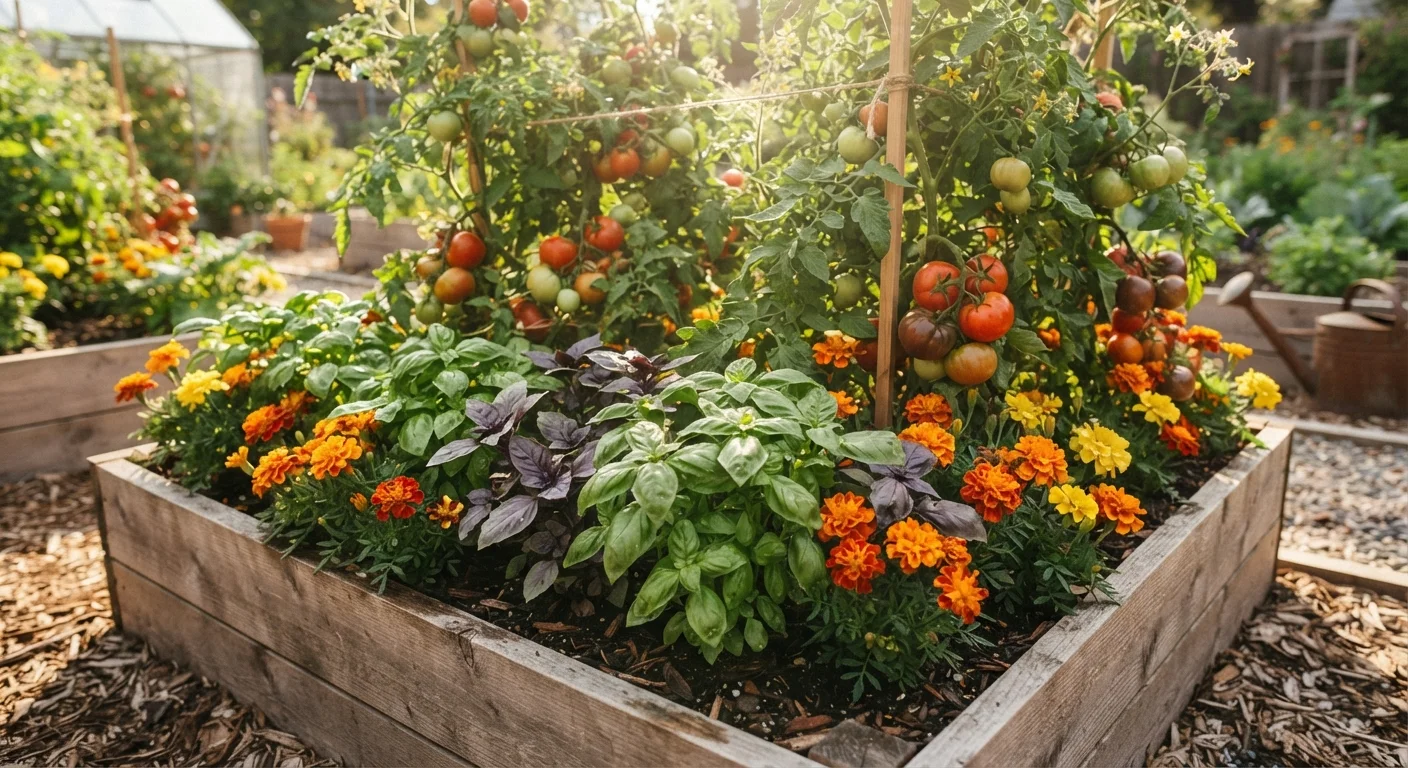
- Tomatoes + Basil: Basil is widely grown alongside tomatoes. Some gardeners report that its volatile oils deter aphids and whiteflies. It also makes efficient use of the space around sprawling tomato plants.
- The Three Sisters (Corn, Beans, Squash): This Indigenous American polyculture is among the most documented companion systems. Corn provides a trellis for beans; beans fix atmospheric nitrogen into the soil; squash leaves shade the ground, suppressing weeds and retaining moisture.
- Carrots + Onions: The strong scent of onion family plants (including chives and leeks) is thought to confuse carrot fly, while carrot foliage may deter onion fly. The pairing makes good use of vertical and root space simultaneously.
- Brassicas + Nasturtiums: Nasturtiums act as a trap crop, attracting aphids away from cabbage, broccoli, and kale. They're easy to grow and edible as a bonus.
For smaller growing spaces, these pairings translate well to containers and raised beds. See how bed type affects your planting options in our raised beds vs. in-ground planting comparison.
Plants That Should Stay Apart
Companion planting isn't only about beneficial pairings — avoiding bad neighbors matters just as much. Some plants compete aggressively for the same nutrients, release root chemicals that inhibit nearby growth, or simply attract each other's worst pests.
Research Is Still Catching Up
Many companion planting claims originate from traditional knowledge rather than controlled studies. Some pairings — like marigolds deterring nematodes — have good experimental support, while others remain largely anecdotal. Treat companion planting as a low-risk tool to experiment with rather than a guaranteed system. Keeping simple notes on what works in your specific soil and climate will give you the most reliable results over time.
- Fennel: Fennel is notoriously allelopathic — it releases compounds that suppress the growth of many vegetables, including tomatoes, peppers, and beans. Grow it in an isolated spot or a separate container.
- Onions + Beans or Peas: Alliums (the onion family) appear to inhibit the growth of legumes. Keep them on opposite ends of the bed.
- Brassicas + Tomatoes: Both are heavy feeders that compete strongly for soil nutrients. Planting them together tends to reduce yields for both.
- Potatoes + Cucumbers: These two share susceptibility to certain fungal diseases; grouping them can increase disease spread under wet conditions.
Good spacing decisions matter as much as species selection. If you're working in a tight space, our small-space gardening guide walks through how to manage competing root zones in containers and on balconies.
Herbs as Garden Partners
Many culinary herbs pull double duty as companion plants. Their aromatic oils and flowering structures support the broader garden ecosystem in practical ways.
- Dill: Attracts predatory wasps and other beneficial insects that prey on aphids and caterpillars. Keep it away from carrots, though — the two are closely related and can cross-pollinate, affecting seed quality.
- Marigolds: Technically a flower, but a staple of vegetable gardens. French marigolds (Tagetes patula) produce a root secretion that suppresses certain soil nematodes over time. They also attract aphid-eating insects.
- Chives: Their mild onion scent deters aphids near roses and some brassicas. They're compact, perennial in many climates, and easy to interplant.
Herbs grown indoors can also be moved outdoors during the growing season to serve as companions. Our indoor herb growing guide explains which herbs transition well between environments.
30–50%
Potential aphid reduction near trap crops
Studies on nasturtium trap cropping in brassica beds suggest meaningful aphid diversion, though results vary by garden conditions.
3-in-1
Functions delivered by the Three Sisters system
The combination addresses structural support, soil nutrition, and weed suppression simultaneously within one planting bed.