

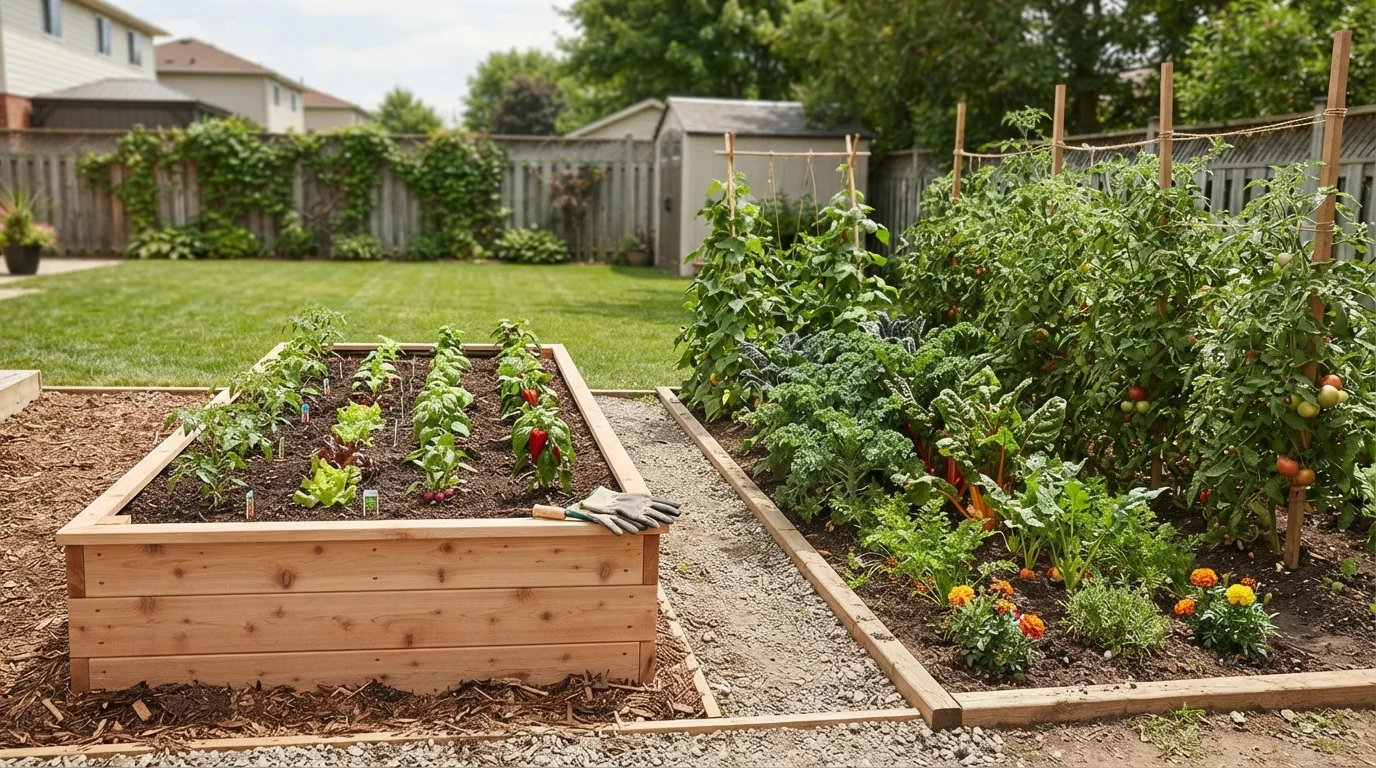
Key Takeaways
- Raised beds give you immediate control over soil quality but require upfront investment in materials and fill.
- In-ground planting scales more economically for large plots but depends heavily on your native soil's condition.
- Both methods require consistent watering, feeding, and pest management — the fundamentals don't change.
- Raised beds warm up faster in spring, which can extend your growing season by a few weeks.
- In-ground gardens can develop deep, self-sustaining soil ecosystems over many seasons with proper care.
Option A
Raised Beds
The controlled, accessible growing environment.
Best for: Gardeners who want precise soil conditions, better drainage, and easier physical access — especially on small or problematic plots.
Option B
In-Ground Planting
The traditional, large-scale growing approach.
Best for: Homeowners with ample yard space, workable native soil, and the capacity to invest in longer-term soil improvement.
If you have poor, compacted, or contaminated native soil
Raised Beds
Raised beds let you bypass problematic ground entirely by filling with quality blended soil, so plants get an optimal root environment from day one.
If you want to grow a large volume of crops affordably
In-Ground Planting
In-ground plots require no lumber, no purchased fill soil, and no construction — making large-scale growing far more cost-effective over time.
If you have limited mobility or prefer less bending
Raised Beds
A bed built 12–24 inches high dramatically reduces the physical strain of planting, weeding, and harvesting.
If you're building a garden with a long-term, generational mindset
In-Ground Planting
With consistent composting and cover cropping, in-ground soil improves year after year, creating a deep, living root environment that raised beds can't fully replicate.
If you're gardening in a small or partially paved space
Raised Beds
Raised beds can sit on patios, gravel, or compacted areas where in-ground planting simply isn't viable.
The Core Difference: Soil Control vs. Natural Depth
The defining distinction between raised beds and in-ground planting comes down to where your plants' roots live. In a raised bed, you build the growing environment from scratch — typically filling a wood, metal, or composite frame with a custom mix of topsoil, compost, and amendments. In-ground planting puts roots directly into your native soil, for better or worse.
This matters most at the start of a garden. If your yard has heavy clay, sandy loam, or compacted subsoil, raised beds let you sidestep those conditions entirely. In-ground planting requires working with — and gradually improving — whatever soil you have. For a thorough overview of how to evaluate and prepare a new growing area, see our guide to starting a vegetable garden from scratch.
| Criterion | Raised Beds | In-Ground Planting |
|---|---|---|
| Upfront cost | Higher — materials and fill soil required | Lower — minimal infrastructure needed |
| Soil control | Full — you choose and build the mix | Limited — depends on native soil quality |
| Drainage | Excellent — elevated, non-compacted fill | Variable — depends on soil composition |
| Spring warm-up speed | Faster — elevated soil warms earlier | Slower — ground temperature lags air temp |
| Scalability | Limited by cost and available frames | Easy — expand rows without extra expense |
| Physical accessibility | High — adjustable height reduces bending | Low — requires kneeling and stooping |
| Long-term soil development | Moderate — can deplete; needs regular topping | High — builds deep ecosystem over seasons |
| Weed pressure | Lower initially — fresh fill has fewer seeds | Higher — established weed seed bank present |
What Changes: Cost, Drainage, and Season Length
Upfront cost is the clearest trade-off. A single 4×8-foot raised bed, including lumber and fill soil, typically costs anywhere from $50 to well over $200 depending on materials and local prices. Multiply that across a full kitchen garden and the investment adds up quickly. In-ground plots require little more than seeds, tools, and soil amendments — a significantly lower barrier for large growing areas.
Drainage and compaction strongly favor raised beds. Because the fill sits above grade and is never walked on, it stays loose and well-aerated. In-ground beds in high-foot-traffic yards can become compacted, restricting root growth and slowing drainage. Dedicated pathways between in-ground rows help, but the risk remains.
Season length is a practical win for raised beds. Elevated soil warms faster in early spring than ground-level soil, which can give you a two- to three-week head start on planting cold-tolerant crops. In fall, that same thermal advantage fades quickly once temperatures drop, so the extension is mainly front-loaded.
6–8 in.
Minimum recommended raised bed depth
Most extension services recommend at least 6–8 inches of growing medium for shallow-rooted crops; 12 inches or more for root vegetables like carrots and parsnips.
2–4°F
Soil temperature advantage in spring
Raised bed soil can run 2–4°F warmer than adjacent ground-level soil in early spring, according to general horticultural guidance on elevated growing systems.
4×8 ft
Most common raised bed footprint
A 4-foot width allows gardeners to reach the center from either side without stepping in, which is the primary ergonomic principle behind this standard size.
What Doesn't Change: The Gardening Fundamentals
Neither method exempts you from the core work of gardening. Both raised beds and in-ground plots need consistent moisture, appropriate fertilization, weed control, and pest management. Switching from one method to the other won't make watering less critical or aphids less persistent.
Soil health requires attention in both systems. Raised bed soil can compact and deplete nutrients over seasons just as in-ground soil can — annual top-dressing with compost is standard practice in either case. For a grounded comparison of how to feed your soil, our article on organic vs. synthetic fertilisers explains the trade-offs clearly.
Plant selection follows the same rules regardless of growing method. A tomato needs full sun whether it's planted in a cedar frame or directly in the ground. Some assumptions new gardeners make — such as believing raised beds are automatically pest-free or that in-ground planting is inherently lower maintenance — don't hold up in practice. Our roundup of common garden myths addresses several of these directly.
If space is your limiting factor rather than soil type, it's worth considering that both methods require meaningful ground area. Gardeners working with patios, balconies, or small urban plots may find that neither raised beds nor in-ground growing fully suits their situation — in which case container and small-space growing offers a practical alternative.
A Note on Wood and Material Safety
If you're building raised beds from lumber, avoid wood treated with older preservatives that may leach harmful compounds into soil. Modern pressure-treated lumber sold in the US uses copper-based treatments considered acceptable by many growers for ornamental use, but opinions vary for food gardens. Untreated cedar, redwood, or composite materials are common alternatives. Check guidance from your local cooperative extension office for the most current regional recommendations.