

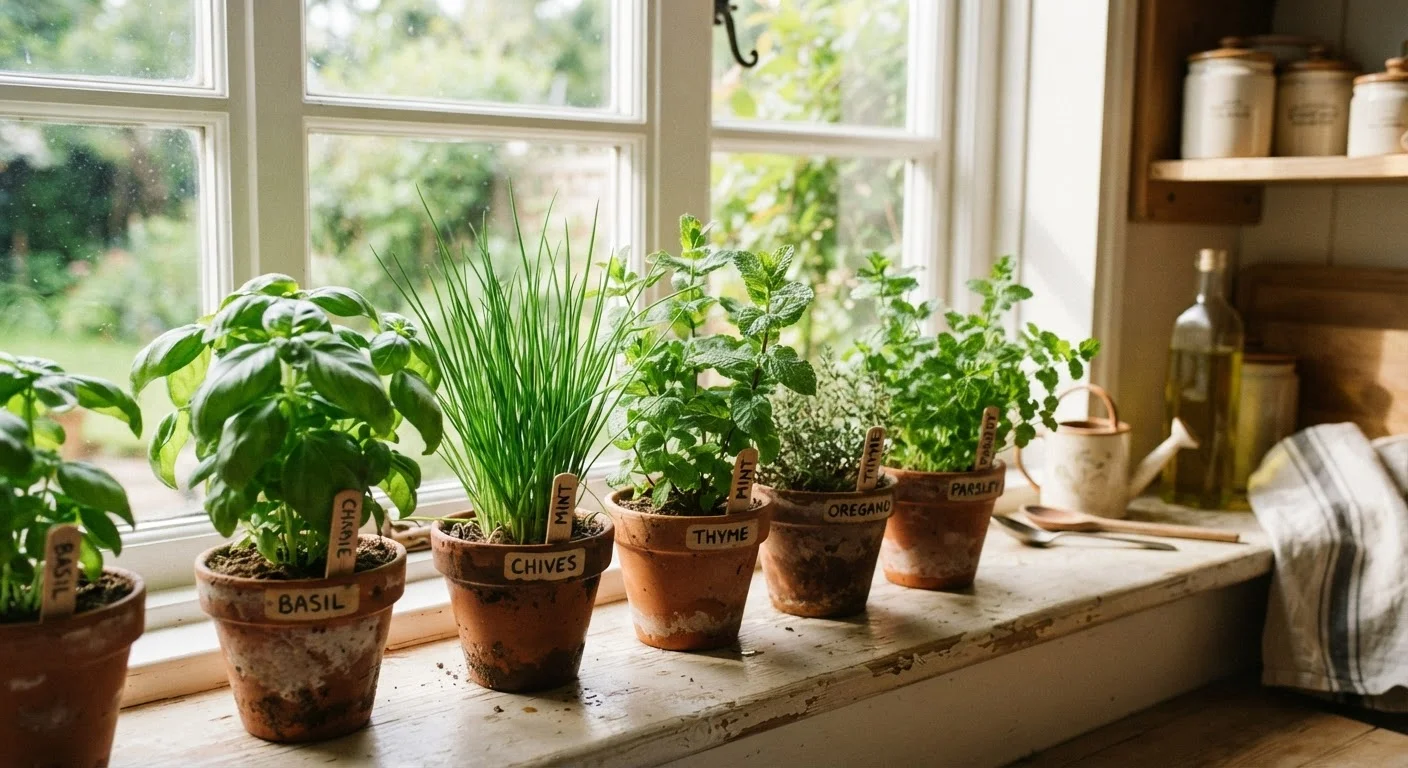
Key Takeaways
- Chives, mint, and parsley are among the most forgiving herbs for indoor container growing.
- Basil needs strong, consistent light — a dim windowsill will cause it to stretch and weaken quickly.
- Most herbs prefer well-draining soil and will rot in containers without adequate drainage holes.
- Grow lights can meaningfully extend what's possible indoors during low-light winter months.
- Herbs like rosemary and lavender struggle indoors long-term due to high light and airflow needs.
Available fresh year-round without outdoor space
Indoor herbs can be harvested any time, making them practical for cooks who want fresh flavor even in winter or without access to a yard.
Several species tolerate low-light conditions well
Chives, mint, and parsley can sustain reasonable growth in a bright indoor windowsill without supplemental lighting, making them accessible for most households.
Compact containers fit almost any living situation
A small pot on a windowsill requires minimal space, making indoor herb growing feasible for apartment dwellers and those with limited counter or shelf space.
Aromatic herbs deter some common household pests
Strongly scented herbs like mint may discourage certain insects near entry points, offering a minor incidental benefit beyond culinary use.
Light levels are rarely sufficient for sun-loving herbs
Basil, rosemary, and thyme need six or more hours of direct sunlight daily — a standard that most indoor windows cannot meet, especially during winter months.
Container root space limits plant size and lifespan
Herbs like dill and fennel develop large taproots that struggle in pots, leading to stunted growth, early bolting, and reduced flavor compared to garden-grown plants.
Overwatering is easy and often fatal
Indoors, evaporation is much slower than outdoors, so soil stays wet longer. Root rot from waterlogged containers is one of the leading causes of indoor herb failure.
Low airflow increases disease and pest risk
Still indoor air encourages fungal issues such as powdery mildew and creates favorable conditions for spider mites, which thrive in warm, dry, undisturbed environments.
Grow lights add cost and setup complexity
Bridging the light gap with supplemental lighting requires an upfront investment in equipment and an ongoing electricity cost, which may not suit every household's budget or aesthetics.
Our Verdict
Indoor herb growing is genuinely rewarding, but success depends heavily on matching each herb to your actual light conditions rather than your wish list. A handful of species — chives, mint, parsley — reliably perform in typical home environments. Others, like basil and rosemary, demand conditions most kitchens simply can't provide consistently without supplemental lighting.
Best for homeowners with a bright south- or west-facing window who want a low-maintenance fresh herb supply and are willing to learn the specific needs of each plant.
Why Indoor Conditions Challenge Most Herbs
Herbs evolved in open, often sunny environments with free airflow and well-drained soil. A typical home inverts nearly every one of those conditions: light is filtered and directional, air is still, and containers limit root spread. Understanding this mismatch is the foundation of any successful indoor herb setup.
The single biggest limiting factor is light intensity. Even a sunny south-facing window delivers significantly less usable light than an outdoor garden in summer. Many culinary herbs need six or more hours of direct sun per day to produce the leaf oils that make them flavorful. Indoors, that threshold is hard to meet without supplemental lighting.
Drainage is the second common failure point. Herbs sitting in waterlogged soil develop root rot quickly — a container without drainage holes, or a pot left sitting in a water-filled saucer, is one of the most reliable ways to kill an otherwise healthy plant. For context on how container choices affect growing success more broadly, see our guide to small-space container gardening.
Herbs That Tend to Perform Well Indoors
Several herbs are genuinely well-suited to indoor life, tolerating lower light levels and the confined root space of a pot.
Available fresh year-round without outdoor space
Indoor herbs can be harvested any time, making them practical for cooks who want fresh flavor even in winter or without access to a yard.
Several species tolerate low-light conditions well
Chives, mint, and parsley can sustain reasonable growth in a bright indoor windowsill without supplemental lighting, making them accessible for most households.
Compact containers fit almost any living situation
A small pot on a windowsill requires minimal space, making indoor herb growing feasible for apartment dwellers and those with limited counter or shelf space.
Aromatic herbs deter some common household pests
Strongly scented herbs like mint may discourage certain insects near entry points, offering a minor incidental benefit beyond culinary use.
Chives are arguably the most reliable indoor herb. They grow steadily in a bright windowsill, tolerate some neglect, and regrow reliably after cutting. Mint is similarly forgiving — it prefers consistent moisture and handles indirect light better than most. Keep it in its own container, as it spreads aggressively and will crowd out neighboring plants. Parsley is a slower grower but tolerates lower light reasonably well; flat-leaf varieties tend to be slightly more vigorous than curly types indoors.
Lemon balm and Vietnamese coriander are less commonly grown but adapt well to container life with moderate light. If you're interested in pairing herbs strategically, some of the same principles that apply to companion planting vegetables apply to herb combinations as well.
Herbs That Struggle Without Ideal Conditions
Some herbs are simply poorly matched to indoor environments, and it's worth being honest about that before investing time and effort.
Light levels are rarely sufficient for sun-loving herbs
Basil, rosemary, and thyme need six or more hours of direct sunlight daily — a standard that most indoor windows cannot meet, especially during winter months.
Container root space limits plant size and lifespan
Herbs like dill and fennel develop large taproots that struggle in pots, leading to stunted growth, early bolting, and reduced flavor compared to garden-grown plants.
Overwatering is easy and often fatal
Indoors, evaporation is much slower than outdoors, so soil stays wet longer. Root rot from waterlogged containers is one of the leading causes of indoor herb failure.
Low airflow increases disease and pest risk
Still indoor air encourages fungal issues such as powdery mildew and creates favorable conditions for spider mites, which thrive in warm, dry, undisturbed environments.
Grow lights add cost and setup complexity
Bridging the light gap with supplemental lighting requires an upfront investment in equipment and an ongoing electricity cost, which may not suit every household's budget or aesthetics.
Basil is the herb most commonly attempted and most often disappointing indoors. It needs intense light, warm temperatures, and excellent airflow. Without all three, it stretches toward the light, produces fewer aromatic oils, and becomes vulnerable to fungal disease. A grow light positioned close to the plant can help substantially, but a dim kitchen counter rarely sustains it.
Rosemary and lavender both originate in Mediterranean climates and need high light, very sharp drainage, and good air circulation. Indoors, they tend to decline slowly — surviving for weeks or months but rarely thriving. Dill and fennel have deep taproots that resist container confinement and bolt (go to seed) quickly when stressed by low light or temperature fluctuation.
A Note on 'Hardy' vs. 'Tender' Herbs
When herb guides describe a plant as 'hardy,' they typically mean it tolerates cold outdoors — not that it adapts easily to indoor conditions. Hardiness and indoor adaptability are separate traits. A plant like thyme is cold-hardy in the garden but still needs strong light and excellent drainage to perform well inside. Don't assume a tough outdoor herb will be an easy indoor one.
Practical Setup Advice
A few consistent habits make a measurable difference for indoor herb growing.
- Choose containers with drainage holes. Terracotta pots dry out faster than plastic and help prevent overwatering — useful for Mediterranean herbs in particular.
- Use a quality potting mix, not garden soil, which compacts in containers and drains poorly. A mix formulated for containers or herbs is preferable.
- Place plants as close to the light source as possible. The light intensity drops off sharply even a foot or two from a window. Rotate pots every few days to encourage even growth.
- Consider a grow light for winter months. A full-spectrum LED grow light on a timer can meaningfully extend what's possible when daylight hours are short.
- Don't overharvest. Taking more than one-third of a plant at once stresses it. Regular light trimming encourages bushy regrowth rather than weak, leggy stems.
If you're new to growing food at home, the same foundational thinking applies whether you're working indoors or out — our article on starting a vegetable garden from scratch covers soil, light, and plant selection in useful detail.
6+ hours
Daily direct sun most culinary herbs need
General horticultural guidance consistently places six hours of direct sunlight as the minimum threshold for productive growth in sun-loving herbs like basil and rosemary.
~50%
Light loss at just 1 foot from a window
Light intensity falls off significantly with distance from a window; even a small step back from the glass can cut usable light roughly in half, according to general plant science principles.