

Key Takeaways
- The two-second rule sets a minimum safe following gap — not an ideal one for all conditions.
- Rear-end collisions are among the most common crash types in the U.S., and tailgating is a leading contributing factor.
- Human reaction time alone averages around 1.5 seconds, leaving almost no margin when following too closely.
- Adverse weather, higher speeds, and heavy loads all require an extended following distance beyond two seconds.
- Drivers often underestimate following distance because shorter gaps feel normal in dense traffic.
The Two-Second Rule
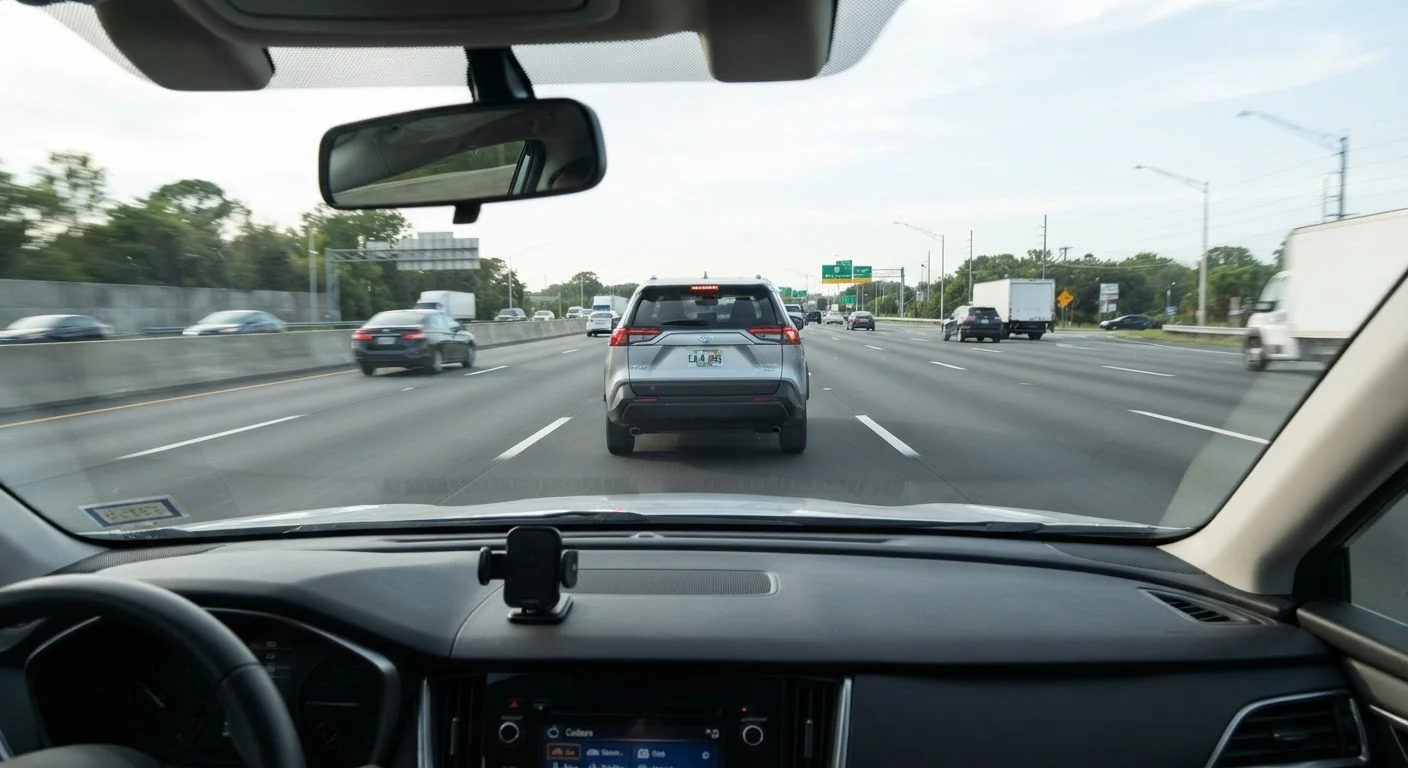
The two-second rule is a straightforward guideline for maintaining a safe following distance between your vehicle and the one ahead. After the car in front passes a fixed roadside point — a sign, a bridge, a lane marking — your vehicle should reach that same point no sooner than two seconds later. That gap gives you enough time and distance to perceive a hazard, react, and brake before a collision.
Two seconds is considered a minimum under ideal conditions. Driving instructors and road safety authorities generally recommend increasing to three or four seconds in rain, heavy traffic, or at highway speeds.
What the Rule Actually Measures
The two-second rule is really measuring time to collision — the window you have between noticing a problem and your bumper making contact with the vehicle ahead. At 60 mph, two seconds translates to roughly 176 feet of space. At 30 mph, the same count covers about 88 feet. The elegance of the rule is that it scales with speed automatically without requiring any math on the driver's part.
The gap needs to cover two distinct events: your perception-reaction time (the moment you see a hazard to the moment your foot moves to the brake) and your braking distance (the distance your vehicle travels while slowing to a stop). Research on driver reaction times consistently shows an average of around 1.5 seconds under alert, normal conditions. That alone consumes most of a two-second gap before braking even begins.
Reaction Time Varies by Condition
The 1.5-second average reaction time applies to alert, undistracted drivers under normal daylight conditions. Fatigue, distraction, or impairment can push reaction time above three seconds or higher — which, at highway speeds, can translate to hundreds of feet of uncontrolled travel. A two-second gap designed for alert conditions offers no safety margin when the driver is not fully attentive.
Why Drivers Consistently Ignore It
Traffic density is one of the biggest culprits. When every car around you is following at one car length, maintaining a two-second gap creates a visually conspicuous open space — and other drivers fill it almost immediately. This creates a feedback loop where safe behavior feels abnormal and even anti-social.
There's also a well-documented phenomenon in driving psychology: people tend to believe their reaction times are faster than average and that they have better vehicle control than they actually do. This overconfidence is compounded by the fact that most drivers have never experienced a genuine emergency stop at highway speed, so the abstract danger of short following distances never becomes concrete until it's too late.
Distraction plays a large role as well. Even a brief glance at a phone, a navigation screen, or a passenger can push effective reaction time well above 2.5 seconds — erasing any safety margin a two-second gap might have provided. As speeds and road conditions change, so does the risk profile, which is why understanding factors beyond the gap itself matters. Road conditions and posted speed limits interact directly with how much following distance you actually need.
Use a Fixed Landmark, Not the Car Ahead
Don't try to estimate distance by how close another car looks — that's unreliable and changes with vehicle size. Instead, pick a stationary point on the road (a bridge pillar, a road marking, a sign post) and count from when the car in front passes it. This technique works at any speed and doesn't require any special equipment.
When Two Seconds Isn't Enough
The two-second rule was designed for dry roads, clear visibility, and alert drivers in vehicles with properly maintained brakes and tires. Adjust your gap upward when any of those conditions change:
- Rain or wet roads: Wet pavement can more than double stopping distance. Add at least two extra seconds.
- Snow or ice: Stopping distances can increase by a factor of ten or more. Four to six seconds is a more realistic minimum.
- Towing a trailer or hauling a heavy load: Extra weight significantly extends braking distance; increase your gap accordingly.
- High speed driving: At 70 mph or above, two seconds covers a very long stretch of highway. Three to four seconds provides meaningful additional buffer.
- Low visibility: Fog, heavy rain, or driving at night all reduce the time you have to perceive a hazard, which effectively narrows your usable reaction window.
Driving culture rarely teaches these adjustments explicitly. Rules of the road like give-way behavior at intersections share the same problem — the written rule is clear, but the real-world application gets overlooked. Roundabout rules and give-way line etiquette are a useful parallel example of how simple rules get complicated in practice.
~29%
Of all U.S. crashes that are rear-end collisions
According to the National Highway Traffic Safety Administration (NHTSA), rear-end crashes are one of the most common crash types on U.S. roads, frequently linked to following too closely.
1.5 sec
Average driver perception-reaction time
Studies on driver reaction time consistently place the average around 1.5 seconds under normal, alert conditions — consuming most of the two-second gap before braking even starts.
2–10x
Increase in stopping distance on ice vs. dry pavement
Road safety research indicates stopping distances can increase dramatically on icy surfaces, underscoring why two seconds is dangerously insufficient in winter conditions.
Building the Habit
Changing following distance habits requires deliberate practice because the behavior feels counterintuitive in traffic. A useful starting approach is to pick one type of road — your highway commute, for example — and commit to counting your two-second gap for every journey for a week. Repetition builds the spatial awareness to judge gaps without conscious effort.
When another driver fills the gap you've created, resist the urge to close back in. Instead, ease back slightly to re-establish your buffer. The goal is to maintain time-to-collision, not to defend a particular slot in the traffic stream. Over time, this mindset shift — from position-based to time-based thinking — is what separates drivers who consistently manage risk from those who react to it.