

Key Takeaways
- Clutter competes for your brain's attention, increasing cognitive load even when you're not actively looking at it.
- Research broadly links disorganized living spaces to elevated cortisol levels, the body's primary stress hormone.
- Clutter can impair focus and decision-making by overwhelming your working memory with irrelevant stimuli.
- Emotional attachment to objects is a major reason people find decluttering difficult to sustain.
- Incremental, consistent tidying tends to be more manageable than large one-time organizing sessions.
Clutter and Mental Load
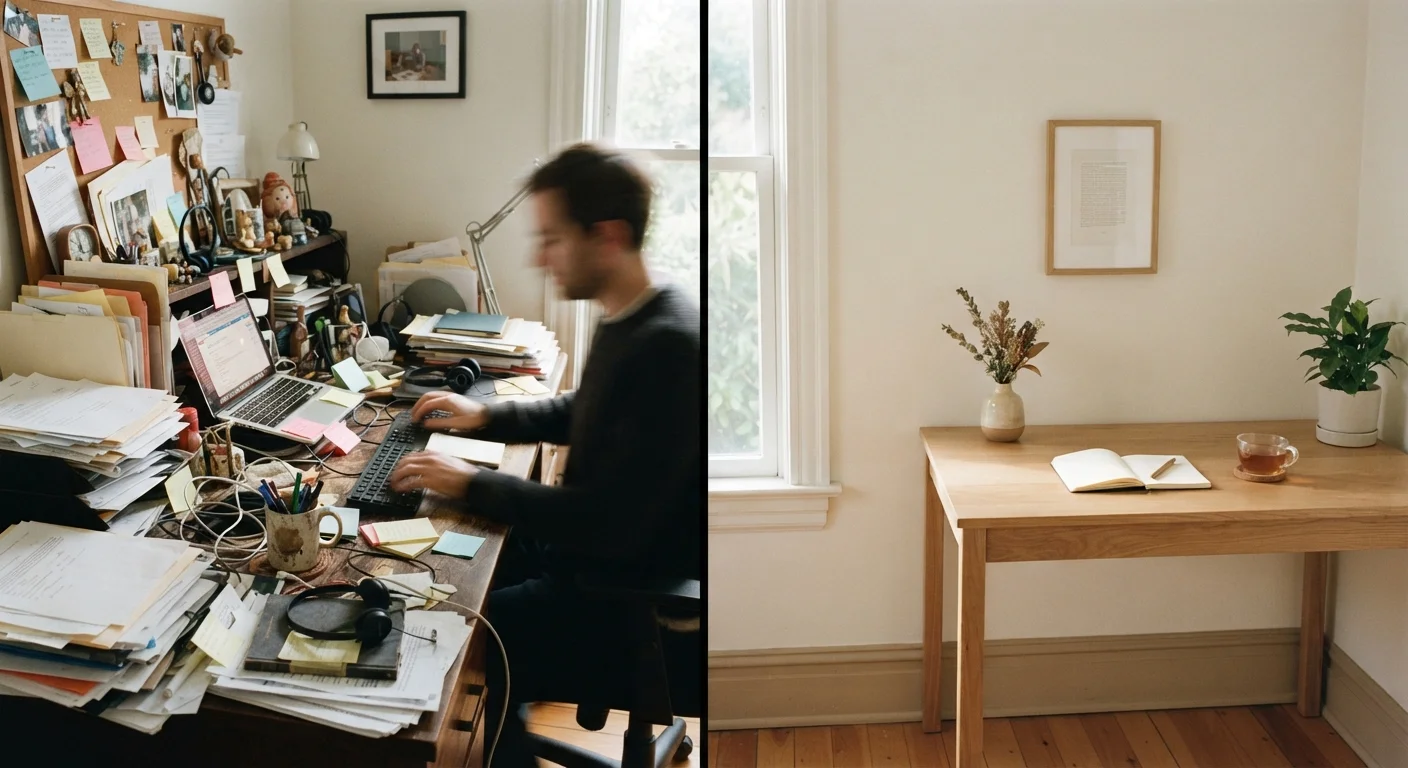
Clutter refers to an accumulation of objects that lack an organized place or purpose in your living space. Beyond the visual mess, clutter creates what researchers call a "mental load" — a persistent background demand on your brain's attention and processing resources. Your mind registers unresolved disorder as an unfinished task, which can contribute to feelings of stress, overwhelm, and reduced focus.
Cognitive load theory suggests that environmental stimuli compete for limited attentional resources; disorganized spaces may deplete these resources even when you're not consciously focused on the mess.
How Your Brain Processes a Disorganized Space
Your brain is constantly scanning your environment for information relevant to your goals and safety — a process that happens largely below conscious awareness. In a tidy space, this scan is quick and low-effort. In a cluttered environment, every visible object competes for your attention, forcing your visual and cognitive systems to work harder simply to filter out what is irrelevant.
Neuroscientists use the term attentional capture to describe how unexpected or salient objects in your field of vision can redirect focus involuntarily. Clutter multiplies these competing signals, which means your brain never fully disengages from the environment. This sustained low-level alertness is a drain on concentration — even when you're trying to focus on something entirely unrelated to the mess around you.
The result is a subtle but cumulative fatigue. Tasks that require sustained attention, such as reading, writing, or problem-solving, tend to feel harder in disordered spaces because your working memory is already partially occupied by unresolved environmental input.
~33%
Adults who feel overwhelmed by clutter
Survey data from the National Association of Professional Organizers (NAPO) suggests roughly one-third of American adults report feeling overwhelmed by the amount of clutter in their homes.
↑ Cortisol
Stress hormone linked to cluttered homes
A UCLA Center on Everyday Lives of Families study found that women who perceived their homes as cluttered showed higher cortisol profiles across the day compared to those who described their spaces as restful.
80%
Items kept are rarely or never used
Professional organizers frequently cite estimates suggesting the vast majority of stored household items are used infrequently or not at all, though precise figures vary across studies.
The Stress Response Clutter Triggers
Physical disorder activates the same stress-response pathways that react to other unresolved demands in your life. Studies examining cortisol levels — a key physiological marker of stress — have found associations between people who describe their homes as cluttered and elevated cortisol patterns across the day, particularly for women who spend more time at home. It is worth noting that this research identifies associations rather than definitive cause-and-effect relationships, and individual circumstances vary widely.
What seems to drive the stress response is less the clutter itself and more the sense of incompleteness it signals. Psychologists describe this as the Zeigarnik effect — the tendency for incomplete tasks to occupy mental space disproportionately. A pile of unsorted mail or an overflowing closet is, in psychological terms, an open loop your brain keeps returning to.
If you've noticed feeling anxious at home or struggling to relax in your own space, it may be worth considering the broader picture. The signs your stress levels may be affecting daily life article offers a practical checklist for recognizing when stress has become chronic.
Start With Your Most-Used Space
Rather than attempting to declutter your entire home at once, identify the single room or zone where you spend the most focused time — a home office, kitchen counter, or bedroom — and concentrate your initial effort there. Reducing cognitive load in your highest-use area tends to produce the most noticeable improvement in how you feel day-to-day.
Why We Accumulate Clutter Despite Knowing Better
Understanding why clutter is stressful is one thing; understanding why people allow it to build up is another. Several well-documented psychological tendencies work against our best organizing intentions:
- Loss aversion: Discarding an object feels riskier than keeping it, even when keeping it has a real cost in space and mental load.
- Optimism bias about future use: We tend to overestimate how likely we are to use or need something later.
- Sentimental attachment: Objects tied to memories or relationships carry emotional weight that makes purely practical decisions difficult. Our guide to sentimental clutter addresses this specifically.
- Decision fatigue: Sorting and discarding requires repeated small decisions. As decision fatigue sets in, people tend to default to keeping items rather than letting them go.
One of the least recognized sources of accumulation is paper. Bills, school forms, receipts, and manuals flow in faster than most households process them. Understanding why paper clutter keeps coming back can help you cut off the source rather than just managing the pile.
Practical Implications: Tidier Spaces for a Clearer Mind
You don't need a minimalist home to benefit from a less cognitively loaded environment. The goal is reducing unnecessary visual and decision-making demands in the spaces where you spend the most focused time — your workspace, bedroom, and kitchen are strong starting points.
A few evidence-informed principles to consider:
- Work in small, targeted sessions. Rather than waiting for a dedicated full-day effort, consistent 15–20 minute sessions focused on one zone tend to be more sustainable and less overwhelming.
- Assign a home to frequently used items. Clutter most often accumulates where objects lack a designated place. Creating and using consistent storage locations reduces the decision load every time you put something down.
- Address inflow, not just accumulation. Decluttering gains ground faster when you simultaneously reduce what enters the space.
It is also worth separating genuinely useful organizing strategies from popular myths. The organization myths that make decluttering harder article examines common misconceptions — like the idea that more storage automatically solves clutter problems — that can keep people stuck.
Decluttering is ultimately an act of environmental design in service of your own mental clarity. For a broader look at how your surroundings fit into overall wellbeing, see The Complete Picture: Mental Wellness Across Body, Mind, and Relationships.
Clutter, Wellbeing, and Professional Support
This article provides general educational information about how environments can influence mental state. It is not a substitute for professional mental health advice. If you feel that clutter, disorganization, or the stress associated with your living space is significantly affecting your daily functioning or wellbeing, consider speaking with a licensed mental health professional. Hoarding disorder, in particular, is a recognized condition that responds well to targeted therapeutic approaches.