

Key Takeaways
- Decluttering before organizing prevents wasted effort on items you don't need.
- No single method works for everyone — match your approach to your habits and household.
- Room-by-room sequencing reduces overwhelm and builds momentum.
- Sustainable organization relies on systems, not willpower alone.
- Annual audits catch creeping clutter before it becomes unmanageable.
- Storage solutions should follow your lifestyle, not the reverse.
Why Home Organization Matters Beyond Aesthetics
A disorganized home does more than look untidy — it creates friction in daily life. Searching for misplaced items, navigating cluttered hallways, and managing piles of unsorted belongings consume time and mental energy that most households can't afford to waste.
Research in environmental psychology suggests that cluttered spaces can elevate stress hormones and reduce an individual's sense of control. While tidiness is not a guarantee of wellbeing, reducing physical disorder tends to lower cognitive load — the invisible effort your brain expends tracking what's where and what needs doing.
Organization is also a practical safety issue. Clear pathways reduce fall risk, especially for children and older adults. Properly stored chemicals, tools, and medications prevent accidents. A well-organized home is often easier to maintain structurally — for example, good airflow around appliances extends their lifespan, and a clutter-free attic or basement makes it simpler to spot issues like moisture damage or pest activity early.
“Clutter is not just the stuff in your closet. It's anything that gets between you and the life you want to be living.”
— Peter Walsh, Professional organizer and author
Beyond safety and stress, organized spaces support better habits. A tidy kitchen makes meal planning more approachable, while a clear entryway encourages consistent routines when entering or leaving the home.
Starting the Declutter: A First-Principles Approach
Decluttering is the non-negotiable first step. Organizing items you don't need or use simply relocates the problem. Before you buy a single storage bin, work through what you own.
The Core Questions to Ask About Each Item
- Do I use this regularly? If not, when did you last use it?
- Do I have duplicates? Redundancy is a major driver of clutter.
- Does it belong in this space? Misplaced items accumulate without purpose.
- Is it in working condition? Broken items waiting to be repaired rarely get repaired.
If your home feels genuinely overwhelming, start with a single room or zone rather than attempting a whole-home overhaul at once. Starting small produces visible wins that sustain motivation.
Start With a Single Drawer or Shelf
If the thought of decluttering an entire room feels paralyzing, begin with one drawer or one shelf. Complete it fully before moving on. This approach builds a concrete sense of progress and makes the larger task feel more manageable without requiring a full-day commitment upfront.
Managing What You Decide to Remove
Sort discards into three categories: donate, recycle, or dispose. Many communities offer free bulk pickup for large items; local nonprofits often accept furniture, kitchenware, and clothing in good condition. Check with local waste management for guidelines on electronics and hazardous materials.
Choosing an Organization Method That Fits Your Life
Once clutter is cleared, the way you arrange and maintain what remains determines whether your system holds up over time. There is no universally superior method — only methods that fit or don't fit a given household.
Popular frameworks include category-based approaches (organizing by item type across the whole home), zone-based approaches (organizing by where things are used), and principles like FIFO (first in, first out), which is especially useful in kitchens and pantries. A detailed comparison of these frameworks can help you identify which aligns with your habits and household size.
Before committing to any organization framework, observe your household's natural patterns for one week — where things land, what gets left out, and what areas generate the most daily friction.
Organizing against the grain of real behavior creates systems that require constant enforcement rather than ones that maintain themselves naturally.
When setting up storage in a shared space, involve every regular user in deciding where things go. A system others help design is one they're far more likely to maintain.
Buy-in from all household members is among the most reliable predictors of a system's longevity, regardless of how logically it's designed.
Households with children or multiple adults benefit from systems everyone can follow without instruction — visual labels, color-coding, and consistent home locations for high-use items reduce the coordination burden significantly.
Room-by-Room Organizing Priorities
Different spaces have different organizing challenges. Targeting the highest-friction areas first gives you the greatest return on effort.
25%
Of two-car garages that can't fit a car
According to the U.S. Department of Energy, roughly one in four two-car garages in the U.S. cannot accommodate any vehicles due to stored belongings.
40%
Of housework attributed to clutter
The National Soap and Detergent Association has estimated that eliminating clutter could reduce the average household's cleaning time by around 40 percent.
Kitchen and Pantry
Group items by function: baking supplies together, cooking tools near the stove, rarely used appliances in upper cabinets. Apply FIFO logic to pantry staples — newer items go behind older ones — to reduce food waste.
Bedrooms and Closets
The bedroom should support rest, not double as storage. Keep surfaces clear and limit what lives under the bed. In closets, organize by category and frequency of use: daily items at eye level, seasonal items higher up or in labeled bins.
Entryways and Mudrooms
Entryways are the threshold between outside chaos and inside calm. A designated spot for keys, bags, and shoes prevents these items from migrating through the home. Hooks, a small bench, and a tray for mail or small items cover most households' needs.
Home Office and Shared Spaces
Paper is one of the fastest-growing clutter categories. Establish an inbox tray, a filing system for documents you must keep, and a shredding habit for what you don't. Digital organization follows similar logic — see organizing your phone for parallel principles.
Building Systems That Last
The gap between an organized home and a persistently organized home is systems. A system is a repeatable process that keeps things in order without requiring active decision-making each time.
The "One Home" Rule
Every item should have a single, consistent location. When it's used, it returns there. This sounds simple but requires deliberate assignment — especially for items that tend to drift (remote controls, scissors, chargers).
Storage Should Follow Behavior
Place items where you naturally reach for them, not where they aesthetically belong. If you always read on the sofa, a small side table for books makes more sense than a distant bookshelf. Resistance in a system is a sign the system needs adjustment, not that the person needs more discipline.
Avoid Over-Buying Storage Before Decluttering
Purchasing bins, baskets, and organizers before decluttering is one of the most common — and costly — mistakes in home organization. Without first removing what you don't need, you end up neatly storing clutter rather than eliminating it. Assess and reduce first; only then measure and buy storage to fit what remains.
Labeling and Visual Cues
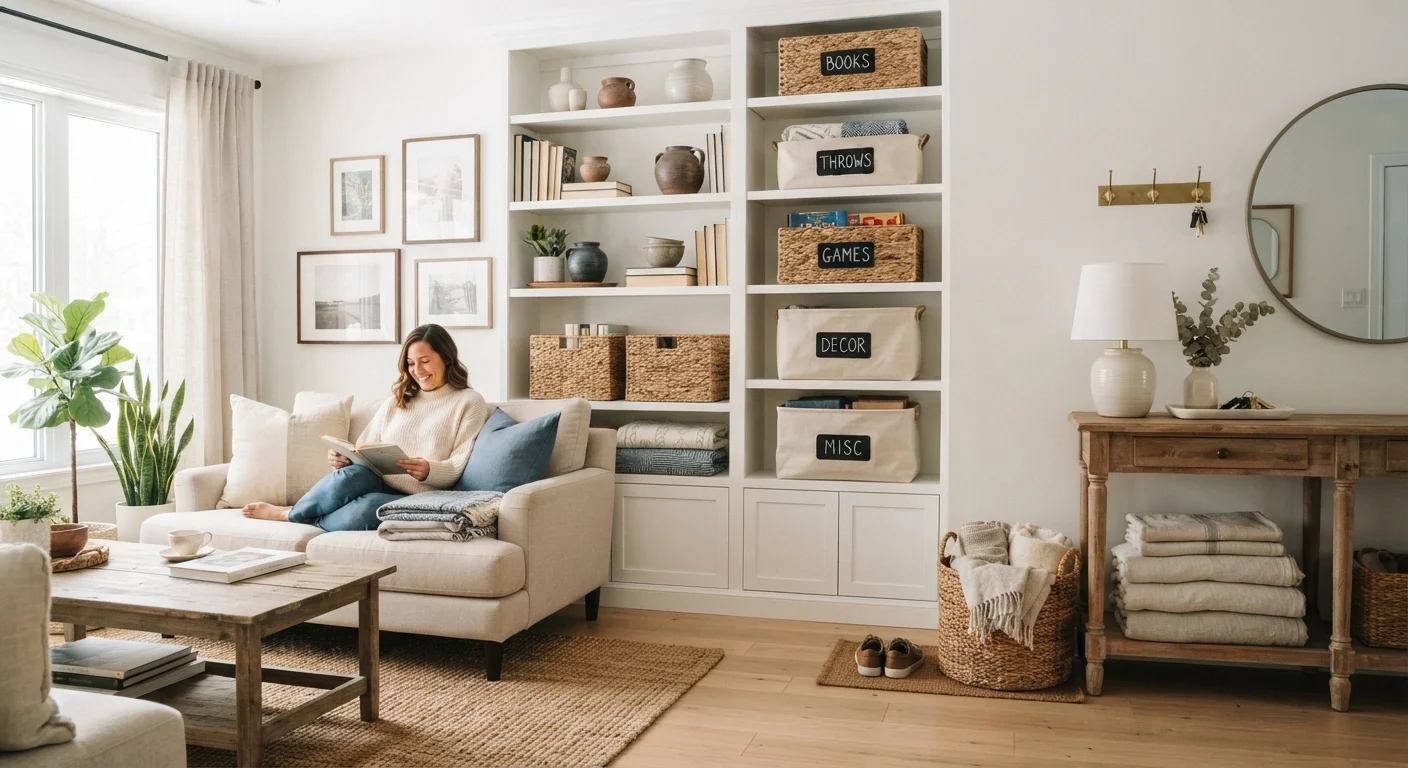
Labels reduce the cognitive effort of maintaining a system, particularly in shared spaces. Even simple masking-tape labels on bins or shelves help everyone in the household return items correctly.
Maintaining Order Over the Long Term
Even well-designed systems drift over time. Life changes — new purchases arrive, routines shift, families grow or shrink — and organization must adapt with them.
Daily and Weekly Habits
Maintenance is easier in small, frequent doses. A ten-minute daily reset — returning items to their homes, clearing surfaces, processing mail — prevents small disorder from compounding into large disorder. Weekly, spend a few minutes evaluating any areas showing early signs of clutter accumulation.
Seasonal Resets
Major life transitions and seasonal changes are natural trigger points for reassessment: switching out warm and cold weather clothing, clearing the garage after winter, reviewing the pantry before stocking up for a holiday. Use these moments to ask whether your current systems still match your current life.
The Annual Audit
Once a year, conduct a structured review of every major area in your home. A structured annual audit gives you a consistent checklist to work through, catching creeping clutter and outdated systems before they become entrenched. Think of it as routine maintenance — the same way you might service a heating system or check your home's insulation, as covered in this homeowner's introduction to insulation.
Home Organization Methods Compared
A clear-eyed look at KonMari, FIFO, the Four-Box Technique, and other popular frameworks — what each prioritizes and who each suits best.
Annual Home Organization Audit Checklist
A structured room-by-room checklist for reviewing your home once a year to catch clutter and outdated systems before they compound.
Organizing a Home From Scratch
A beginner-friendly guide walking through a logical, low-stress starting point when a home feels overwhelming to organize.