

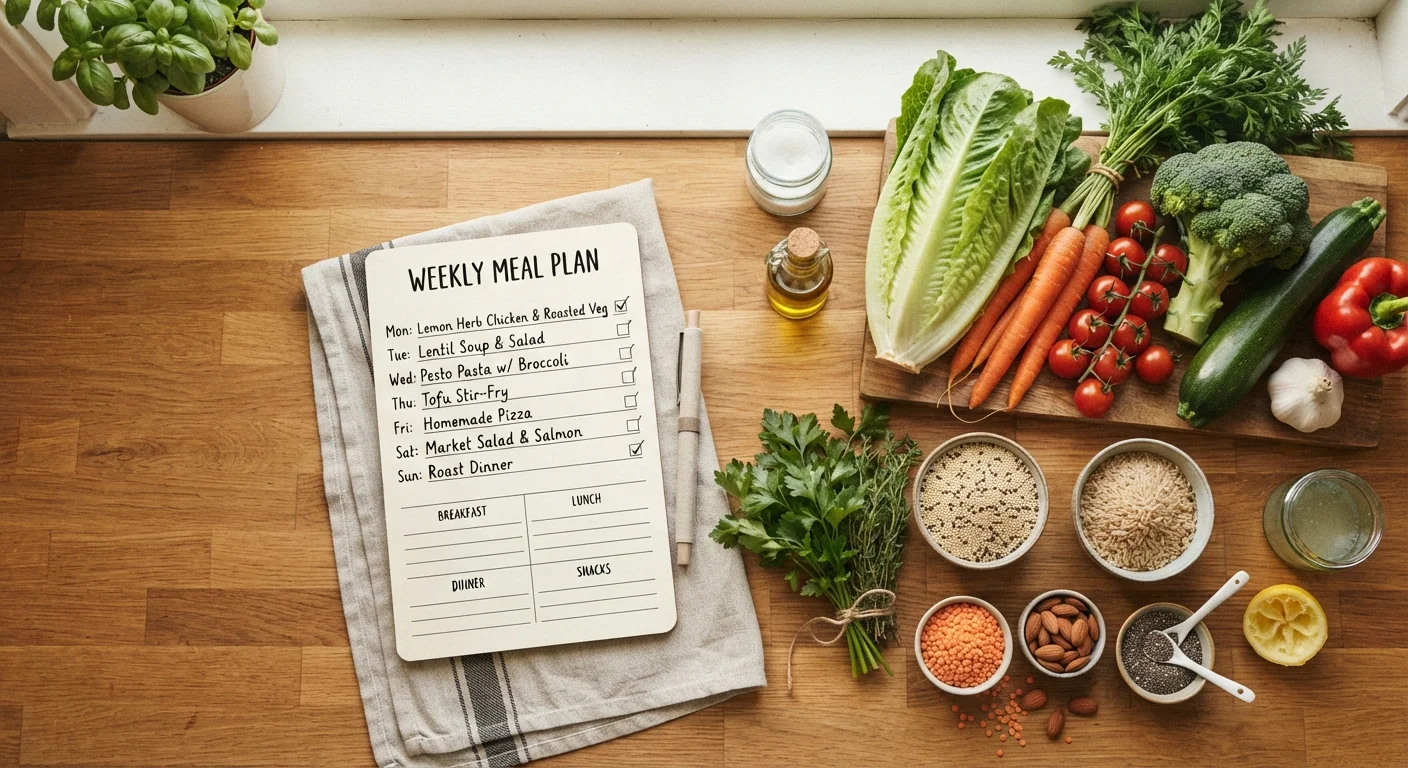
Key Takeaways
- Effective meal planning doesn't require perfection — flexibility and consistency matter far more.
- Building meals around a few reliable templates reduces decision fatigue without sacrificing variety.
- Planning with ingredient overlap cuts food waste and saves money without extra effort.
- A realistic plan that accounts for your actual schedule is more sustainable than an ideal one.
Why Most Meal Plans Fail Before Wednesday
Meal planning has a reputation for being aspirational but impractical. Many people start the week with a colour-coded spreadsheet and finish it ordering takeout — not because the idea is flawed, but because the approach was built for an ideal week rather than a real one.
The core problem isn't lack of motivation. It's that most planning frameworks prioritise nutritional optimisation over behavioural sustainability. A plan that looks perfect on Sunday night but ignores that Tuesday is packed and Thursday you're exhausted is not a workable plan — it's a source of mid-week guilt.
What actually holds up over months and years is a set of consistent principles rather than rigid weekly menus. For a grounding perspective on how dietary guidance is developed and why it evolves, see why nutrition advice keeps changing — it helps put planning decisions in context.
The Principles That Actually Work
Durable meal planning isn't about optimisation — it's about removing friction. The practices below are grounded in behavioural research on habit formation and practical nutrition guidance, not trending diet frameworks.
Start with a realistic weekly audit before writing a single meal
Planning meals that don't fit your actual schedule is the leading reason people abandon meal plans. Knowing which evenings are genuinely available for cooking — and which aren't — prevents the gap between intention and reality. A plan designed around a 45-minute Tuesday becomes workable; one that ignores it becomes guilt.
Use meal templates rather than rigid recipes
Templates — such as 'protein + grain + vegetable + sauce' — free you from hunting for a new recipe every week while still producing varied, nutritious meals. They also make it easier to cook with what's already on hand, reducing impulse purchases. Templates scale naturally with seasons and household preferences.
Plan ingredient overlap deliberately to minimise waste
Buying a full bunch of cilantro for one recipe and discarding the rest is one of the most common sources of household food waste. Intentionally pairing ingredients across two or three meals in a week uses whole quantities and reduces both waste and grocery spend. Research from the Natural Resources Defense Council has highlighted food waste reduction in the home as one of the most impactful areas households can address.
Keep a rotating shortlist of reliable, low-effort meals
Decision fatigue is real. Maintaining a personal shortlist of eight to ten meals your household reliably enjoys removes the cognitive load of planning from scratch each week. These 'anchor meals' provide a foundation you can rotate, reducing the friction that causes plans to collapse mid-week.
Batch-prepare components, not complete dishes, for maximum flexibility
Cooking full meals in advance can feel restrictive by mid-week. Preparing versatile components — cooked grains, roasted vegetables, a batch of legumes — gives you building blocks that can be assembled into different meals rather than eating the same dish four days running. This approach supports dietary variety without requiring daily cooking.
The 'Loose Plan' Is Still a Plan
You don't need to assign a specific meal to every night of the week. Planning three or four dinners and leaving two slots open for leftovers or flexible assemblies is a legitimate strategy. A loose plan consistently followed beats a detailed plan repeatedly abandoned.
For a practical foundation on how to proportion food groups within the meals you plan, building a balanced plate offers a beginner-friendly starting point that pairs well with any planning system.
Start This Week: Quick Actions
Sustainable meal planning doesn't require a complete overhaul of how you eat. Small, immediate changes to how you organise your week compound into lasting habits. The following actions can be taken before your next grocery shop.
This Is General Information, Not Personal Advice
This article offers general, evidence-informed guidance on meal planning habits and organisation. It is not personalised nutrition or medical advice. If you have specific dietary needs, a health condition, or are managing a chronic illness, consult a registered dietitian or your healthcare provider before making significant changes to your eating patterns.
Meal planning also intersects naturally with household budgeting. If reducing food costs is a goal alongside reducing waste, budgeting basics offers straightforward strategies for tracking everyday spending that complement a more intentional approach to grocery shopping.
30–40%
Share of US food supply wasted at consumer level
The USDA estimates that between 30 and 40 percent of the US food supply is wasted, much of it in homes — a figure that intentional meal planning can meaningfully reduce.
~$1,500
Average annual food waste cost per US household
The Natural Resources Defense Council has estimated that the average American family of four discards roughly $1,500 worth of food annually — much of it perishables purchased without a clear plan.
“The best diet is the one you can actually follow. Sustainable eating habits matter far more than any short-term regimen, no matter how nutritionally optimised it looks on paper.”
— Walter Willett, Professor of Epidemiology and Nutrition, Harvard T.H. Chan School of Public Health
This article is for general informational purposes only and does not constitute personalised nutrition or medical advice. Consult a registered dietitian or qualified healthcare professional for guidance specific to your health needs.