

Key Takeaways
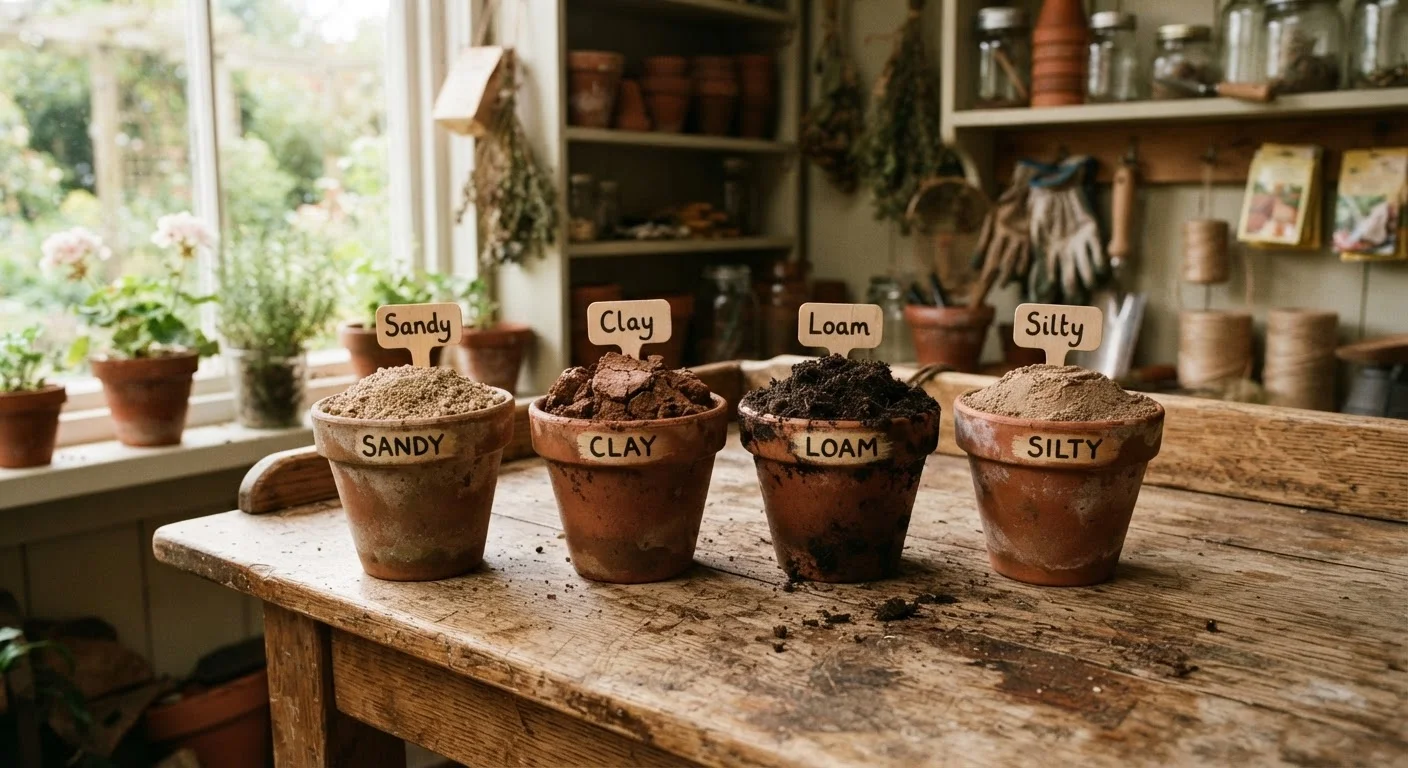
- The four main garden soil types are sandy, clay, silty, and loam — each with distinct drainage and nutrient traits.
- Loam is considered ideal because it balances drainage, aeration, and nutrient retention.
- Clay soil holds nutrients well but drains poorly; sandy soil drains fast but struggles to retain moisture.
- A simple jar test or ribbon test at home can help you identify your soil type without lab equipment.
- Most soil types can be improved over time by adding organic matter such as compost.
Soil Type
Soil type refers to the physical makeup of your garden's ground — specifically the ratio of sand, silt, and clay particles it contains. Each combination affects how water drains, how nutrients are held, and how easily plant roots can grow. Identifying your soil type helps you choose the right plants and know when to amend what you have.
Soil texture is classified by particle size: sand particles are largest (0.05–2 mm), silt is medium (0.002–0.05 mm), and clay is smallest (under 0.002 mm). These proportions, measured using a soil texture triangle, determine most of your soil's behavior.
The Four Main Soil Types and What They Mean
Walk through any garden center and you'll see bags labeled "garden soil" or "potting mix" — but what's already in your backyard matters just as much. Garden soil is broadly categorized into four types based on the dominant particles it contains: sandy, clay, silty, and loam. Understanding where your soil falls on that spectrum shapes every decision you make, from what you plant to how you water.
Sandy soil has large, loose particles that let water pass through quickly. It warms up fast in spring and is easy to work, but it doesn't hold moisture or nutrients well. Plants in sandy soil often need more frequent watering and feeding.
Clay soil is dense and made of very fine, tightly packed particles. It holds water and nutrients effectively, but drains slowly and can become compacted and waterlogged. It's also prone to cracking when dry and is sticky and hard to dig when wet.
Silty soil sits between sand and clay in particle size. It's smooth and retains moisture better than sand while draining better than clay. It's fairly fertile but can compact under foot traffic and heavy rain, making it prone to crusting on the surface.
Loam is the blend that most gardeners aim for — roughly equal parts sand, silt, and clay. It drains well without drying out too fast, holds nutrients efficiently, and is easy to dig. It's the foundation that makes the widest range of plants happy. See our guide to composting at home for one of the most practical ways to work toward loamier soil over time.
~25%
Ideal air space in healthy garden soil
Soil scientists generally describe ideal garden soil as roughly 45% mineral particles, 25% water, 25% air, and 5% organic matter by volume.
6.0–7.0
Optimal pH range for most vegetables
Most common vegetable crops perform best in a slightly acidic to neutral soil pH, according to university extension guidelines across the US.
2–3 inches
Recommended annual compost application depth
Many cooperative extension services recommend incorporating 2–3 inches of compost annually to steadily improve soil structure and fertility.
How to Identify Your Soil Type at Home
You don't need to send a sample to a lab to get a useful read on your soil. Two simple tests give a clear picture.
The Ribbon Test
Take a small handful of moist (not soaking wet) soil and squeeze it in your palm, then push it between your thumb and forefinger into a ribbon. If it forms a long, smooth ribbon over 2 inches without breaking, you have a high clay content. A short, gritty ribbon points to sandy clay. If it barely ribbons and feels gritty throughout, your soil is predominantly sandy.
The Jar Test
Fill a quart jar about one-third with garden soil. Add water nearly to the top, seal it, and shake vigorously. Then set it aside for 48 hours. The layers that form show your soil's makeup: sand settles first at the bottom, silt settles in the middle, and clay forms the thinnest top layer — or stays suspended, making the water cloudy. The relative thickness of each layer tells you approximately how much of each you have.
Once you know your texture, you can also consider pH testing, which measures acidity or alkalinity on a scale of 0–14. Most vegetables and flowers prefer a range of 6.0–7.0. Your local cooperative extension service often offers affordable or free soil testing that covers both texture and pH — a worthwhile step before making major amendments. Soil texture affects how water moves through your garden, which is explored further in our garden watering guide.
Test When Soil Is Moist, Not Wet
Both the ribbon test and jar test work best when your soil sample is moist but not saturated. Soil that's too wet will smear rather than ribbon properly, while bone-dry soil may not hold together at all. Collect your sample a day or two after light rain or watering for the most accurate results.
Improving Your Soil: The Role of Organic Matter
No matter what soil type you're starting with, organic matter is the universal improver. Compost, aged manure, leaf mold, and cover crops all add organic material that changes how soil particles interact with each other — and with water, air, and plant roots.
In clay soil, organic matter opens up the structure, creating pore spaces that allow excess water to drain and roots to penetrate. In sandy soil, it acts like a sponge, helping retain moisture and nutrients that would otherwise leach away. In silty soil, it adds structure that resists compaction.
The key is consistency. A single application of compost improves things slightly; annual additions over several growing seasons genuinely transform soil structure. A 2–3 inch layer of compost worked into the top 6–8 inches of soil each season is a widely recommended starting point, though exact needs vary by soil condition and plant type.
Once your soil is in better shape, nutrient management becomes the next layer of gardening knowledge. Understanding what fertilizers add — and how to read their labels — helps you avoid over- or under-feeding your plants. Our guide to reading fertiliser labels walks through N-P-K ratios in plain terms. And if you're considering whether organic or synthetic options make more sense for your garden, see our comparison of organic vs. synthetic fertilisers.
Raised Beds Let You Start Fresh
If your native soil is severely compacted, contaminated, or extreme in texture, raised beds filled with a quality soil mix offer a practical alternative to in-ground amendment. They give you full control over drainage and fertility from the start. That said, building good native soil alongside raised beds remains worthwhile for long-term landscape health.