

Key Takeaways
- Refining removes the bran and germ from a grain kernel, stripping out most of the fiber, vitamins, and minerals.
- Whole grains retain all three kernel layers — bran, germ, and endosperm — and their associated nutrients.
- Enrichment adds back some B vitamins and iron to refined grains, but does not fully replace what processing removes.
- Diets higher in whole grains are consistently linked to lower risks of cardiovascular disease and type 2 diabetes in population studies.
- Refined grains are not inherently harmful; overall dietary pattern matters more than any single food choice.
- Reading ingredient labels helps identify whether a product genuinely contains whole grains or mostly refined flour.
Option A
Whole Grains
The intact, nutrient-dense original.
Best for: People seeking higher fiber, sustained energy, and a broader range of naturally occurring vitamins and minerals from their grain foods.
Option B
Refined Grains
The processed, longer-lasting alternative.
Best for: Situations where texture, shelf life, or palatability are priorities, and total diet quality provides nutrients from other sources.
If you want to maximize fiber and micronutrient intake from grain-based foods
Whole Grains
Whole grains deliver fiber, B vitamins, magnesium, and phytochemicals that are largely stripped away during refining, making them the more nutrient-dense choice gram for gram.
If digestive sensitivity makes high-fiber foods uncomfortable
Refined Grains
Lower fiber content in refined grains can be easier to tolerate for people with certain gastrointestinal conditions; a healthcare provider can help determine the right balance.
If you are building long-term healthy eating habits and want the most evidence-backed grain choice
Whole Grains
Decades of population research consistently associate higher whole grain intake with reduced risk of cardiovascular disease, type 2 diabetes, and some digestive conditions.
If your overall diet is varied and nutritionally balanced
Refined Grains
When the rest of the diet supplies adequate fiber, vitamins, and minerals from vegetables, legumes, and other whole foods, moderate refined grain consumption is unlikely to cause harm.
Anatomy of a Grain Kernel
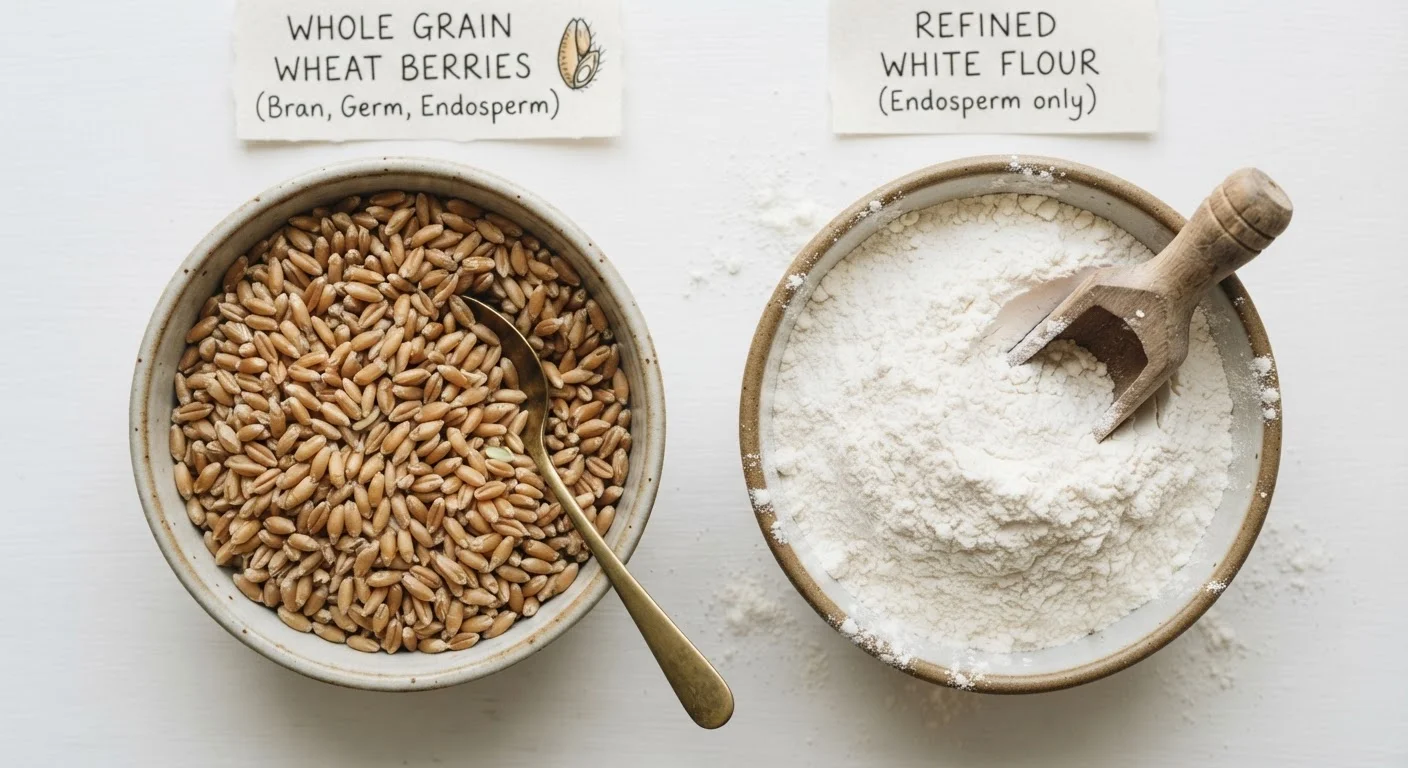
Every grain — wheat, rice, oats, barley, corn — starts as a kernel made up of three distinct layers. The bran is the fibrous outer shell, rich in dietary fiber, B vitamins, and minerals such as magnesium and zinc. The germ is the small inner embryo that would sprout into a new plant; it contains healthy fats, vitamin E, and additional B vitamins. The endosperm makes up the bulk of the kernel and is composed mainly of starch and a modest amount of protein.
A whole grain product uses all three layers in roughly their natural proportions. A refined grain product has had the bran and germ mechanically removed, leaving behind primarily the starchy endosperm. That milling process extends shelf life and creates a lighter, smoother texture — but it also removes the majority of the kernel's nutritional complexity.
Understanding this structure helps decode a lot of nutrition label language. For a deeper look at how to read those labels accurately, see how to interpret a food nutrition label.
What Refining Actually Removes
The nutritional gap between a whole grain and its refined counterpart is substantial. Milling wheat into white flour removes roughly 75–80% of its fiber, along with significant portions of B vitamins (thiamine, riboflavin, niacin, folate), iron, magnesium, phosphorus, zinc, and antioxidant compounds called phytochemicals. Most of these losses come directly from discarding the bran and germ.
~75–80%
Fiber lost during wheat milling
Removing the bran and germ during standard milling strips most of the grain's dietary fiber content.
3x
More magnesium in whole vs. refined wheat
Whole wheat flour contains roughly three times the magnesium of enriched white flour, a mineral not restored through standard enrichment.
~25%
Lower cardiovascular disease risk association
Multiple large cohort studies suggest diets high in whole grains are associated with meaningfully lower cardiovascular disease risk compared to low whole grain intakes.
In response, many countries — including the United States — mandate enrichment: the addition of specific B vitamins (thiamine, riboflavin, niacin, folic acid) and iron back into refined grain products. Enrichment meaningfully addresses some deficiency risks, particularly neural tube defects linked to low folate intake. However, it does not restore fiber, magnesium, zinc, vitamin E, or the full spectrum of phytochemicals lost in milling.
It is worth keeping in mind that grain-processing practices and enrichment requirements vary by country and product type — always check the ingredient and nutrition facts panel of a specific product rather than assuming. For help separating nutrition fact from popular assumption, common nutrition myths examined against the evidence offers useful context.
Head-to-Head: Key Nutritional Differences
The table below compares whole and refined grains across the dimensions that matter most for everyday dietary decisions. Values reflect general patterns across grain types rather than any single product.
| Criterion | Whole Grains | Refined Grains |
|---|---|---|
| Kernel layers retained | Bran, germ, and endosperm | Endosperm only |
| Dietary fiber | High | Low (mostly removed) |
| B vitamins (natural) | Broad range present | Largely removed; some added back via enrichment |
| Minerals (magnesium, zinc) | Naturally present | Significantly reduced; not fully restored |
| Vitamin E | Present in germ | Removed with germ; not restored |
| Phytochemicals / antioxidants | Present in bran and germ | Largely removed |
| Glycemic response (general) | Slower glucose release | Faster glucose release |
| Shelf life | Shorter (germ fats can oxidize) | Longer |
| Texture and palatability | Denser, nuttier | Lighter, smoother |
One critical practical point: the word "wheat" on a label does not mean whole wheat. Look for "whole wheat," "whole grain ," or "whole oat flour" as the first listed ingredient. Enriched flour, unbleached flour, and multigrain are not equivalent to whole grain designations.
What the Evidence Says About Health Outcomes
Population-level research — including large cohort studies and systematic reviews — has consistently found associations between higher whole grain consumption and reduced risk of several chronic conditions. These include cardiovascular disease, type 2 diabetes, and colorectal cancer. The mechanisms proposed include the role of dietary fiber in slowing glucose absorption, supporting gut microbiome diversity, and reducing LDL cholesterol levels.
It is important to frame this accurately: these are associations observed in populations with varied diets, not guarantees of individual outcomes. Whole grain intake tends to cluster with other healthy behaviors in research populations, which can complicate causal interpretation. Nutrition science is also a field where evidence continues to evolve; understanding how to evaluate nutrition research helps put these findings in perspective.
Refined grains, meanwhile, are not a categorical health hazard. Diets high in white rice are common in populations with low rates of the conditions listed above, suggesting that overall dietary pattern — total fiber, vegetable intake, lifestyle factors — matters more than any single food category. The concern with refined grains in typical Western diets is less about the grain itself and more about what often accompanies it: added sugars, saturated fats, and low vegetable intake. For more on how food processing categories intersect with this discussion, see what "ultra-processed food" actually means.
Enrichment Is Partial, Not Complete Restoration
U.S. law requires enriched grain products to have thiamine, riboflavin, niacin, folic acid, and iron added back after milling. This addresses some public health priorities — notably the reduction of neural tube defect risk through folic acid — but enrichment does not replace fiber, vitamin E, magnesium, zinc, or phytochemicals. A label reading 'enriched' should not be read as equivalent to 'whole grain.'
This article provides general nutrition information and is not a substitute for personalized dietary advice. Consult a registered dietitian or qualified healthcare professional before making significant changes to your diet, especially if you have a medical condition.