

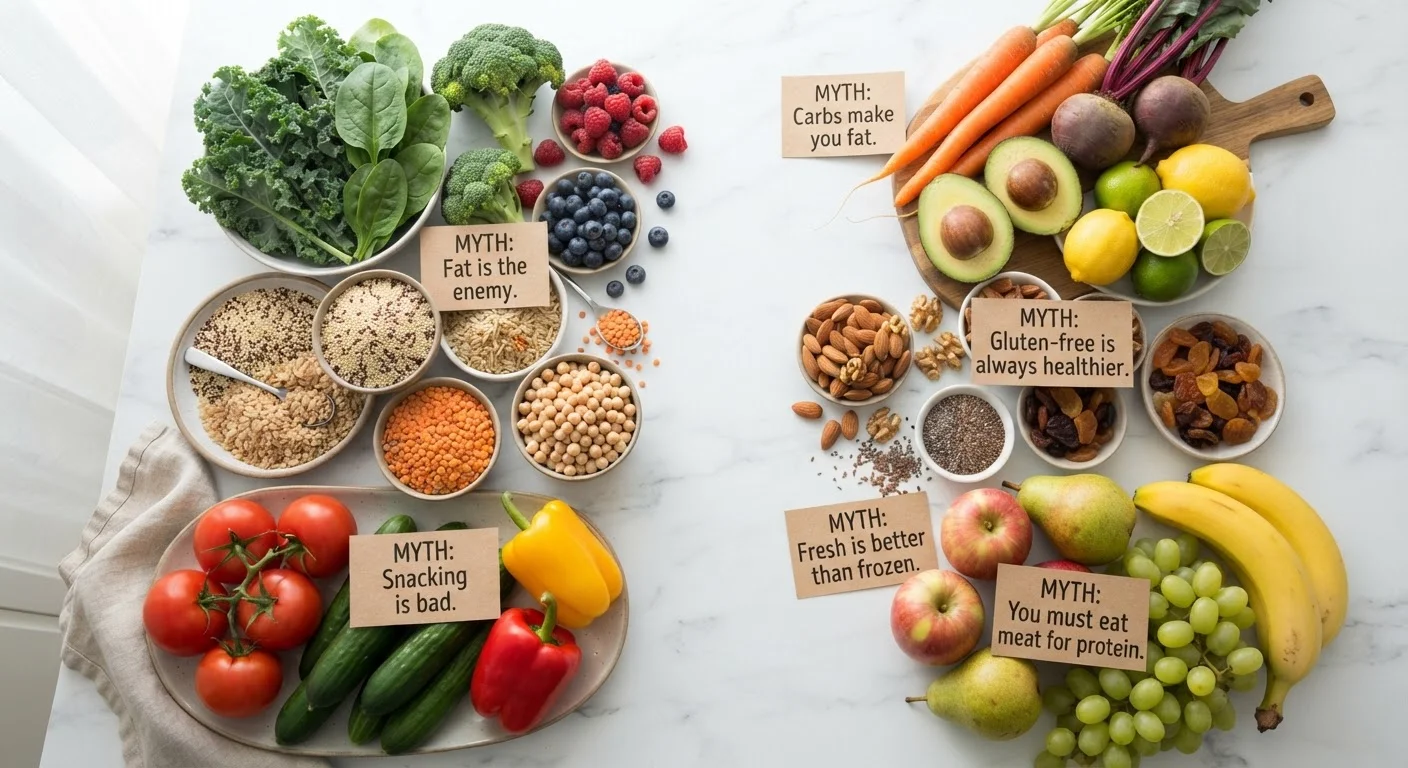
Key Takeaways
- Carbohydrates are not inherently fattening; total calorie balance and food quality matter most.
- The liver and kidneys handle detoxification — no commercial diet or juice can replicate or enhance this.
- Dietary fat is essential for health; the type of fat consumed matters far more than fat intake alone.
- Eating frequently does not meaningfully speed up metabolism for most people.
- High-protein diets are generally safe for healthy adults, though individual needs vary widely.
Why Nutrition Myths Are So Hard to Kill
Nutrition is one of the most misunderstood fields in everyday health conversation. Oversimplified headlines, social media influencers, and decades of conflicting dietary guidelines have created a landscape where myths thrive long after researchers have moved on. Understanding why these beliefs persist is the first step to replacing them with something more useful.
Much of the confusion stems from how nutrition science works. Studies often rely on self-reported food diaries, short observation windows, and populations that don't reflect everyone. A finding that makes headlines one year may be qualified or reversed as evidence accumulates. For a deeper look at how this process plays out, see why nutrition advice keeps changing.
What follows examines some of the most persistent myths — not to shame anyone who believed them, but to replace outdated ideas with what the current evidence actually supports.
Myth
Carbohydrates make you gain weight, so cutting them is the key to fat loss.
Fact
Carbohydrates themselves do not cause fat gain; excess calories from any source do. Whole-food carbohydrate sources provide essential energy, fiber, and micronutrients.
Weight change is driven by overall energy balance — calories consumed versus calories expended — not by any single macronutrient. Low-carbohydrate diets can produce weight loss, but largely because they reduce total calorie intake, not because carbohydrates are uniquely fattening. Refined carbohydrates and added sugars do warrant attention because they are energy-dense and low in nutrients, but whole grains, legumes, and fruit deliver fiber, vitamins, and minerals that support long-term health. See what changes when you process a grain for more on the nutritional difference.
Myth
Detox diets and juice cleanses remove toxins from the body.
Fact
The liver and kidneys continuously filter waste products and metabolic byproducts. No diet, juice, or supplement protocol has been shown to enhance or accelerate this process in healthy individuals.
The term "detox" as used in marketing has no agreed clinical definition. Your body's detoxification system — primarily the liver, kidneys, and gastrointestinal tract — operates around the clock and does not require external help from commercial cleanses. Short juice fasts may produce a transient sense of wellbeing, likely due to reduced processed food intake and increased hydration, but there is no robust evidence that they remove any specific toxin or meaningfully improve organ function in healthy adults. Claims to the contrary are not supported by current clinical research.
Myth
Eating fat makes you fat — a low-fat diet is the healthiest approach.
Fact
Dietary fat is essential for hormone production, nutrient absorption, and cell function. The quality and type of fat matters far more than fat quantity alone.
The low-fat dietary movement of the 1980s and 1990s was based on an oversimplification of cardiovascular research. When food manufacturers reduced fat, they frequently replaced it with sugar and refined starch to maintain palatability — a substitution that did not improve public health outcomes. Current dietary guidance distinguishes between fat types: unsaturated fats are associated with favorable cardiovascular markers, while industrially produced trans fats are associated with increased cardiovascular risk. Fat-soluble vitamins A, D, E, and K require dietary fat for absorption, making adequate fat intake a nutritional necessity. Learn more at vitamins and minerals your body can't make itself.
Myth
Eating many small meals throughout the day boosts your metabolism.
Fact
Meal frequency has minimal effect on metabolic rate for most people. Total daily calorie and nutrient intake matters far more than how meals are distributed.
The idea that eating frequently "stokes the metabolic fire" was popularized in fitness culture but is not well-supported by controlled research. While digesting food does require energy — a phenomenon called the thermic effect of food — this effect is determined by total food consumed, not how often it is eaten. Some individuals do find more frequent eating helps with hunger management and portion control, which can indirectly support a healthy weight. However, this is a matter of personal preference and lifestyle fit, not a metabolic advantage that applies universally.
Myth
High-protein diets damage the kidneys in healthy adults.
Fact
Current evidence does not support the idea that higher protein intakes harm kidney function in people with healthy kidneys. Those with existing kidney disease should follow individualized medical guidance.
This myth likely originated from observations that high protein intake increases the kidneys' filtration workload. In people with pre-existing chronic kidney disease, dietary protein restriction is indeed a legitimate clinical consideration — but this does not translate to risk in healthy individuals. Multiple systematic reviews have not found evidence of kidney damage from higher protein diets in people with normal kidney function. As with all dietary questions involving a specific health condition, anyone with kidney concerns should consult their healthcare provider rather than applying general population guidance.
Reading the Evidence on Fat, Protein, and Meal Timing
Several myths cluster around macronutrients — the carbohydrates, proteins, and fats that form the backbone of any diet. Misunderstanding their roles leads people to cut entire food groups unnecessarily or follow regimens that offer no measurable benefit. Our guide to what carbs, proteins, and fats actually do covers the fundamentals in detail.
~5%
US adults meeting fiber intake recommendations
According to a dietary intake analysis published in the American Journal of Lifestyle Medicine, approximately 5% of US adults meet recommended fiber intake levels.
40–45%
Share of calories from carbohydrates in typical US diet
USDA dietary surveillance data indicates Americans typically obtain 40–45% of daily calories from carbohydrates, well below the commonly feared 'carb-heavy' threshold.
$50B+
US dietary supplement industry annual revenue
The US dietary supplement market, which includes many 'detox' products, has surpassed $50 billion in annual revenue, according to industry market research estimates.
Fat has perhaps suffered the worst reputation undeservedly. Decades of low-fat dietary advice — driven partly by industry-influenced research — left many people fearful of all dietary fat. Current evidence distinguishes clearly between fat types. Unsaturated fats found in foods like olive oil, nuts, and fatty fish are associated with cardiovascular benefit, while industrially produced trans fats carry well-documented risk. Saturated, unsaturated, and trans fats compared offers a clear breakdown of these differences.
Be Cautious with Extreme Elimination Diets
Diets that eliminate entire food groups — all fats, all carbohydrates, all animal products — can result in micronutrient deficiencies if not carefully planned. Symptoms may develop gradually and be easy to overlook. If you are considering a highly restrictive eating pattern, consult a registered dietitian to ensure your nutritional needs are met.
Fiber is another area where myths crowd out good information. Most US adults consume significantly less fiber than current guidelines recommend, partly because fiber-rich whole grains, legumes, and vegetables have been sidelined by low-carb trends. For a detailed look at why fiber matters, see why most people eat far less fiber than they need.
This article is for general informational and educational purposes only and does not constitute medical or dietary advice. Consult a registered dietitian or qualified healthcare professional before making significant changes to your diet.