

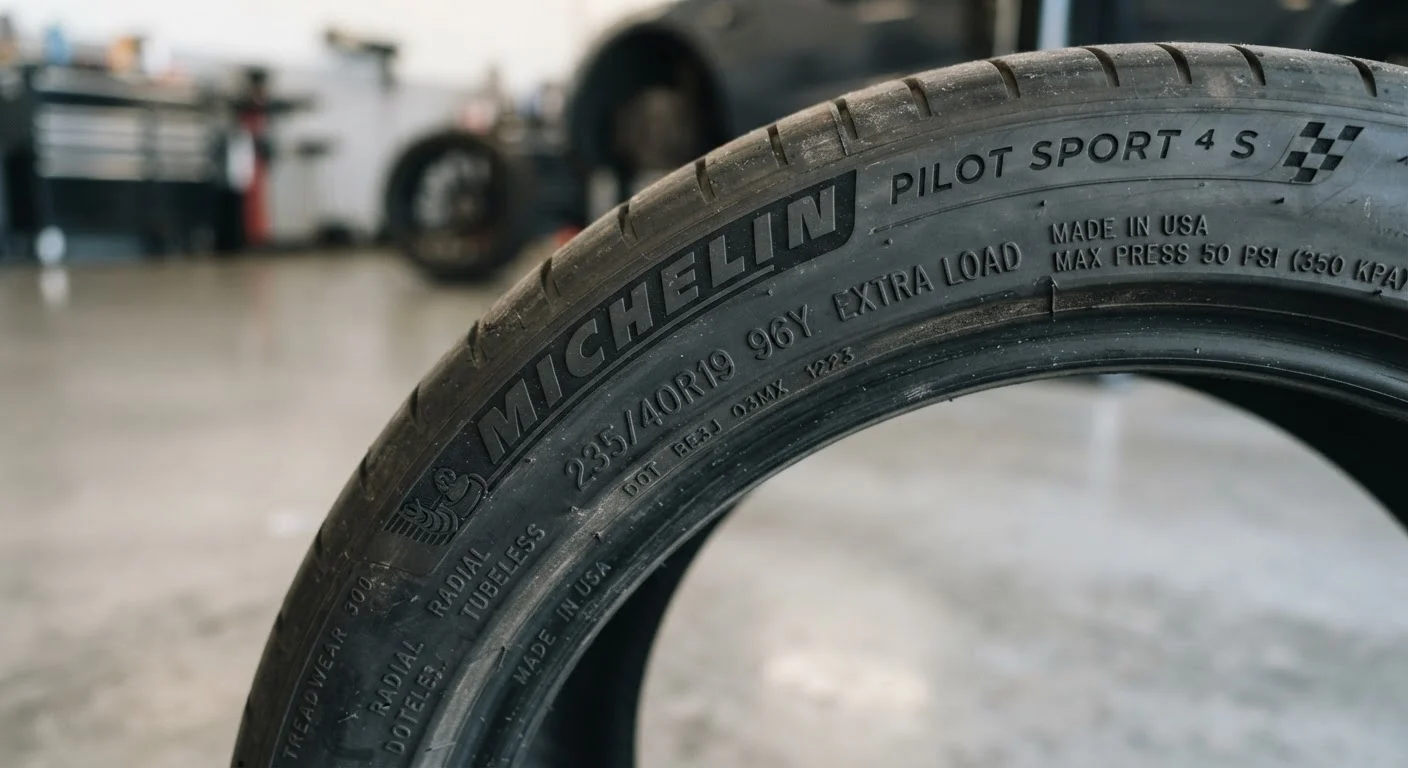
What That String of Characters Actually Means
Glance at your tyre sidewall and you'll see something like P215/65R16 98H. That compact string encodes everything from the tyre's intended vehicle type and physical dimensions to how much weight it can safely carry and how fast it's rated to go. Understanding each segment lets you verify that a replacement tyre matches your vehicle's requirements — and spot when something is off.
Here's how to break down the code, segment by segment.
- Service descriptor (P, LT, T): The leading letter identifies the tyre's intended use. P stands for passenger vehicle, LT for light truck, and T for temporary spare. Some metric-only tyres carry no letter at all.
- Section width (e.g., 215): The three-digit number following the service descriptor is the tyre's width in millimetres, measured from sidewall to sidewall.
- Aspect ratio (e.g., 65): After the slash, this two-digit number expresses the sidewall height as a percentage of the section width. A 65 means the sidewall height is 65% of 215 mm. Lower numbers indicate a shorter, stiffer sidewall — common on performance-oriented tyres.
- Construction code (R): The letter between the aspect ratio and the rim diameter almost always reads R, standing for radial — the standard construction type for modern passenger tyres.
- Rim diameter (e.g., 16): This number, in inches, is the wheel diameter the tyre is designed to fit. Getting this wrong means the tyre simply won't mount.
Load Index and Speed Rating
The two characters after the rim diameter — 98H in our example — carry critical safety information that's easy to overlook.
Load index
A standardised numerical code on the tyre sidewall that corresponds to the maximum weight a single tyre can support when correctly inflated. Higher numbers indicate greater load capacity.
Speed rating
A letter code indicating the maximum sustained speed a tyre is engineered to handle safely. It should meet or exceed the vehicle manufacturer's minimum specification.
Aspect ratio
The sidewall height expressed as a percentage of the tyre's section width. A lower aspect ratio means a shorter, stiffer sidewall.
UTQG
Uniform Tire Quality Grading — a US system requiring passenger tyres to carry standardised treadwear, traction, and temperature ratings to help consumers make comparisons.
DOT code
A Department of Transportation compliance identifier molded into the tyre sidewall. Its final four digits encode the tyre's week and year of manufacture.
Load Index
The load index is a standardised numerical code representing the maximum weight a single tyre can support when properly inflated. A load index of 98 corresponds to 1,653 lbs (750 kg) per tyre. Load index tables are published by tyre standards bodies; you don't need to memorise them, but you do need to ensure a replacement tyre carries an equal or higher load index than your vehicle's placard specifies. Fitting a tyre with a lower load index than required is unsafe and may violate federal motor vehicle safety standards.
Speed Rating
The letter following the load index is the speed rating — a code indicating the maximum sustained speed the tyre is designed to handle. H, for instance, is rated to 130 mph (210 km/h). Common ratings you'll encounter include S (112 mph), T (118 mph), H (130 mph), V (149 mph), and W (168 mph). As with load index, fitting a tyre with a lower speed rating than the vehicle manufacturer specifies is not recommended. See our guide to routine maintenance milestones for context on how tyre checks fit into a broader service schedule.
130 mph
Max speed for H-rated tyres
The H speed rating (210 km/h) is among the most common on US passenger vehicles; ratings vary by tyre line and vehicle type.
1,653 lbs
Load capacity for a single load-index-98 tyre
Load index values are standardised across the industry; equivalent to 750 kg per tyre at proper inflation.
DOT Code, Treadwear, and Other Markings
Beyond the size-and-rating string, the sidewall carries additional federally mandated and manufacturer-specific information.
DOT Code and Manufacture Date
In the US, every tyre must display a DOT compliance code. The last four digits of this code are the most useful to drivers: they identify the week and year of manufacture. 2419, for example, means the tyre was made in the 24th week of 2019. Most manufacturers and safety organisations suggest replacing tyres that are six to ten years old regardless of tread depth, because rubber compounds degrade over time. For more on how the DOT encodes vehicle data, our article on understanding your VIN provides helpful context on US vehicle identification standards.
Treadwear, Traction, and Temperature Grades
The Uniform Tire Quality Grading (UTQG) system requires most passenger tyres to display three ratings:
- Treadwear: A comparative index — higher numbers indicate longer-lasting tread compounds relative to a government reference tyre.
- Traction: Rated AA, A, B, or C, reflecting wet-braking performance.
- Temperature: Rated A, B, or C, reflecting resistance to heat buildup at speed.
These grades are useful for comparison shopping, but they are manufacturer-tested and not independently verified, so treat them as directional rather than absolute.
Your Door Jamb Placard Is the Authority
The tyre placard on the driver's door jamb or in your owner's manual lists the exact size, load index, and inflation pressure your vehicle requires. When in doubt, that placard overrides any other source. If you're unsure whether a tyre matches your vehicle's requirements, consult a qualified tyre professional before fitting.
Always cross-reference your sidewall markings against the tyre placard found on the driver's door jamb or in your owner's manual — that placard defines the minimum specifications your vehicle requires. Our companion piece on tyre pressure explains the related inflation figures you'll find on the same placard.