

Key Takeaways
- Your vehicle's correct tyre pressure is on the door jamb sticker, not on the tyre sidewall itself.
- Both underinflation and overinflation cause uneven tread wear and reduce tyre lifespan.
- Underinflated tyres measurably increase fuel consumption over time.
- Tyre pressure should be checked when tyres are cold — before driving more than a mile.
- Temperature swings of 10°F can shift pressure by roughly 1 PSI, making seasonal checks essential.
- A blowout risk rises significantly with sustained underinflation, especially at highway speeds.
Tyre Pressure
Tyre pressure refers to the amount of air inside a tyre, measured in pounds per square inch (PSI) or, less commonly in the US, bar or kPa. Every vehicle has a manufacturer-specified pressure range that balances ride comfort, handling, fuel efficiency, and tyre wear. Running tyres at the wrong pressure — too high or too low — compromises all of these at once.
Tyre pressure is measured as gauge pressure, meaning it reflects pressure above atmospheric (ambient) levels rather than absolute pressure. Temperature changes cause air to expand or contract roughly 1 PSI for every 10°F shift, which is why cold-inflation readings are the standard reference.
What the Numbers Actually Mean
The pressure specification for your tyres is not printed on the tyre itself — or at least, not in the way most drivers assume. The number stamped on the tyre sidewall (for example, "Max. Press. 51 PSI") is a structural ceiling, not a driving target. The number that matters for everyday use is found on the driver's side door jamb sticker or in the owner's manual, and it typically falls somewhere between 30 and 36 PSI for most passenger vehicles.
Different axles sometimes carry different specifications — front tyres on a front-wheel-drive vehicle may be set at a different pressure than the rears. If you're carrying a heavy load or towing, some manufacturers publish adjusted pressure recommendations for those conditions. For a broader look at decoding the markings on your tyres, see our field guide to tyre sidewall markings.
~0.2%
Fuel economy loss per 1 PSI drop below spec
The US Department of Energy estimates roughly 0.2% lower fuel economy for every 1 PSI drop in average tyre pressure across all four tyres.
25%
Pressure drop needed to trigger TPMS warning
Federal standards require TPMS to alert drivers only when a tyre is at least 25% below the vehicle's recommended cold inflation pressure — well past the point of optimal performance.
~1 PSI
Pressure change per 10°F temperature shift
As a general rule of thumb, tyre pressure rises or falls by approximately 1 PSI for every 10°F change in ambient temperature.
How Wrong Pressure Costs You Money
The financial impact of improper tyre pressure works through three channels simultaneously: fuel consumption, tyre lifespan, and handling wear on other components.
Underinflated tyres flex more with every rotation. That flexing generates heat and increases the tyre's rolling resistance — meaning the engine works harder to maintain speed. Studies by the US Department of Energy have consistently found that rolling resistance accounts for a meaningful portion of a vehicle's fuel consumption, and underinflation measurably increases it.
Tyre wear is an equally direct cost. An underinflated tyre wears its outer shoulders fastest because the tread bows outward under load. An overinflated tyre wears the centre strip first, because the tyre bulges and concentrates contact in the middle. Either pattern shortens a tyre's life noticeably compared to one maintained at the correct pressure. Replacing a full set of tyres early is one of the more avoidable ownership costs — see routine maintenance milestones for where tyre rotation fits into the broader service picture.
Check Pressure Before Seasonal Temperature Swings
When outside temperatures drop significantly in autumn, tyre pressure can fall 3–5 PSI below summer readings without any air loss from the tyre itself. Make a habit of checking all four tyres — including the spare — at the start of each season and adjusting to the door jamb specification. This single habit prevents both the fuel penalty and accelerated wear that come with cold-weather underinflation.
The Safety Dimension
Beyond cost, tyre pressure directly affects how your vehicle responds in a critical moment. An underinflated tyre runs hotter, and sustained heat buildup is the leading cause of sudden tyre failure — particularly at highway speeds. If you ever need to execute an emergency response to a blowout or skid, your tyres' condition beforehand matters enormously. Our guide on emergency manoeuvres at speed explains what to do if something goes wrong.
Overinflation, while less likely to cause a blowout, reduces the tyre's contact patch with the road. A smaller contact patch means less grip, longer stopping distances, and reduced responsiveness — effects that become most significant in wet conditions or during sudden steering inputs.
TPMS Is a Warning System, Not a Gauge
The Tyre Pressure Monitoring System in your vehicle is designed to alert you to a potentially dangerous condition, not to replace routine checks. Because it only activates at a significant pressure deficit, a tyre can be underperforming — costing fuel and wearing unevenly — for weeks before any dashboard light appears. Use a physical gauge monthly regardless of whether your TPMS light is on.
Checking Pressure Correctly
The most common checking mistake is measuring a tyre that has already been driven on. Heat from driving expands the air inside, giving a reading that is typically 4–6 PSI higher than the true cold-inflation pressure. Always check tyres cold — before driving, or after the vehicle has been stationary for at least three hours.
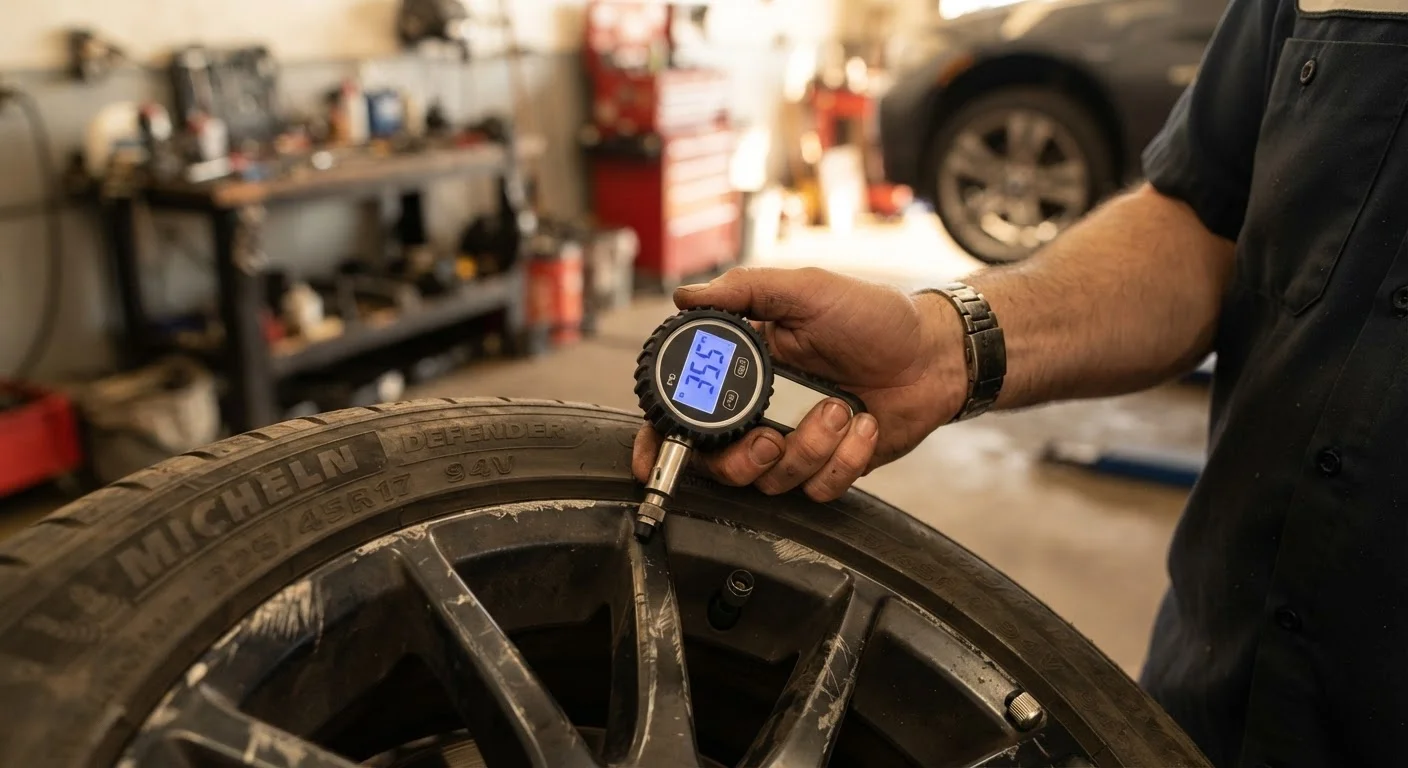
A basic dial or digital gauge costs a few dollars and is accurate enough for routine use. Tyre Pressure Monitoring System (TPMS) dashboard warnings, required on US vehicles since 2008, are a safety net, not a maintenance substitute — they only trigger when pressure drops roughly 25% below the specification. By that point, measurable fuel efficiency loss and wear have already occurred.
Tyre pressure is a simple check that rewards consistent attention. Drivers new to taking ownership of their vehicle's maintenance will find it covered in our roundup of what new car owners often get wrong in the first year.