

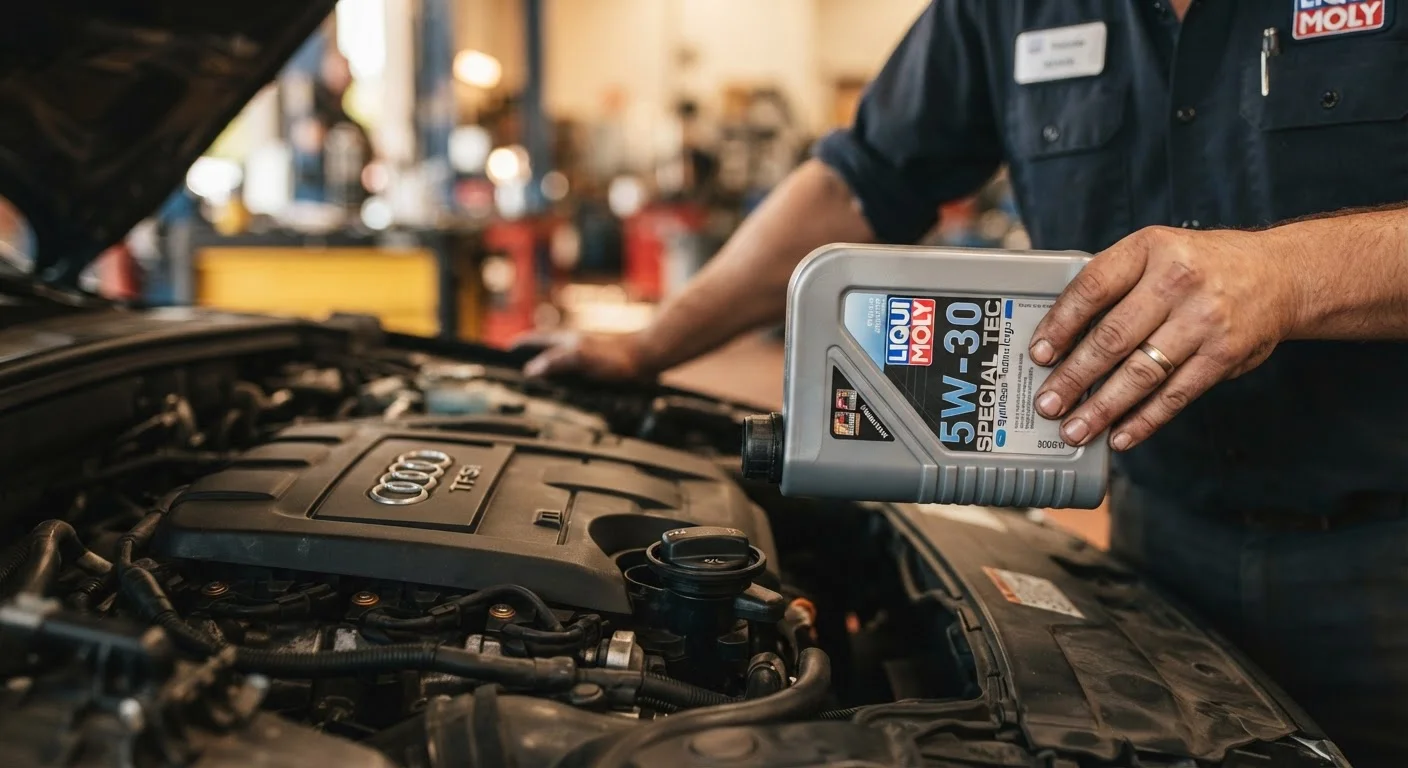
Key Takeaways
- Engine oil lubricates, cools, and cleans internal engine components simultaneously.
- Viscosity grades like 5W-30 describe how oil flows at cold starts and operating temperature.
- Your owner's manual specifies the exact oil grade your engine is designed to use.
- Synthetic oil generally offers better performance in extreme temperatures and longer change intervals.
- Checking oil level monthly takes under two minutes and can prevent serious engine damage.
Start here
What Engine Oil Actually Does
Next
Decoding Viscosity Grades
Then
Synthetic vs. Conventional Oil
Apply it
How to Find the Right Oil for Your Car
Stay on top of it
When and How to Check Your Oil Level
What Engine Oil Actually Does
Engine oil performs four overlapping jobs inside your engine: it lubricates metal surfaces to reduce friction, carries heat away from components that coolant can't reach, suspends contaminants and carries them to the oil filter, and provides a thin protective film that prevents metal-to-metal contact during cold starts.
Without adequate oil, engine components grind against each other within seconds. The resulting heat and metal wear can cause irreversible damage — the kind that often means a full engine replacement. Staying on top of your oil is one of the most cost-effective things you can do as a car owner. Our guide to routine maintenance milestones covers where oil changes fit alongside other service intervals.
Viscosity
A measure of how thick or thin a fluid is and how easily it flows. In motor oil, higher viscosity means thicker oil that flows more slowly.
SAE Grade
A standardized number assigned by the Society of Automotive Engineers that describes an oil's viscosity at cold and operating temperatures (e.g., 5W-30).
Synthetic Oil
Motor oil that is chemically engineered rather than simply refined from crude oil, offering more uniform molecular structure and consistent performance across temperature extremes.
API Service Category
A certification from the American Petroleum Institute confirming that a motor oil meets minimum performance standards for a given engine type and model year range.
Multi-grade Oil
An oil formulated to flow appropriately across a range of temperatures — both at cold start and at full operating temperature — using a two-number grade like 5W-30.
Dipstick
A long metal rod inserted into the engine that lets you measure the current oil level by reading where the oil film sits between two marked points.
Decoding Viscosity Grades
The number sequence on every oil bottle — such as 5W-30 or 10W-40 — is a viscosity grade set by the Society of Automotive Engineers (SAE). Viscosity describes how easily a fluid flows; thicker oil flows more slowly, thinner oil more freely.
The number before the W (which stands for winter) rates cold-temperature flow. A lower number here — like 0W or 5W — means the oil flows more readily during a cold start, reducing wear during those critical first seconds of engine operation. The number after the W rates viscosity at normal operating temperature, roughly 212°F (100°C). A higher number indicates a thicker film that maintains better pressure under heat and load.
Most modern passenger vehicles call for a multi-grade oil such as 5W-30 or 0W-20 because these grades perform acceptably across a wide temperature range. Single-grade oils are largely limited to small engines and older vehicles.
Use the Owner's Manual, Not the Shelf Label
Marketing language on oil bottles can make it tempting to choose the 'most protective' formula available. Stick to the grade your manufacturer specifies — an oil engineered for a different viscosity range won't serve your engine better, regardless of other claims on the label.
Synthetic vs. Conventional Oil
Conventional motor oil is refined directly from crude oil and contains natural molecular variations. Synthetic oil is engineered in a lab to produce a more uniform molecular structure, which translates into more consistent behavior at temperature extremes and under sustained stress.
Synthetic oil typically resists breakdown longer, flows better at very low temperatures, and maintains its protective film under high heat — making it well-suited to turbocharged engines, vehicles operated in extreme climates, or cars that frequently sit for extended periods. Conventional oil remains a perfectly adequate choice for many everyday driving situations when used at the manufacturer's recommended interval.
For a deeper look at how the two types compare under real-world conditions, see our article on synthetic vs. conventional motor oil.
How to Find the Right Oil for Your Car
Your vehicle's owner's manual is the single most reliable source for oil specification. It will list the required SAE viscosity grade and may also specify an API (American Petroleum Institute) service category or an OEM-specific approval code. Using an oil that meets these standards is more important than choosing any particular brand.
The oil filler cap under the hood sometimes shows the recommended grade as a quick reference. If you've misplaced your manual, most automaker websites provide digital copies searchable by VIN or model year.
OEM Approvals vs. API Categories
Some manufacturers — particularly European automakers — specify proprietary oil standards (such as VW 504.00 or BMW Longlife-04) that go beyond standard API categories. If your vehicle has an OEM-specific requirement listed in the manual, look for oils that explicitly carry that approval, not just the general API rating.
If you're not sure whether a widely circulated maintenance rule actually applies to your car, our piece on car maintenance myths can help you separate fact from outdated habit.
When and How to Check Your Oil Level
Checking your oil level takes less than two minutes and should be part of a simple monthly routine. Park on level ground, wait until the engine is cold or has been off for at least five minutes, then pull the dipstick, wipe it clean, reinsert it fully, and withdraw it again. The oil film should fall between the two marks on the dipstick — typically labeled MIN and MAX or represented by hatching.
If the level is low, add small amounts of the correct grade and recheck before adding more. Overfilling can be just as problematic as running low, potentially aerating the oil and reducing its protective effectiveness.
Pay attention to the oil's appearance as well. If it looks milky or foamy, that can indicate coolant contamination — a condition that warrants prompt inspection by a qualified mechanic. For a broader walkthrough of under-hood fluid checks, see fluid checks you can do in under ten minutes.
Your Vehicle Owner's Manual
The definitive source for your car's required oil grade, change interval, and any OEM-specific approvals. Digital versions are usually available through your automaker's website using your VIN.
API Engine Oil Guide
The American Petroleum Institute publishes educational resources explaining oil service categories and how to read certification markings — useful for understanding what API ratings on labels actually mean.