
Solo Travel vs. Group Tours: Matching the Format to How You Actually Travel

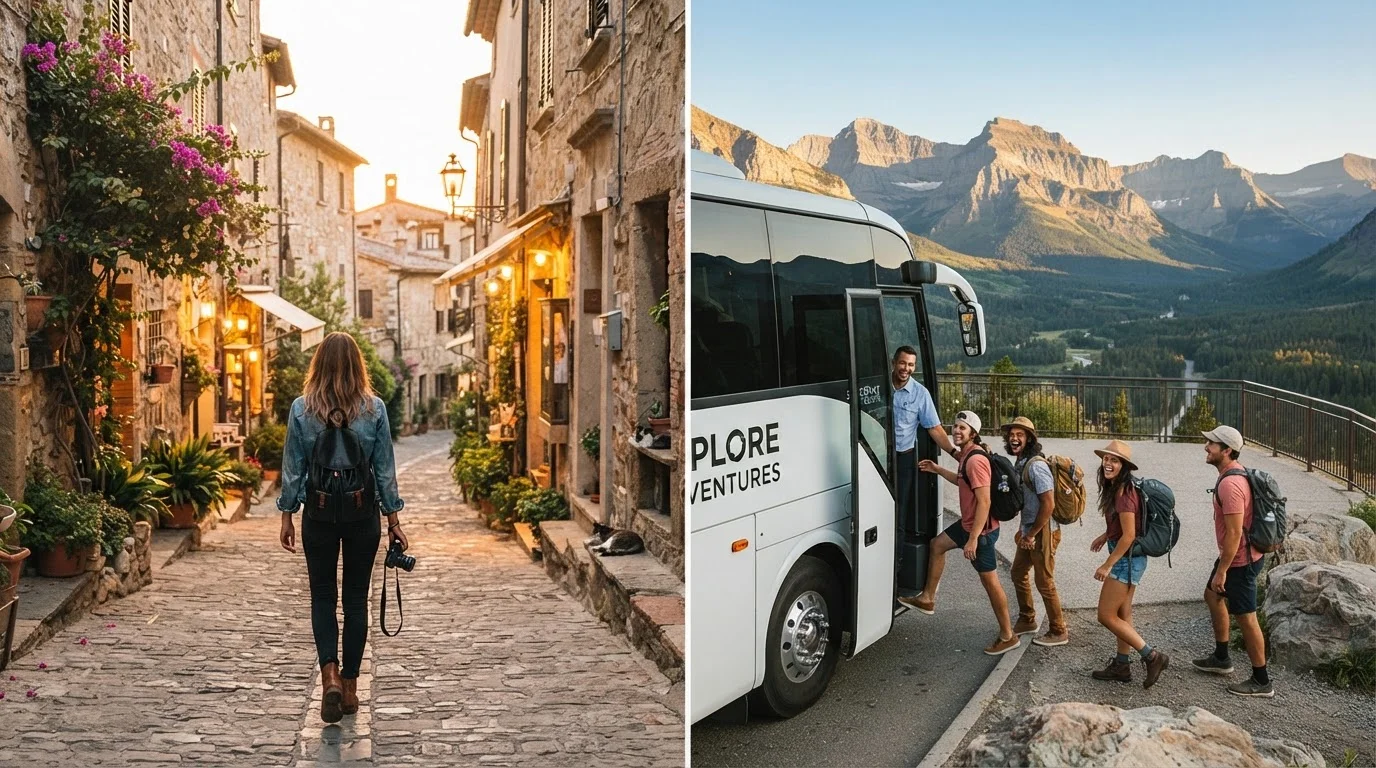
Key Takeaways
- Solo travel offers maximum flexibility but demands more personal planning effort and self-reliance.
- Group tours reduce logistical burden significantly, especially in complex or unfamiliar destinations.
- Cost comparisons between the two formats depend heavily on destination, trip length, and travel style.
- Solo travel can feel isolating; group tours can feel constraining — knowing your own preferences matters most.
- Many experienced travelers combine both formats across different trips rather than committing to one approach.
Option A
Solo Independent Travel
The self-directed, flexible approach to exploring on your own terms.
Best for: Travelers who prioritize personal freedom, spontaneous decisions, and deeply individualized itineraries.
Option B
Organised Group Tours
The structured, socially rich alternative with logistics handled for you.
Best for: Travelers who value convenience, built-in companionship, and expert-guided access to destinations.
If you want complete control over your daily schedule
Solo Independent Travel
No fixed itinerary means you can linger, pivot, or skip anything that doesn't interest you — every day is shaped around your own pace and curiosity.
If you're visiting a destination where logistics are genuinely complex
Organised Group Tours
Tours handle permits, transport, and local access arrangements that can be time-consuming or difficult to arrange independently, particularly in remote or heavily regulated sites.
If you're a first-time solo international traveler feeling uncertain
Organised Group Tours
The structured environment, group safety in numbers, and on-the-ground guide support can meaningfully reduce the stress of navigating an unfamiliar country alone for the first time.
If social connection is a primary goal of your trip
Organised Group Tours
Tours naturally create shared experiences with fellow travelers, making it far easier to form connections than solo travel, where social interaction requires more proactive effort.
If you want to immerse yourself in local culture at your own depth
Solo Independent Travel
Without a group schedule, you can spend more time in neighborhoods, markets, or conversations that a structured tour typically moves past too quickly.
The Real Question Isn't Which Is Better
Picture yourself standing at a train station in a country where you don't speak the language. The departure board is all unfamiliar characters, the platform numbering makes no intuitive sense, and your phone signal is unreliable. Now ask yourself honestly: does that scenario feel like a thrilling puzzle or an exhausting problem?
Your answer tells you more about which travel format suits you than any ranked list could. Solo independent travel and organised group tours aren't in competition — they're tools, and the right one depends on the trip you're actually planning and the traveler you genuinely are. For a fuller picture of what goes into planning any trip well, it helps to understand how your chosen format shapes every decision that follows.
That said, the trade-offs are real and worth mapping clearly before you commit time, money, and expectations to either path.
What Solo Travel Actually Demands
Independent travel hands you complete authorship over the experience. You choose when to move, where to eat, how long to stay, and when to abandon a plan that isn't working. That freedom is genuinely valuable — but it rests on a foundation of pre-trip research, logistical self-sufficiency, and a comfortable tolerance for uncertainty.
The planning load is the most underestimated part. Before departure, solo travelers typically handle accommodation, transportation between destinations, visa research, and activity bookings entirely on their own. The process of building an itinerary from scratch can be deeply satisfying, but it's also time-intensive, and mistakes have no group buffer to absorb them.
Safety considerations carry more personal weight when traveling alone, particularly in unfamiliar regions. First-time solo international travelers often underestimate how much mental energy goes into staying aware, navigating communication barriers, and managing unexpected disruptions without a travel companion to share the problem-solving.
~70%
Solo travelers who are women
Multiple travel industry surveys have consistently found that women represent the majority of solo travelers globally, challenging the assumption that solo travel skews male.
2–4 weeks
Typical solo trip planning lead time
Travel research suggests independent travelers often underestimate planning time; complex international itineraries commonly require several months of preparation for visas, permits, and accommodation.
None of this makes solo travel inadvisable — far from it. It just means the rewards (genuine autonomy, self-paced discovery, deeply personal memories) come with commensurate responsibility.
What Group Tours Actually Deliver
The strongest case for an organised tour isn't convenience for its own sake — it's access. Many of the world's most compelling travel experiences sit behind logistical barriers that are genuinely difficult to navigate independently: remote trekking permits allocated months in advance, sites that require licensed local guides by law, or regions where transport infrastructure is unreliable for travelers unfamiliar with the terrain.
A well-run tour collapses that complexity. Transport, accommodation, entry arrangements, and knowledgeable commentary are bundled into a single purchase. For travelers whose time or planning bandwidth is limited, or who are visiting a destination for the first time, that compression has real practical value.
| Criterion | Solo Independent Travel | Organised Group Tours |
|---|---|---|
| Schedule flexibility | Fully self-directed | Fixed group itinerary |
| Planning responsibility | Entirely on traveler | Handled by operator |
| Social interaction | Requires proactive effort | Built in naturally |
| Access to restricted sites | Often harder to arrange | Frequently included |
| Cost predictability | Variable; depends on choices | Fixed upfront; fewer surprises |
| Cultural immersion depth | Higher potential at own pace | Constrained by group schedule |
| Suitable for first-time visitors | Steeper learning curve | Generally more supportive |
The trade-off is schedule rigidity. You move when the group moves, you stay where the itinerary places you, and the depth of any individual experience is capped by the group's pace. For travelers who compare flexible versus fixed itinerary styles, tours sit firmly at the structured end of that spectrum — which suits some trips and some travelers very well, and others not at all.
Group dynamics are also worth considering honestly. Sharing a tour with strangers creates the potential for easy social connection, which many solo travelers find genuinely valuable. It also means your daily experience is influenced by others' preferences and pace, which requires a level of adaptability that not every traveler naturally has.
Small-Group Tours: A Middle Ground
Not all group tours involve large coaches and rigid mass itineraries. Small-group tours — typically capped at 12 to 16 participants — often offer a more flexible pace, more authentic local access, and a more socially comfortable dynamic than large-group alternatives. If the size of a typical tour feels off-putting, it's worth exploring small-group options as a genuine middle ground between fully independent travel and traditional organised tours.
Matching the Format to the Trip, Not Just the Person
Experienced travelers often don't think of themselves as exclusively solo travelers or group tour participants — they pick the format based on what a specific trip calls for. A two-week independent exploration of cities in Europe might suit the same person who joins an organised hiking expedition in a remote mountain region, because the logistical contexts are completely different.
A few questions worth asking before you book:
- How complex is the destination's logistics? Destinations with limited English-language infrastructure, regulated access to key sites, or challenging transport options often favor tours for first-time visitors.
- How much planning time and interest do you have? Building a detailed itinerary from scratch is a skill and a time investment; it should feel like preparation, not a chore.
- What's the primary goal of the trip? Relaxation, adventure, cultural immersion, and social connection each point toward different formats.
- Are entry or visa requirements a complicating factor? Some tour operators assist with documentation logistics, though travelers should always verify visa requirements through official sources independently.
There's also a meaningful difference between solo travel and solo-booked travel. You can design a deeply independent trip and still join locally guided day activities, cooking classes, or small-group excursions at specific points. The formats aren't mutually exclusive at the activity level — only at the structural planning level.
For a closer look at how logistics shift when traveling with others rather than alone, the comparison in solo travel versus group travel planning differences explores those specific considerations in more depth.