

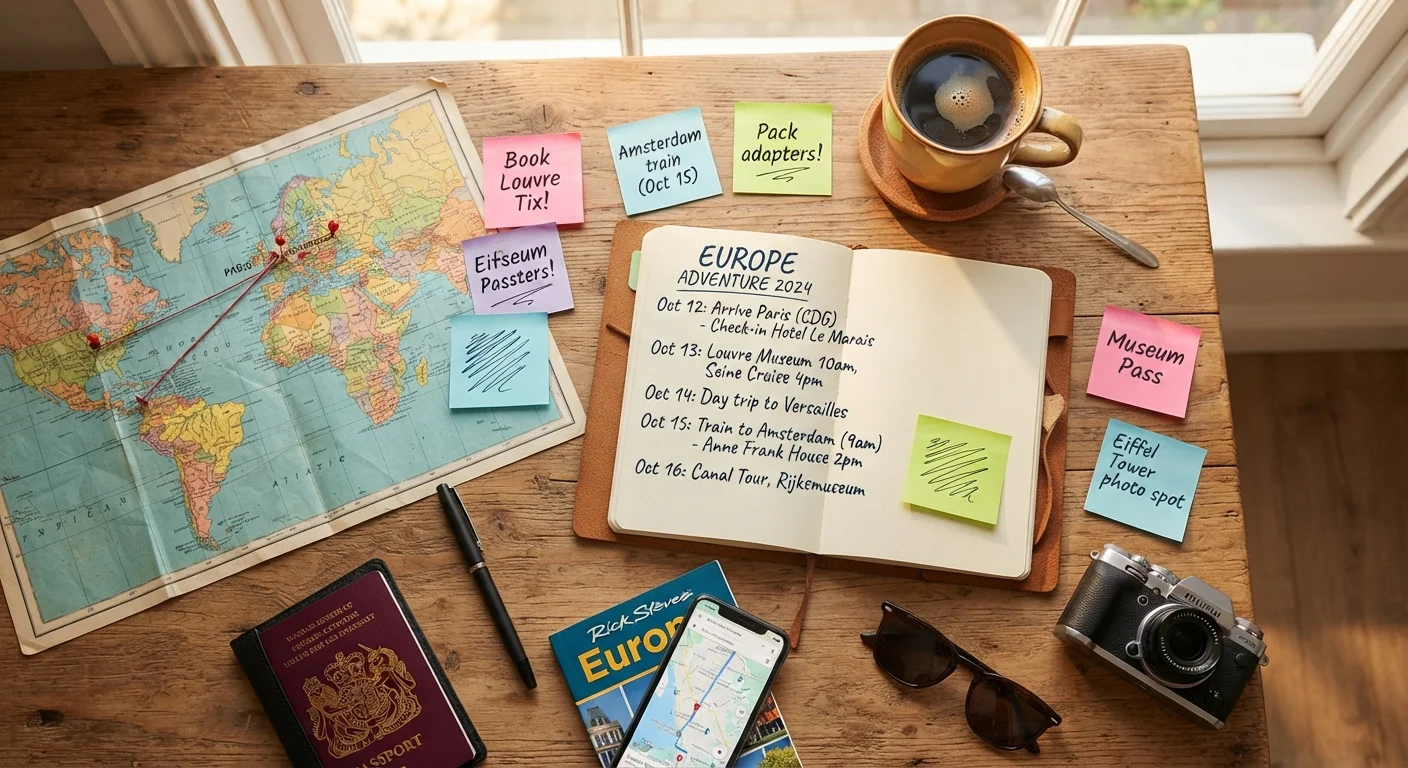
Key Takeaways
- Start with your travel dates and a realistic daily capacity before adding any activities.
- Anchor each day around one major experience, then fill gaps with lower-effort options.
- Build buffer time into every day — transit and fatigue routinely consume more time than expected.
- A good itinerary reflects your personal travel style, not a checklist of tourist obligations.
- Verify visa, entry, and booking requirements through official government and provider sources before finalizing plans.
What you will need
Why Most Itineraries Fall Apart
There's a particular kind of travel disappointment that comes not from bad luck, but from a plan that was never quite realistic. You've seen it: the beautifully formatted day-by-day schedule that assumes a 9 a.m. museum opens on time, a midday walk takes exactly twenty minutes, and dinner reservations are somehow secured at the most popular restaurant in town. By noon on day two, the whole thing has unraveled.
The problem isn't planning itself — it's planning without a clear sense of capacity, geography, or personal travel style. A good itinerary isn't a to-do list; it's a framework that holds up when reality pushes back. Understanding the anatomy of a well-planned trip can help you see why structure and flexibility need to coexist from the start.
Match Your Planning Style to Your Travel Personality
Some travelers thrive with hour-by-hour schedules; others do better with a loose list of intentions. Neither approach is wrong — the key is choosing a method that reduces stress rather than creating it. Our guide to flexible vs. fixed itineraries can help you decide which style fits your trip.
The steps below walk you through building an itinerary from nothing — one that's grounded in how travel actually works rather than how we wish it did.
Digital or Paper Calendar
Lay out your travel dates visually so you can see exactly how many full days you have at each destination.
Mapping App or Printed Map
Group activities by geographic proximity to minimize unnecessary transit time between locations.
Spreadsheet or Planning Doc
Track bookings, opening hours, reservation requirements, and notes in one organized place.
Official Government Travel Advisory Page
Verify current entry requirements, safety advisories, and any travel restrictions for your destination.
Putting It All Together
Once you've worked through the steps above, you'll have a draft that balances intention with room to breathe. Read back through it with fresh eyes and ask: does each day have a clear purpose? Is there enough time between commitments? Do the logistics actually connect?
Overscheduling Is the Most Common Itinerary Mistake
Fitting twelve activities into a single day might look satisfying on paper, but it reliably leads to exhaustion and disappointment. If you find your day has more than three substantial activities, consider spreading them across two days. For a deeper look at why this matters, see why overpacking an itinerary ruins the trip.
If you're traveling with a group, share the draft early and invite honest feedback — the gap between what one person imagines and what another expects can be significant. For a closer look at how solo and group planning differ in practice, see solo travel vs. group travel planning differences that matter.
Always Verify Entry Requirements Independently
Visa rules, vaccination requirements, and border conditions change frequently and vary by nationality. Never rely solely on travel blogs or third-party aggregators for this information. Check the official embassy or consulate website for your destination country and your own government's travel advisory page before finalizing any itinerary.
A finished itinerary is a living document. Build in the assumption that something will shift — a venue will be closed, a delay will ripple through the afternoon, or you'll simply want to stay somewhere longer than planned. The travelers who enjoy their trips most tend to be the ones who planned carefully enough to feel prepared, then held those plans loosely enough to follow the day wherever it led.
For a broader reference on every phase of the planning process, the complete traveler's reference covers research, booking, packing, and on-the-road preparation in one place.