
Lump-Sum Investing vs. Spreading Contributions Over Time: A Straightforward Comparison

Key Takeaways
- Lump-sum investing puts all available capital to work immediately, maximizing time in the market.
- Spreading contributions over time (dollar-cost averaging) reduces the risk of investing at a market peak.
- Historical data generally favors lump-sum investing for long-term returns, but the margin varies.
- Psychological comfort and personal cash flow matter as much as theoretical outcomes.
- Neither approach guarantees results — both carry market risk and require a long-term perspective.
Our Verdict
Lump-sum investing has historically produced stronger average returns when a windfall is available, but dollar-cost averaging is a sound, lower-stress alternative for those who are risk-averse or working with irregular income. The best approach is the one you can commit to consistently without abandoning during market downturns.
| Best for | Recommended |
|---|---|
| Those with a windfall and a long investment horizon | Lump-Sum Investing |
| Those who are anxious about market timing or volatility | Spreading Contributions Over Time |
| Those with steady income and no large cash reserves | Spreading Contributions Over Time |
| Those who can tolerate short-term losses for long-term growth potential | Lump-Sum Investing |
What the Two Approaches Actually Mean
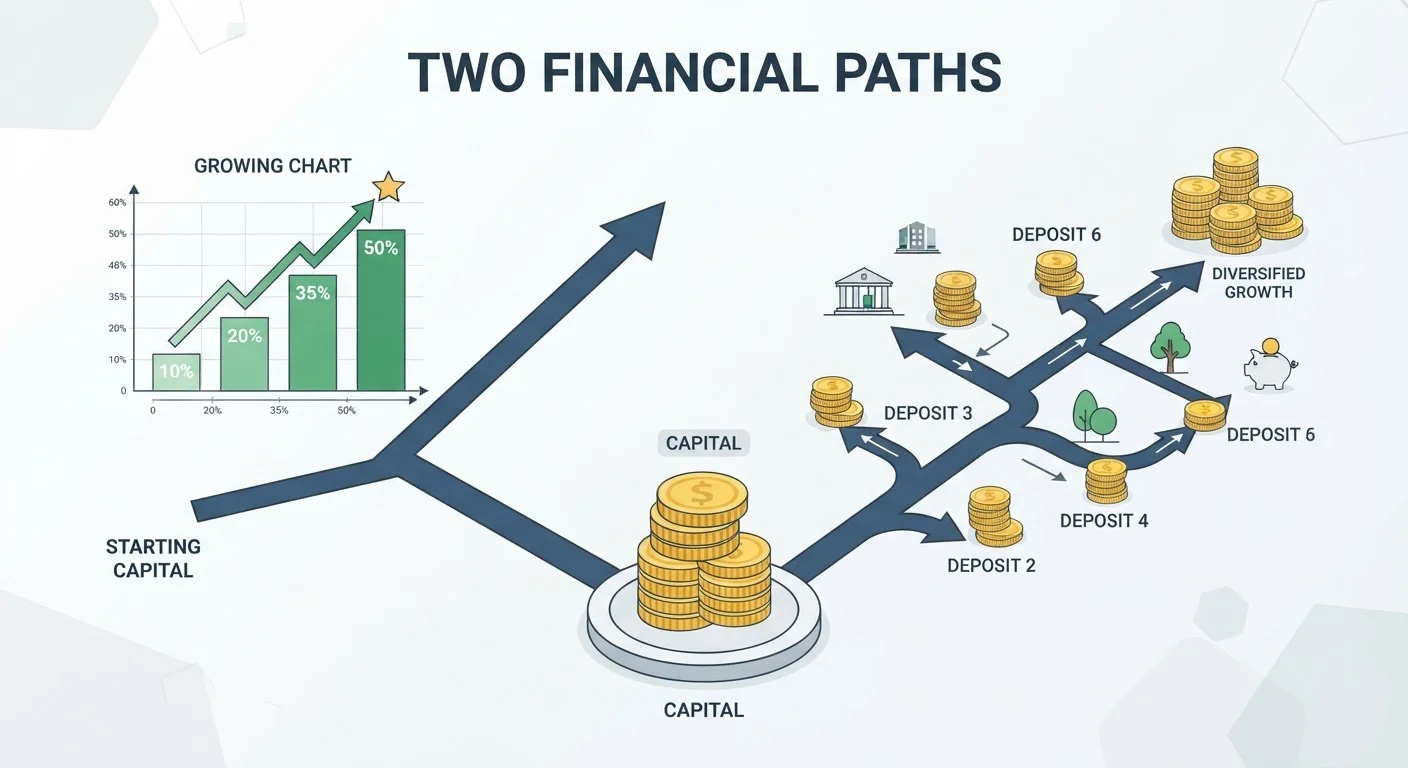
When you have a sum of money to invest — whether from a bonus, inheritance, savings buildup, or the sale of an asset — you face a practical question: invest it all immediately, or deploy it gradually over weeks or months?
Lump-sum investing means committing the full amount to the market at once. Your capital starts working immediately, exposed to both the upside and downside of market movements from day one.
Spreading contributions over time — often called dollar-cost averaging (DCA) — means dividing the total into equal installments and investing on a fixed schedule, regardless of market conditions. You might invest one-sixth of a sum each month for six months, for example. See our full guide to dollar-cost averaging for a deeper look at how the strategy works in practice.
These approaches differ primarily in timing risk — the danger of putting money in at a market high — and in how quickly your capital is exposed to potential growth.
| Lump-Sum Investing | Spreading Contributions Over Time | |
|---|---|---|
| Capital deployment | All at once | Divided over set intervals |
| Time in the market | Maximum from day one | Increases gradually |
| Timing risk | Higher — full exposure immediately | Lower — purchases spread across prices |
| Historical average performance | Stronger in ~2/3 of scenarios | Stronger when markets decline after investing |
| Emotional difficulty | Higher — large single commitment | Lower — smaller, regular commitments |
| Best suited for | Windfalls, high risk tolerance | Regular income, risk-averse investors |
What the Evidence Shows
Several studies, including well-cited research from Vanguard, have found that lump-sum investing outperforms dollar-cost averaging roughly two-thirds of the time when measured over a 12-month deployment window, across U.S., U.K., and Australian markets. The logic is straightforward: markets tend to rise over long periods, so money invested earlier has more time to participate in that growth.
~68%
Of the time lump-sum beats DCA
Vanguard research across multiple markets found lump-sum investing outperformed a 12-month DCA schedule approximately two-thirds of the time.
~32%
Of the time DCA wins
Dollar-cost averaging outperformed lump-sum investing in roughly one-third of periods studied, typically when markets fell shortly after a lump-sum entry.
That said, the one-third of cases where DCA wins are meaningful — they typically occur during periods of market decline shortly after a lump-sum investment. For someone who invests a large amount just before a significant downturn, the emotional and financial impact can be severe enough to prompt panic selling, which would lock in losses and erase the theoretical advantage.
It's also worth noting that most everyday investors don't face a genuine lump-sum decision. They invest regularly from a paycheck — which is, by definition, a form of dollar-cost averaging. The lump-sum question mainly arises when a windfall appears.
The Role of Risk Tolerance and Behavior
Investment strategy isn't just arithmetic. Behavioral factors — how you respond to losses, how much volatility you can tolerate without making impulsive decisions — are central to what approach will actually serve you well.
If investing a large sum all at once means you'll check your portfolio obsessively and sell during the first correction, the theoretical return advantage of lump-sum investing is negated. Spreading contributions out can function as an emotional buffer, making it easier to stay invested through volatility because you know you have more installments coming regardless of short-term price swings.
A Middle Path Worth Considering
If you're torn between the two approaches, consider a compromise: invest a portion as a lump sum immediately and spread the remainder over three to six months. This strategy captures some of the time-in-market benefit while softening the psychological impact of going all-in at once. There's no formula that eliminates market risk — the goal is to find an approach you'll actually stick with.
Conversely, if you have a high risk tolerance, a long time horizon, and the discipline to ignore short-term market noise, deploying capital quickly gets it working sooner. If you're building your first portfolio and aren't sure where to begin structuring your investments, the framework for beginner investors walks through the key decisions involved.
Practical Considerations Before You Decide
Before choosing an approach, work through a few practical questions:
- Do you have an emergency fund? Never invest money you might need within the next one to three years. Investing should use funds you can genuinely leave untouched. Good spending tracking habits can help you confirm how much is truly available to invest.
- What is your investment timeline? Lump-sum investing's edge is strongest over longer periods (10+ years). Shorter horizons reduce the advantage and increase exposure to sequence risk.
- What are you investing in? Lump-sum investing into a broadly diversified, low-cost portfolio is very different from concentrating capital in a single asset class. Understanding diversification is essential regardless of which deployment strategy you choose.
- How would you handle a 20–30% drop right after investing? Be honest. If that scenario would prompt you to sell, a phased approach may reduce that risk.
There is no universally correct answer. Both strategies, when used with appropriate diversification and a long-term mindset, represent disciplined approaches to building wealth. Consulting a licensed financial adviser can help you match the right approach to your specific situation.
This article is for general informational and educational purposes only and does not constitute personalized financial, investment, or tax advice. Past market performance does not guarantee future results. Please consult a qualified financial professional before making investment decisions.