

Key Takeaways
- You don't need a large sum of money to start investing — consistency matters more than size.
- Defining your goals and time horizon before choosing investments leads to better decisions.
- Diversification across asset types helps manage risk in a starter portfolio.
- Tax-advantaged accounts like 401(k)s and IRAs are often the best starting point for new investors.
- Low-cost index funds are a straightforward vehicle for broad market exposure.
- Regularly reviewing — but not obsessively tinkering with — your portfolio keeps it aligned with your goals.
What you will need
What You Need Before You Start
Before choosing a single investment, two financial foundations should be in place. First, high-interest debt — particularly credit card balances — should ideally be paid down, since carrying a 20% interest rate while earning a lower expected market return works against you mathematically. Second, an emergency fund covering three to six months of essential expenses provides a buffer so you're never forced to sell investments at an inopportune time.
If those boxes are checked, you're ready to build. And if you're still working on budgeting basics, that's a natural place to start before directing money toward investing.
What you will need
It's also worth challenging any hesitations you might carry into this process. Many people delay investing based on beliefs that don't hold up to scrutiny — common investing myths like needing a lot of money upfront or thinking markets are equivalent to gambling are worth examining before you begin.
This article is for general informational and educational purposes only and is not personalized financial, investment, or tax advice. Consult a licensed financial professional before making decisions specific to your situation.
The Step-by-Step Framework
Building a starter portfolio doesn't require predicting market movements or picking winning stocks. It requires making a handful of deliberate decisions in the right sequence. Follow the steps below to create a foundation that is diversified, cost-conscious, and aligned with your personal goals.
Define Your Goal and Time Horizon
Every portfolio decision flows from purpose. Are you investing for retirement 30 years away, a home purchase in 7 years, or a child's education in 15? A longer time horizon generally allows you to tolerate more short-term volatility in exchange for potentially higher long-term growth. A shorter horizon calls for more conservative, stable investments to protect what you accumulate.
Write your goal down clearly: the target amount, the target date, and why it matters. This single step prevents reactive decision-making later.
Assess Your Risk Tolerance
Risk tolerance is how much short-term loss you can emotionally and financially absorb without abandoning your plan. It's shaped by both your circumstances (income stability, dependents, time horizon) and your psychology. A simple self-test: if your portfolio dropped 20% in a year, would you hold steady, add more, or sell? Honest answers here guide how much you allocate to higher-risk assets like stocks versus lower-risk ones like bonds.
Most brokerage platforms and retirement account providers offer free risk-assessment questionnaires that can help you calibrate this.
Choose the Right Account Type First
Before selecting investments, select the right account shell. For most beginners in the U.S., tax-advantaged accounts come first:
- 401(k) or 403(b): If your employer offers a match, contribute at least enough to capture the full match — that's an immediate guaranteed return on your contribution.
- IRA (Traditional or Roth): Individual Retirement Accounts offer tax benefits and flexibility. A Roth IRA grows tax-free if you meet eligibility requirements; a Traditional IRA may offer an upfront tax deduction.
- Taxable brokerage account: Once tax-advantaged space is used, a standard brokerage account offers flexibility without contribution limits.
Account type affects your tax situation meaningfully — consult a tax professional if you're unsure which is best for your circumstances.
Select a Simple Asset Allocation
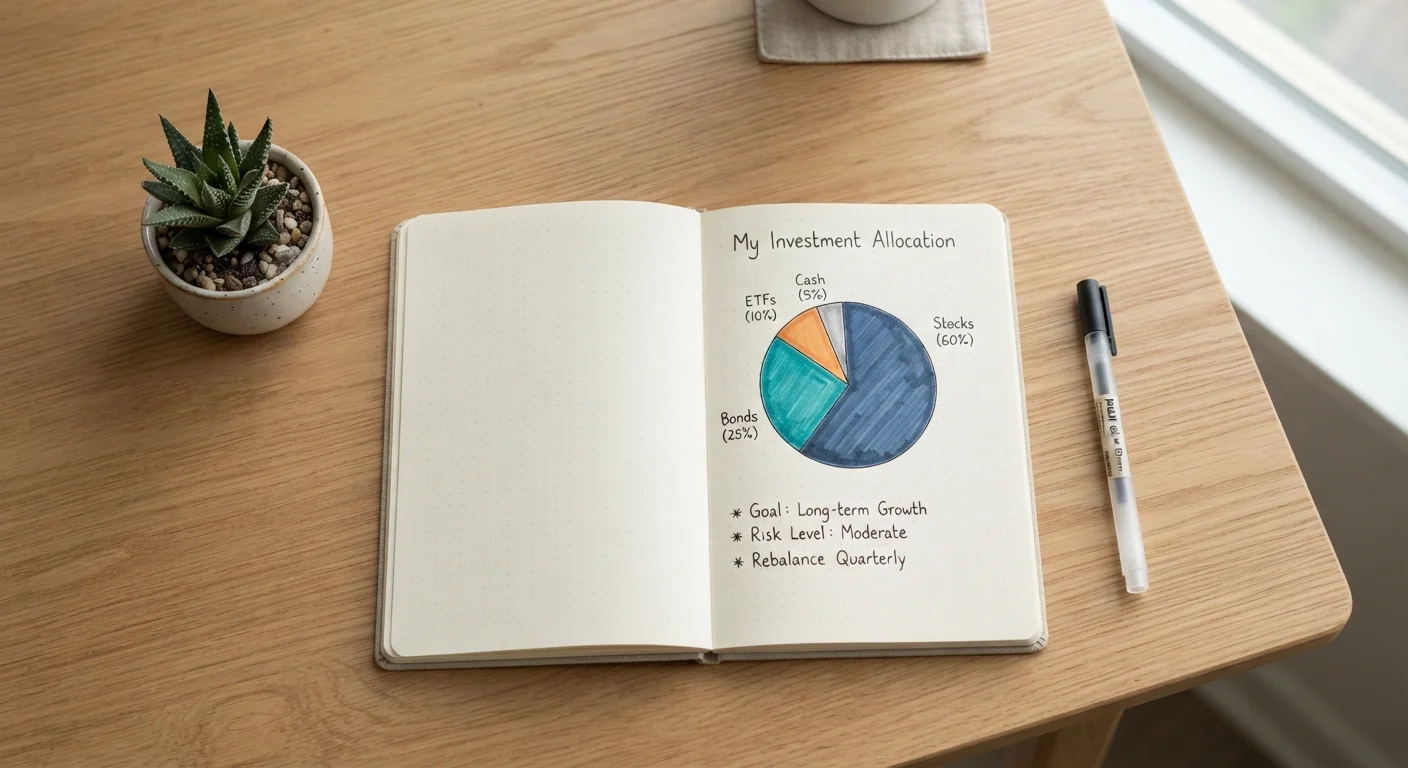
Asset allocation — how you divide money among stocks, bonds, and cash equivalents — is the primary driver of both risk and return. A common starting framework for long-horizon investors is a higher proportion in stocks (for growth) and a smaller portion in bonds (for stability). More conservative investors or those with shorter horizons typically shift the balance toward bonds.
A simple two- or three-fund portfolio using broad index funds can cover domestic stocks, international stocks, and bonds — providing global diversification with minimal complexity.
Pick Low-Cost, Diversified Funds
For most beginners, broad market index funds or exchange-traded funds (ETFs) are a practical starting point. They track a market index (such as the total U.S. stock market or a broad bond market), provide instant diversification across hundreds or thousands of securities, and typically carry low expense ratios — the annual fee charged by the fund.
When comparing funds, the expense ratio is the most controllable variable you have. Even a difference of 0.5% annually compounds significantly over decades. Look for funds with expense ratios well below 1%.
Automate Contributions and Review Periodically
Set up automatic contributions on a regular schedule — monthly or with each paycheck. This approach, sometimes called dollar-cost averaging, means you buy more shares when prices are lower and fewer when prices are higher, without requiring you to time the market.
Schedule a portfolio review every six to twelve months. Check whether your allocation has drifted from your target due to market movement, and rebalance by redirecting contributions or selling a small portion of overweighted assets into underweighted ones.
Keep It Simple at the Start
A two- or three-fund portfolio covering total U.S. stock market, international stocks, and bonds is a widely cited starting structure for beginners. Complexity can always be added later — but simplicity is easier to maintain and less prone to emotional tinkering. Focus on getting started rather than finding the 'perfect' allocation.
Once your portfolio is established, consider how you'll handle future contributions. Whether you invest periodically or deploy a lump sum has meaningful trade-offs — the comparison between lump-sum and spread-out investing is worth reading before you decide on a contribution rhythm.
Staying the Course
Once your portfolio is set up, the most common mistake is over-managing it. Markets fluctuate daily, and reacting emotionally to short-term swings is one of the leading causes of poor long-term results. Set a calendar reminder — quarterly or semi-annually — to review your allocation and rebalance if one asset class has drifted significantly from your target.
Avoid Reacting to Market Noise
Checking your portfolio daily or making changes based on news headlines is one of the most reliably harmful investing behaviors. Studies consistently show that frequent trading tends to reduce returns for individual investors. Build your plan, automate contributions, and check in infrequently on a fixed schedule.
Investing is not a one-time event but an ongoing habit. Starting with a simple, low-cost structure gives you room to learn, adjust, and grow your knowledge without exposing yourself to unnecessary complexity or cost. The framework outlined here is a starting point, not a permanent prescription — your needs will evolve, and periodic check-ins with a qualified financial adviser can help you adapt accordingly.