

Key Takeaways
- No single tracking method works for everyone — the best one is the one you'll actually stick with.
- Manual methods (pen and paper, spreadsheets) build stronger awareness; automated apps trade depth for convenience.
- Each approach has a real time and effort cost — underestimating it is the most common reason tracking fails.
- Tracking is most valuable when it feeds into a broader budget plan, not as a standalone exercise.
Our Verdict
All three major tracking approaches — pen and paper, spreadsheets, and apps — can be effective. The meaningful differences come down to how much friction you're willing to accept and how closely you want to engage with your numbers. Manual methods tend to sharpen awareness; digital tools scale up convenience. Neither is inherently superior.
| Best for | Recommended |
|---|---|
| Those who want maximum spending awareness with minimal tech | Pen and paper |
| Those comfortable with data and wanting full customisation | Spreadsheet |
| Those with complex finances who want automation and summaries | Budgeting app |
| Those building their first budget from scratch | Any method paired with a structured budget plan |
Why Tracking Matters Before You Budget
Most people underestimate how much they spend in specific categories — not because they're careless, but because small, scattered purchases don't feel significant in the moment. Tracking spending creates a factual record that replaces guesswork with data.
This matters most when you're setting up a monthly budget from scratch — you can't assign money to categories sensibly without knowing your actual spending patterns first. Even a few weeks of honest tracking can reveal surprises.
The method you choose shapes how much you engage with that data. A passive approach (an app that logs everything automatically) requires less effort but may also produce less insight. A hands-on approach demands more time but tends to make patterns harder to ignore.
Start With One Month of Observation
Before choosing a tracking method, try any approach for a single month without changing your spending habits. The goal is to observe, not to optimize. Once you have real data, you can make informed decisions about where to adjust — rather than guessing at a budget built on assumptions.
The Three Main Tracking Approaches
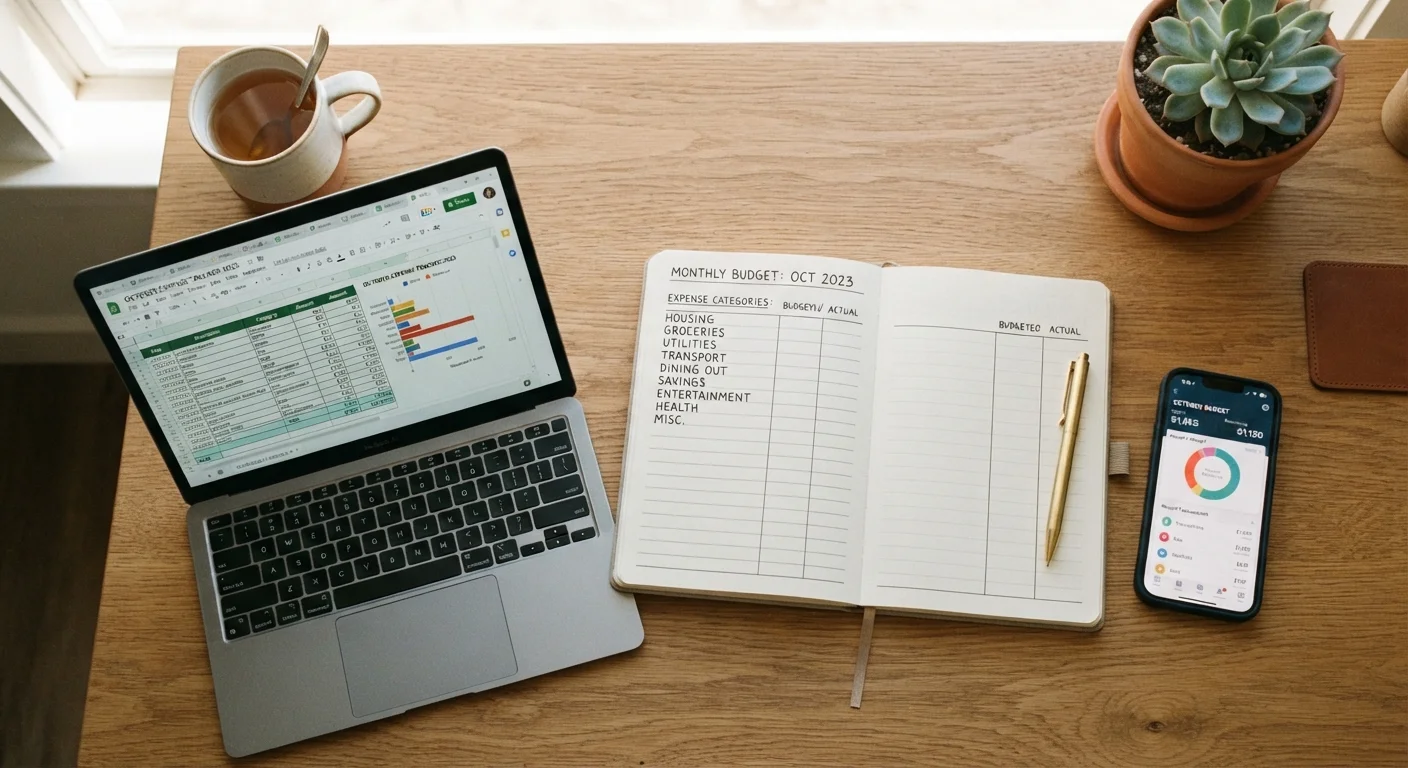
Most spending trackers fall into one of three categories. Each works on a different premise.
Pen and Paper
Writing down every transaction by hand is the most deliberate method. It asks you to engage with each purchase consciously — which is its primary benefit. There's nothing to set up, no software to learn, and no privacy trade-off involved. The cost is time and consistency: if you miss a day, the record has gaps.
Spreadsheets
A spreadsheet (whether in a desktop program or a cloud-based tool) sits between fully manual and fully automated. You enter transactions yourself, but the spreadsheet handles calculations, totals, and category summaries automatically. This approach rewards people who enjoy seeing their data laid out precisely and want to customize how categories are defined. It can also scale up — linking to your monthly budget review process is straightforward when your data is already organized in rows and columns.
Budgeting and Tracking Apps
Apps typically connect to bank and card accounts and import transactions automatically, categorizing them by merchant type. The main appeal is speed — your week's spending can appear in a dashboard without manual input. The trade-offs include account-linking requirements, potential data-sharing policies, and the risk that automatic categorization is wrong often enough to require regular correction. For a balanced look at what these tools genuinely deliver, see what budget apps can and cannot do for you.
| Pen and Paper | Spreadsheet | Budgeting App | |
|---|---|---|---|
| Setup effort | Minimal — just start writing | Low to moderate — build or adapt a template | Moderate — account linking and configuration |
| Ongoing time cost | High — manual entry every transaction | Medium — batch entry a few times a week | Low — mostly automated with check-ins |
| Customisation | Fully flexible | Highly customisable | Limited to app's category structure |
| Spending awareness generated | Very high — deliberate engagement | High — hands-on data entry | Lower — passive import reduces attention |
| Privacy considerations | None — fully offline | Depends on tool used | Data shared with third-party service |
| Best for | Simplicity and mindfulness | Data-oriented planners | Busy users wanting automation |
What Each Method Demands in Practice
Choosing a method based on its upside alone is a common mistake. The more useful question is: what does this method require from me on an ordinary Tuesday?
- Pen and paper requires you to carry something to write in, log purchases at or near the time they happen, and total up categories manually at the end of a period. Forgetting receipts or purchases after the fact is a real gap risk.
- Spreadsheets require a regular sit-down — many people batch their entries two or three times a week. If you let it lapse for two weeks, catching up becomes a chore that many people simply skip.
- Apps require the initial setup (linking accounts, reviewing category mappings) and then periodic check-ins to catch miscategorized transactions and review summaries. The effort is front-loaded, but ongoing attention is still needed.
Whichever method you pick, habits that keep a budget working long-term matter more than the tool itself. A perfect spreadsheet you open twice a year tells you less than a rough notebook you update daily.
Don't Confuse Tracking With Budgeting
Recording where money went is not the same as deciding in advance where it should go. Tracking alone is a diagnostic tool — it tells you what happened, not what should happen next. Without connecting your records to a plan, you risk spending weeks logging data that never changes your behavior.
Mixing Methods and Starting Simple
There's no rule requiring you to commit to one method permanently. Some people begin with pen and paper for a month simply to get a raw picture of spending, then migrate that information into a spreadsheet for easier totaling. Others use an app for card spending and a notebook for cash — though if you're trying to reduce paper clutter, a fully digital approach may suit you better.
What matters most at the start is that the method creates no enough friction that you abandon it in week two. If you're new to tracking, start with the simplest version of whichever approach sounds most natural. Sophistication can come later once the habit is established.
Tracking spending is ultimately preparation for better decisions — about saving, allocating income, or exploring saving and investing once your outgoings are genuinely understood. The record itself isn't the goal; acting on what it shows you is.
This article is for general informational purposes only and does not constitute personalised financial advice. For guidance specific to your circumstances, consider speaking with a qualified financial professional.