

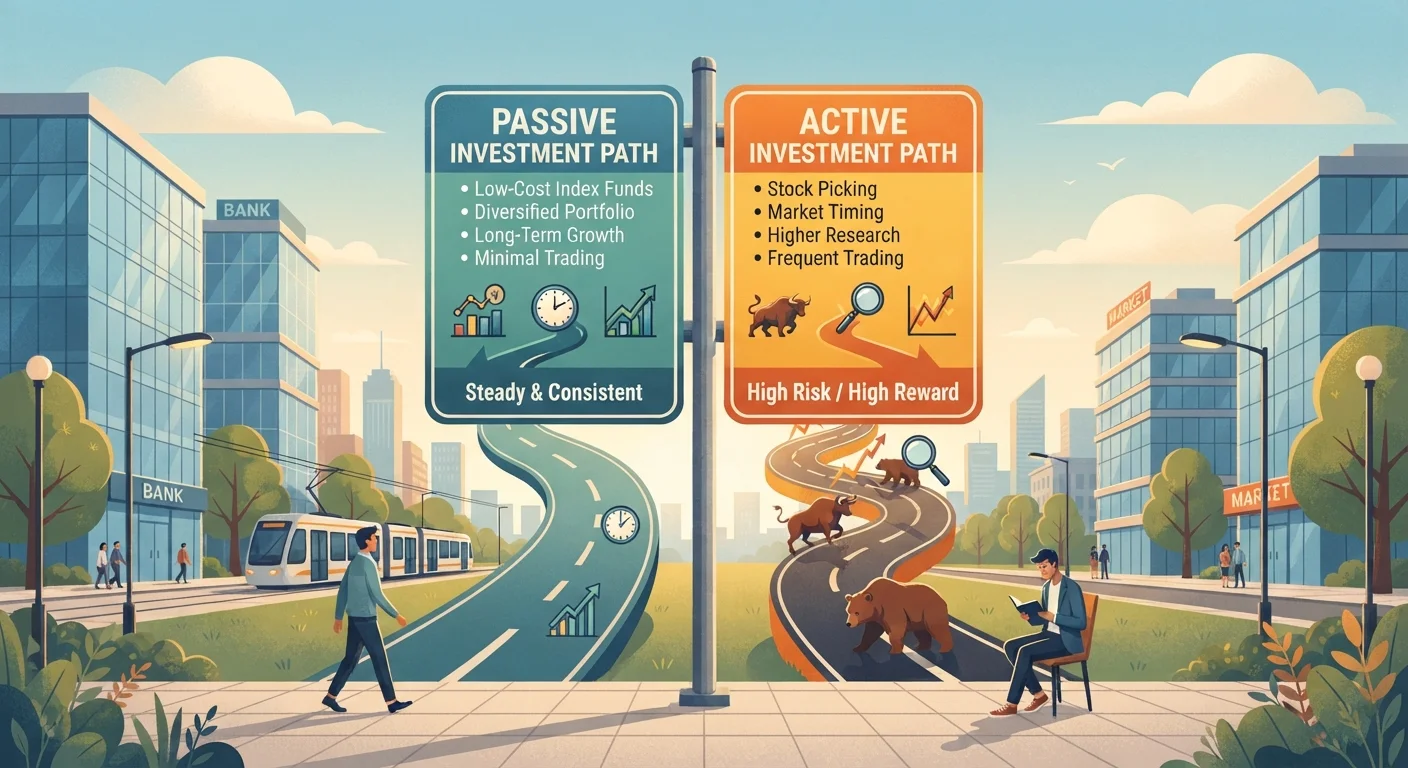
Key Takeaways
- Index funds track a market benchmark passively, while actively managed funds rely on managers picking securities.
- Lower fees in index funds compound significantly over long investment horizons.
- Research consistently shows most active funds underperform their benchmark index after fees over time.
- Active funds can offer potential advantages in certain niche markets or during specific conditions.
- Neither approach is universally superior — your goals, timeline, and costs should drive the decision.
- Consulting a licensed financial adviser is recommended before making fund selection decisions.
Option A
Index Funds
The low-cost, market-mirroring approach.
Best for: Investors seeking broad market exposure, minimal fees, and a hands-off long-term strategy.
Option B
Actively Managed Funds
The research-driven, manager-led strategy.
Best for: Investors who want a professional manager making targeted decisions in pursuit of above-market returns.
If you want low-cost, long-term exposure to broad market growth
Index Funds
Index funds minimize fees and have historically kept pace with market benchmarks, making them a straightforward choice for long-horizon investors.
If you're investing in a less-efficient or specialized market segment
Actively Managed Funds
Active managers may have a better opportunity to add value in markets where information is less uniformly priced, such as small-cap or emerging market segments.
If keeping costs as low as possible is your primary concern
Index Funds
Index fund expense ratios are typically a fraction of those charged by active funds, and that cost difference compounds meaningfully over decades.
If you want a fund that can shift holdings defensively during downturns
Actively Managed Funds
An active manager has the discretion to adjust holdings in response to market conditions, whereas index funds must remain fully invested per their benchmark.
How Each Fund Type Actually Works
Understanding the mechanics of each approach is the foundation of this comparison. Before exploring performance data, it helps to grasp what these two fund types are actually doing with your money.
An index fund is designed to mirror the holdings of a specific market index — such as the S&P 500 or the total U.S. bond market. The fund buys the same securities in roughly the same proportions as the index it tracks. There's no manager making judgment calls about which stocks to hold or avoid. The strategy is inherently passive: the fund changes only when the underlying index changes.
An actively managed fund, by contrast, employs a portfolio manager (or a team) whose job is to research, select, and rebalance securities with the goal of outperforming a benchmark index. These managers analyze company financials, economic conditions, and market trends to make buy and sell decisions. The value proposition is professional expertise — the idea that skilled stock-picking can beat what the market delivers on its own.
If you're newer to the fundamentals of investing, our plain-language guide to asset classes explains how the underlying securities — stocks, bonds, and cash — behave before you layer fund strategy on top.
| Criterion | Index Funds | Actively Managed Funds |
|---|---|---|
| Management style | Passive — tracks a benchmark | Active — manager selects securities |
| Typical expense ratio | Often below 0.10% | Commonly 0.50%–1.00%+ |
| Long-term benchmark performance | Matches index (minus small fee) | Majority underperform after fees |
| Trading frequency | Low — changes only with index | Higher — manager-driven decisions |
| Tax efficiency | Generally higher | Lower due to more trading activity |
| Potential for above-market return | Not by design | Yes, though not commonly achieved |
What the Evidence Shows on Performance and Cost
Cost is where the two approaches diverge most sharply — and where the evidence is clearest. Index funds typically carry expense ratios (the annual fee as a percentage of assets) well below 0.10% for many broad-market options. Actively managed funds commonly charge between 0.50% and 1.00% or more annually.
That gap may look modest, but compounded over 20 or 30 years, it represents a meaningful drag on net returns. A 0.80% annual fee difference on a $50,000 portfolio, over 30 years at identical gross returns, results in thousands of dollars less at retirement — entirely due to costs, not market behavior.
~85%
Active large-cap funds underperforming S&P 500
Per S&P Dow Jones Indices' SPIVA reports, roughly 85% of actively managed U.S. large-cap funds have underperformed the S&P 500 over 15-year periods in recent scorecards.
0.03%–0.10%
Typical index fund expense ratio range
Many broad-market index funds charge annual fees in this range, compared to 0.50%–1.00%+ for most actively managed equity funds.
30 years
Time horizon where cost drag is most consequential
Financial planning research consistently shows that fee differences compound most significantly over multi-decade holding periods, directly reducing final portfolio value.
On the performance question, S&P Dow Jones Indices publishes a widely cited annual report — the SPIVA (S&P Indices Versus Active) scorecard — tracking how many active funds outperform their benchmark index. Consistently across time periods and fund categories, the majority of actively managed funds underperform their index benchmark over 10- and 15-year periods, after accounting for fees. That pattern holds across equity and fixed-income categories alike.
This doesn't mean active funds never outperform — some do, and some managers have sustained strong records. But identifying in advance which active funds will outperform is genuinely difficult, even for professional investors. Past outperformance is not a reliable predictor of future results.
Active Funds Can Have a Role in Certain Markets
The case for active management is strongest in markets considered less "efficient" — where not all information is quickly reflected in prices. Certain small-cap, international, or alternative asset categories may offer more opportunity for skilled managers to add value. In highly efficient markets like large-cap U.S. equities, the evidence supporting active outperformance is weaker. This distinction matters when evaluating where active strategies might fit within a diversified portfolio.
Making a Thoughtful Choice for Your Situation
The evidence tilts toward index funds for most long-term, cost-conscious investors. But the right structure for your portfolio depends on more than just a performance scorecard.
Consider your investment horizon, your comfort with hands-off management, and whether you're investing in a tax-advantaged account (like a 401(k) or IRA) where active trading may create fewer immediate tax implications. Also examine whether you have exposure to niche markets — such as certain international regions — where active management may have a stronger historical case.
Some investors choose a blended approach: using low-cost index funds for core market exposure and selectively incorporating active strategies for specialized allocations. Neither path is inherently right or wrong.
If you're building your first portfolio and unsure where these fund types fit, the framework for beginner investors walks through practical starting points. And if you're working through assumptions about how investing works, common investing myths addresses several beliefs that aren't well-supported by the evidence.
This article is for general educational purposes only and does not constitute personalized investment, tax, or financial advice. Consult a qualified, licensed financial adviser before making decisions based on your individual circumstances. Past performance does not guarantee future results.