

Key Takeaways
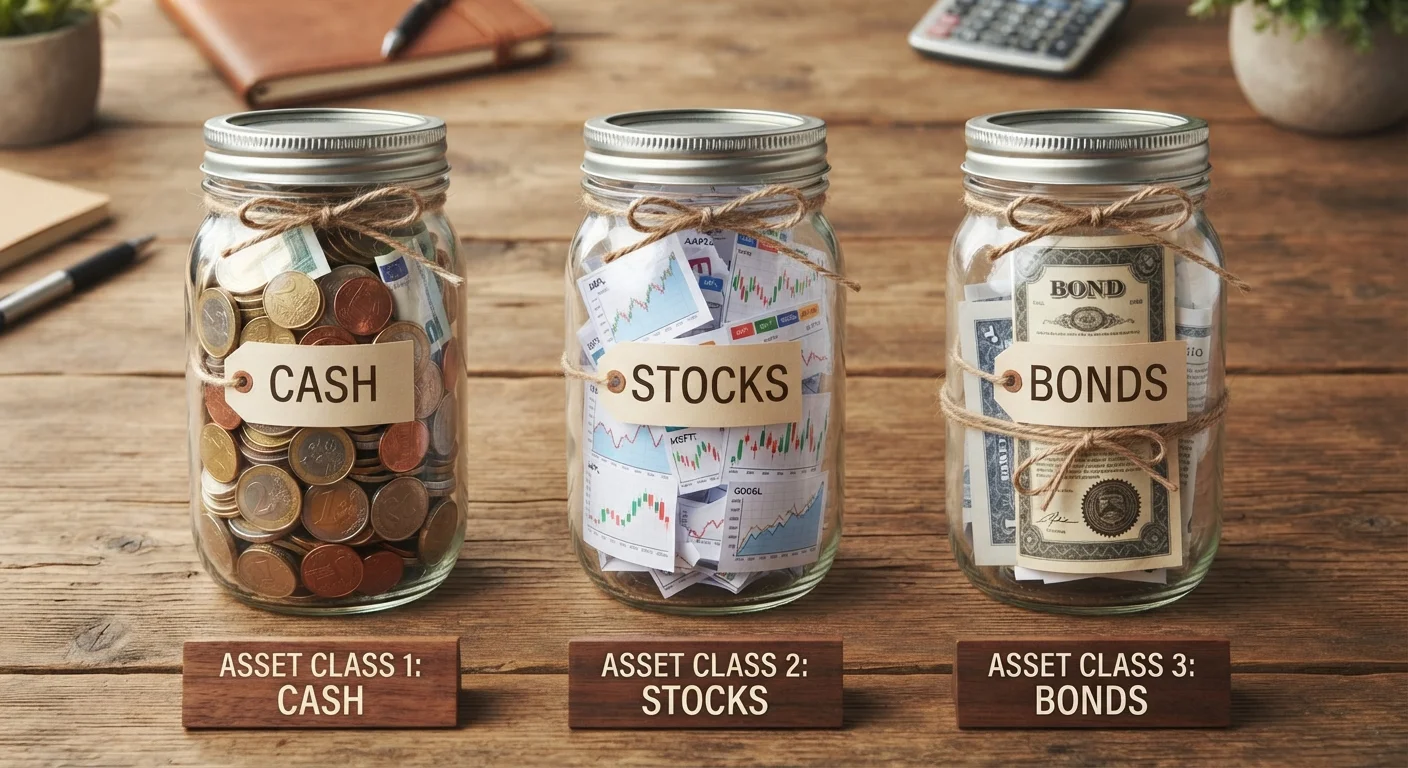
- Stocks, bonds, and cash are the three foundational asset classes every investor should understand.
- Stocks carry more risk but historically offer higher long-term growth potential than other asset classes.
- Bonds provide more stable income with lower risk, acting as a buffer against stock market volatility.
- Cash and cash equivalents prioritize safety and easy access over growth.
- Mixing asset classes — known as diversification — helps manage overall portfolio risk.
- The right balance depends on your goals, timeline, and personal risk tolerance.
Start here
What Is an Asset Class?
Next
Stocks: Ownership with Growth Potential
Then
Bonds: Lending Your Money for a Return
Also cover
Cash and Cash Equivalents: Safety and Liquidity
Put it together
How Asset Classes Work Together in a Portfolio
What Is an Asset Class?
An asset class is a group of investments that share similar characteristics, behave in comparable ways under market conditions, and are governed by the same general rules and regulations. Think of asset classes as broad categories — not individual investments, but families of them.
Why does this matter? Because different asset classes tend to rise and fall at different times and for different reasons. When one category struggles, another may hold steady or even gain. That non-identical behavior is what makes combining them useful.
Before diving into specific asset classes, it helps to have a solid financial foundation. If you haven't yet tackled budgeting, see our plain-language budgeting guide — getting your cash flow organized is typically the right step before investing.
Asset class
A broad category of investments that share similar characteristics and tend to behave similarly in the market — for example, all stocks or all bonds.
Equity (stock)
A share of ownership in a company. Owning equity means you benefit if the company grows in value, but you also bear the risk if it declines.
Bond
A loan you make to a government or company. The borrower agrees to pay you regular interest and return your original amount on a set future date.
Liquidity
How quickly and easily an investment can be converted to usable cash without significantly affecting its value. A savings account is highly liquid; real estate is not.
Diversification
Spreading money across different types of investments so that poor performance in one area doesn't devastate your entire portfolio.
Risk tolerance
Your personal ability and willingness to endure drops in investment value without panicking or making harmful financial decisions.
Inflation
The gradual increase in prices over time. Inflation reduces the purchasing power of cash that isn't growing at least as fast as prices rise.
Coupon rate
The annual interest rate paid by a bond issuer to the bondholder, expressed as a percentage of the bond's face value.
Stocks: Ownership with Growth Potential
When you buy a stock (also called a share or equity), you are purchasing a small ownership stake in a company. If the company grows and becomes more profitable, the value of your shares can increase. Some companies also pay dividends — regular cash distributions to shareholders.
Stocks have historically delivered higher long-term returns than bonds or cash. However, that growth potential comes with greater volatility. Stock prices can drop sharply during economic downturns, market crises, or when a specific company performs poorly. An investor can lose a significant portion of their value in a short period.
Time Horizon Matters With Stocks
The longer you plan to hold stocks, the more time you have to recover from short-term market drops. Historically, broad stock market indices have recovered from downturns over multi-year periods — but past performance does not guarantee future results. Always consider your timeline before allocating heavily to stocks.
Stocks are generally considered better suited for long-term goals — retirement savings, for example — where you have enough time to ride out market downturns. For money you'll need within one to three years, the volatility of stocks can be a real problem.
To learn about common missteps new stock investors make, see our guide on what new investors get wrong about the stock market.
Bonds: Lending Your Money for a Return
A bond is essentially a loan you make to a government or corporation. In exchange, the issuer promises to pay you regular interest payments (called the coupon) and to return your original amount (the principal) at a set date in the future (the maturity date).
Bonds are generally less volatile than stocks. They provide more predictable income, which is why they are often used to add stability to a portfolio. However, bonds are not risk-free:
- Interest rate risk: When interest rates rise, existing bond prices typically fall. If you sell before maturity, you could receive less than you paid.
- Credit risk: The issuer might struggle to make payments. U.S. government bonds carry very low credit risk; some corporate bonds carry considerably more.
Government vs. Corporate Bonds
U.S. government bonds (like Treasury bills, notes, and bonds) are backed by the federal government and generally considered among the safest investments available. Corporate bonds are issued by companies and typically offer higher interest rates to compensate for higher credit risk. The difference in yield between a safe bond and a riskier one is often called the 'spread.'
Understanding how debt and lending works more broadly can strengthen your grasp of bonds. Our Debt & Credit hub covers loans, interest, and credit concepts in plain language.
Cash and Cash Equivalents: Safety and Liquidity
Cash and cash equivalents include physical currency, checking and savings accounts, money market accounts, and short-term Treasury bills. They share two key traits: they are very safe (low risk of losing value) and highly liquid — meaning you can access the money quickly.
The trade-off is growth. Cash typically earns very little, and over time, inflation — the gradual rise in prices — can erode purchasing power. A dollar saved today may buy less in ten years if it has only earned minimal interest.
Cash serves important roles: it is the right home for an emergency fund, for short-term savings goals, and as a stabilizing portion of a larger portfolio. It simply shouldn't be the only tool in your financial toolkit if you're saving for decades-away goals.
Inflation Can Quietly Erode Cash Savings
Keeping all your long-term savings in cash or a low-interest account means inflation may gradually reduce what your money can buy. While cash is essential for safety and short-term needs, relying on it exclusively for goals that are many years away often means falling behind the cost of living. A financial adviser can help you find the right balance.
How Asset Classes Work Together in a Portfolio
Asset allocation is the practice of dividing your investments across different asset classes. The goal is to build a mix that reflects your financial goals, the amount of time you have to invest (your time horizon), and how much volatility you can tolerate emotionally and financially (your risk tolerance).
A common example: a younger investor saving for retirement decades away might hold a higher proportion of stocks for growth, balanced by some bonds and a small cash reserve. An investor nearing retirement might shift toward more bonds and cash to protect accumulated savings from sudden market drops.
Diversification — spreading investments across multiple asset classes (and within each class) — does not guarantee profit or prevent all loss, but it can reduce the impact of any single investment performing poorly.
Ready to take the next step? Our beginner's guide to building a starter portfolio walks through the practical decisions involved. You may also want to explore tax-advantaged retirement accounts — the containers these asset classes often live in.
This article is for general informational and educational purposes only and does not constitute personalized financial, investment, tax, or legal advice. Consult a qualified financial professional before making decisions about your own investments or financial situation.