

Key Takeaways
- Budget apps automate transaction tracking but cannot make spending decisions for you.
- Most apps require consistent manual oversight to stay accurate and useful.
- Privacy trade-offs are real: many apps request access to your bank account credentials.
- Apps work best as a tool to support a financial plan, not replace one.
- Free app versions often limit features or monetize your data in other ways.
Automates transaction tracking across accounts
Connecting to bank and credit card feeds means spending is logged without manual entry, lowering the barrier to consistent financial monitoring.
Visualizes spending patterns clearly
Charts and category summaries make it easier to spot where money is going at a glance — a form of financial awareness that raw statements rarely provide.
Sends alerts before limits are exceeded
Many apps notify users when a category is nearing its set limit, offering a real-time nudge before overspending occurs rather than after.
Consolidates accounts in one view
Seeing checking, savings, and credit balances in a single dashboard reduces the effort of piecing together a financial picture from multiple logins.
Supports goal-setting and progress tracking
Built-in savings goals allow users to earmark funds and monitor progress, which can reinforce motivation over time.
Requires active oversight to stay accurate
Automatic categorization frequently misfires, meaning unchecked apps can present a distorted picture of spending that leads to false confidence.
Does not replace financial decision-making
An app records what you spent — it cannot evaluate whether that spending aligns with your values, goals, or circumstances.
Privacy trade-offs with account linking
Granting third-party access to bank credentials or transaction data carries data-security and privacy implications that vary by provider and policy.
Free tiers often monetize user data
Many no-cost budget apps generate revenue through advertising or data sharing arrangements, meaning the product is sustainable in ways users may not initially consider.
Can create passive rather than engaged habits
The ease of automation can lead users to assume the app is 'handling it,' reducing the active engagement that makes budgeting effective.
Our Verdict
Budget apps can meaningfully reduce the friction of tracking spending and spotting patterns — which matters, because awareness is the foundation of any workable budget. However, they are not a substitute for the financial thinking, goal-setting, and behavioral discipline that make budgeting actually work. Used as a tool rather than a solution, they offer genuine value.
Budget apps are most useful for people who already have a basic financial plan and want a low-effort way to monitor progress — not for those hoping an app alone will solve spending problems.
What Budget Apps Actually Do
Budget apps are software tools — available on smartphones and, in many cases, via web browsers — that help users organize income, categorize spending, and monitor financial goals. Most connect directly to bank accounts and credit cards, pulling in transactions automatically. Some use manual entry instead, which requires more effort but raises fewer data-sharing concerns.
Common features include spending category breakdowns, monthly budget limits with alerts, net worth snapshots, and bill reminders. Some apps incorporate goal-tracking — for saving toward a vacation fund or paying down a balance, for example.
It's worth understanding what these tools are at their core: they are data organizers. They make existing financial information easier to see. They do not generate income, negotiate lower rates, or make decisions on your behalf. If you're curious how apps compare to other tracking methods, see our overview of spending tracking approaches for a fuller picture.
The Genuine Advantages
Automates transaction tracking across accounts
Connecting to bank and credit card feeds means spending is logged without manual entry, lowering the barrier to consistent financial monitoring.
Visualizes spending patterns clearly
Charts and category summaries make it easier to spot where money is going at a glance — a form of financial awareness that raw statements rarely provide.
Sends alerts before limits are exceeded
Many apps notify users when a category is nearing its set limit, offering a real-time nudge before overspending occurs rather than after.
Consolidates accounts in one view
Seeing checking, savings, and credit balances in a single dashboard reduces the effort of piecing together a financial picture from multiple logins.
Supports goal-setting and progress tracking
Built-in savings goals allow users to earmark funds and monitor progress, which can reinforce motivation over time.
The strongest case for budget apps is convenience. Manually logging every transaction into a spreadsheet takes time and discipline that many people simply don't sustain. Automation removes much of that friction, making it easier to stay engaged with your finances week to week.
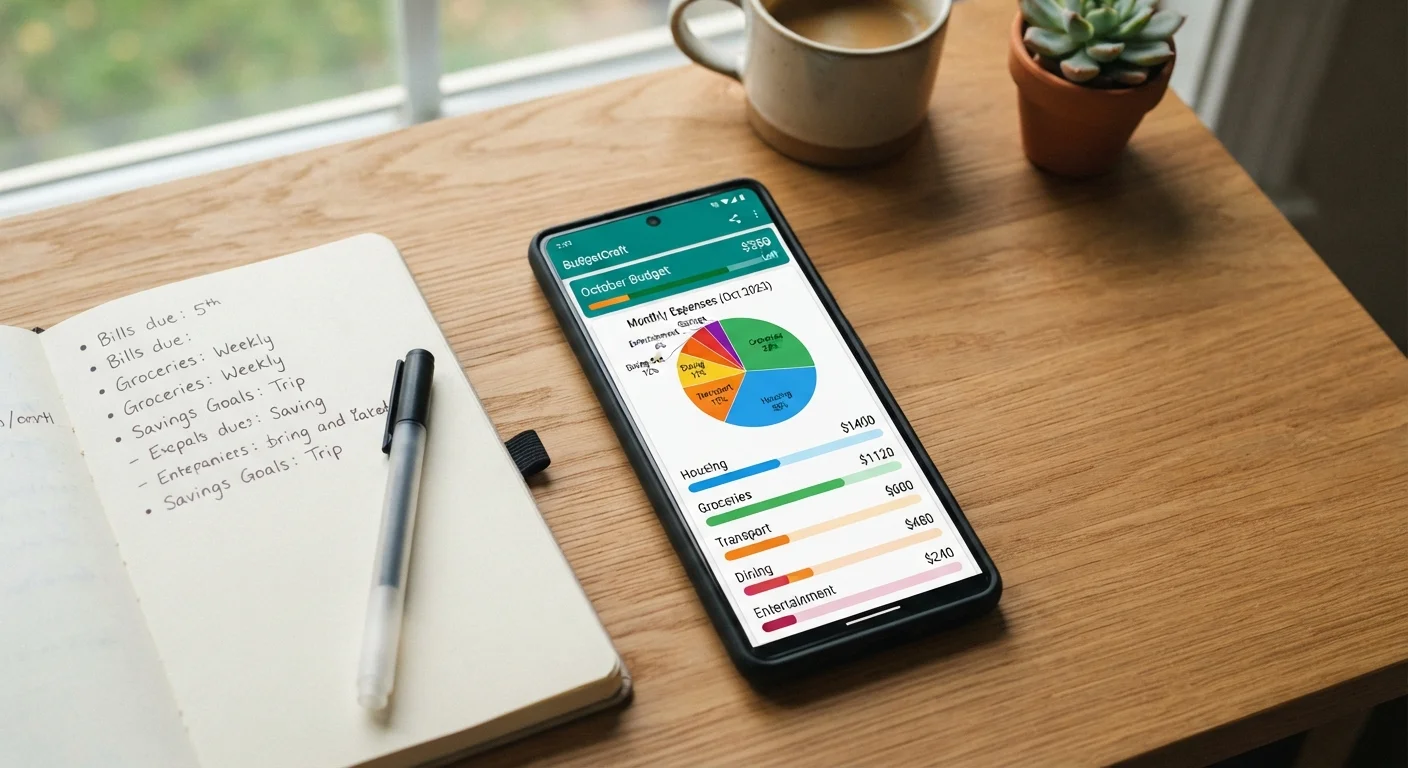
Visual presentation is another real benefit. Seeing that 34% of monthly spending went to dining out — displayed as a chart rather than a column of numbers — can prompt reflection that a raw bank statement doesn't. That kind of awareness is often the first step toward change. If you've been held back by the idea that budgeting is too complicated, our piece on common budgeting misconceptions addresses that directly.
Where They Fall Short
Requires active oversight to stay accurate
Automatic categorization frequently misfires, meaning unchecked apps can present a distorted picture of spending that leads to false confidence.
Does not replace financial decision-making
An app records what you spent — it cannot evaluate whether that spending aligns with your values, goals, or circumstances.
Privacy trade-offs with account linking
Granting third-party access to bank credentials or transaction data carries data-security and privacy implications that vary by provider and policy.
Free tiers often monetize user data
Many no-cost budget apps generate revenue through advertising or data sharing arrangements, meaning the product is sustainable in ways users may not initially consider.
Can create passive rather than engaged habits
The ease of automation can lead users to assume the app is 'handling it,' reducing the active engagement that makes budgeting effective.
Automation creates a false sense of control if users aren't actively reviewing what the app surfaces. An app can categorize a charge — but it can't tell you whether that charge fits your priorities or whether a pattern is heading in the wrong direction. That judgment requires human attention.
Miscategorization is also common. Apps frequently tag spending incorrectly — a grocery store purchase coded as dining, or a medical copay appearing under entertainment. Without regular review, these errors accumulate and distort the picture. This connects to a broader pattern worth understanding: see why budgets often erode mid-month for more on where financial tracking typically breaks down.
Privacy and Data Considerations
A Note on Account Linking and Data Security
When a budget app connects to your bank, it typically uses a third-party data aggregator rather than a direct bank partnership. This means your credentials or a secure token may be held by a company separate from both your bank and the app itself. Most reputable aggregators use read-only access and encrypted storage, but policies vary. Before linking accounts, review the app's privacy policy and check whether your bank offers tokenized (rather than credential-based) connections, which are generally considered more secure.
Many budget apps request read-only access to your financial accounts through third-party aggregators. Before connecting any account, it's reasonable to review the app's privacy policy, understand what data is stored, how long it's retained, and whether it's shared with third parties. Free apps in particular may offset costs through data monetization. This is not a reason to avoid apps categorically — but it is a factor worth weighing consciously.
For readers thinking about the broader question of app accumulation on their devices, our look at the trade-offs of keeping every app you download covers storage, privacy, and performance concerns in more depth.
Using an App as Part of a Broader Plan
A budget app is most effective when it supports an existing financial framework rather than acting as the framework itself. Knowing your monthly take-home, your fixed obligations, and your savings targets before opening an app means you have something concrete to measure against.
Apps pair naturally with structured approaches like zero-based budgeting or envelope-style allocation — methods that define where money should go before it arrives. Our comparison of zero-based budgeting and the envelope method outlines how each works if you want a framework to build on.
Ultimately, the app is the instrument panel — useful for reading conditions, not for steering. The decisions still belong to you.
This article is for general informational purposes only and does not constitute personalized financial advice. For guidance specific to your financial situation, consider consulting a qualified financial professional.