

Key Takeaways
- Zero-based budgeting assigns every dollar of income a specific job, leaving a net balance of zero each month.
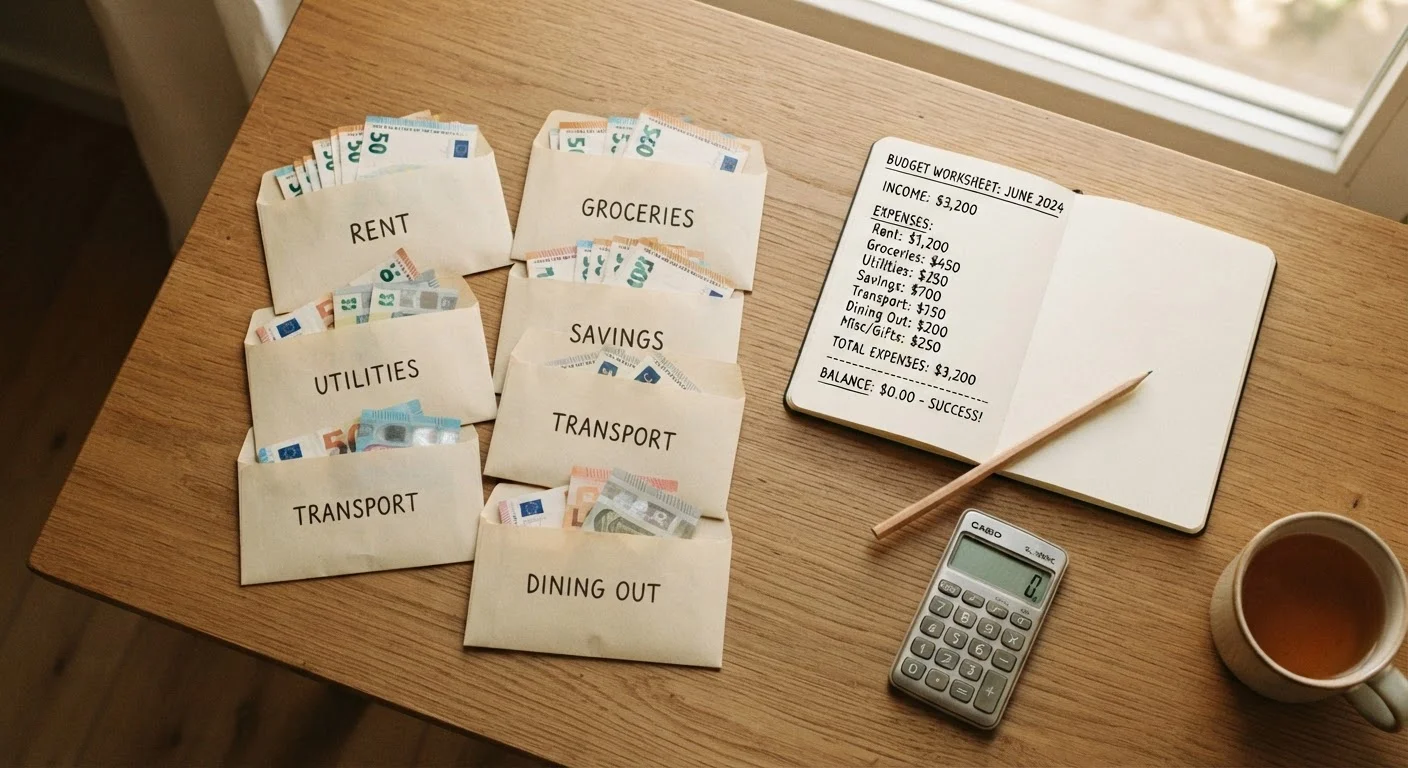
- The envelope method uses physical cash divided into labeled envelopes for each spending category.
- Zero-based budgeting works well with digital payments; the envelope method requires cash-based transactions.
- Both methods demand active, ongoing engagement — they are not set-and-forget systems.
- Your lifestyle, spending habits, and willingness to handle cash largely determine which method fits better.
- Either method can be combined with a broader financial plan once you're comfortable with the basics.
Option A
Zero-Based Budgeting
The comprehensive, intentional allocation method.
Best for: People who want full visibility into every dollar of their income — including digital spenders and those with variable expenses.
Option B
The Envelope Method
The tactile, cash-first spending boundary system.
Best for: People who overspend on specific categories and want a physical, hard-stop mechanism to build spending discipline.
If you primarily pay with cards or bank transfers
Zero-Based Budgeting
Zero-based budgeting works entirely on paper or a spreadsheet, making it fully compatible with digital and electronic spending without requiring cash withdrawals.
If you consistently overspend in specific categories like dining or entertainment
The Envelope Method
A physical envelope creates a hard spending ceiling — once the cash is gone, it's gone. This tangible limit is harder to rationalize around than a digital balance.
If you have irregular or fluctuating monthly income
Zero-Based Budgeting
Zero-based budgeting lets you re-allocate your income fresh each month, adapting easily when the amount changes from paycheck to paycheck.
If you are new to budgeting and want a simple, concrete system to start
The Envelope Method
The envelope method's visual and physical nature makes it intuitive for beginners — you can see exactly what is available in each category at a glance.
What Each Method Actually Is
Both approaches are forms of intentional budgeting — systems that require you to decide in advance how your money will be spent, rather than tracking after the fact. But they work differently in practice.
Zero-based budgeting (ZBB) means that at the start of each budget period (typically a month), you assign every dollar of expected income to a specific category — rent, groceries, savings, debt repayment, and so on — until the total assigned equals your total income. The "zero" refers to the end-of-month balance after all allocations, not an empty bank account. If you earn $3,000 this month, you give every one of those dollars a purpose, leaving nothing unassigned.
The envelope method takes a more tangible approach: you withdraw your spending money as cash and divide it into labeled envelopes — one for groceries, one for dining out, one for gas, and so on. Each envelope holds only what you've budgeted for that category. When an envelope is empty, spending in that category stops until the next budget period. If you're new to the concept of budget categories, the key budgeting terms guide explains the vocabulary clearly.
| Criterion | Zero-Based Budgeting | The Envelope Method |
|---|---|---|
| Core mechanism | Assign every income dollar a category | Divide cash into labeled envelopes |
| Works with digital payments | Yes, fully compatible | Partial — requires workarounds |
| Requires cash withdrawals | No | Yes, essential to the system |
| Setup complexity | Moderate — detailed forecasting needed | Low — straightforward category split |
| Discipline mechanism | Conscious planning and reallocation | Physical scarcity and cash finality |
| Best for irregular income | Yes — re-set amounts each month | Less ideal — cash amounts fixed |
| Mid-month flexibility | Easy — adjust category numbers | Requires physical cash transfers |
How Each Method Creates Discipline
The core mechanism of control differs meaningfully between the two methods.
Zero-based budgeting creates discipline through deliberate planning. Before the month begins, you confront your full financial picture — income, fixed expenses, variable costs, savings goals — and make conscious trade-offs. Overspending in one category requires you to consciously shift money from another, which reinforces awareness. For a guided walkthrough of building this kind of plan, see setting up a monthly budget from scratch.
The envelope method creates discipline through physical scarcity. The psychological impact of handing over cash — and watching an envelope thin out — tends to make spending feel more real than tapping a card. Research in behavioral economics suggests people generally spend less when using cash compared to digital payment methods, though individual results vary.
~1 in 3
U.S. adults with a written monthly budget
Surveys from the National Foundation for Credit Counseling have consistently found that a minority of American adults maintain a formal monthly budget, suggesting significant room for structured methods to help.
12–18%
Typical spending reduction with cash vs. cards
Multiple behavioral studies have found that people tend to spend measurably less when using physical cash compared to card payments, though the effect varies by individual and context.
Neither system is passive. Both require you to check in regularly, and neither will work if you skip the monthly setup. If you've heard otherwise, the budgeting myths article addresses common misconceptions head-on.
Practical Trade-Offs to Consider
Before choosing one method, consider these real-world factors:
- Cash access and safety: The envelope method requires regular cash withdrawals. If your area has limited ATM access, or if carrying cash feels unsafe or inconvenient, this creates friction that can derail the system.
- Digital payments: Subscriptions, online shopping, and automatic bill payments don't fit neatly into physical envelopes. ZBB handles these naturally; envelope users often need a hybrid approach for non-cash expenses.
- Time investment: ZBB requires detailed income-and-expense forecasting each month. The envelope method's setup is simpler, but mid-month cash management can be fiddly.
- Flexibility: Moving money between ZBB categories is straightforward — adjust the numbers. Reallocating envelope cash requires physically moving bills between envelopes, which some people find oddly effective as a friction point that discourages impulsive transfers.
Hybrid Approaches Are Common
Many people use the envelope method for discretionary categories — like dining, clothing, or entertainment — while applying zero-based budgeting logic to fixed expenses and savings goals. This hybrid can capture the psychological benefits of cash limits where overspending is most likely, while keeping digital payments for bills and subscriptions. There is no rule requiring you to use one method exclusively.
If you're considering using an app to support either method, it's worth understanding what digital tools can and can't do — the budget apps overview provides a balanced look. And if you haven't built any budget before, start with your first budget guide before committing to either system.