

Key Takeaways
- Many homes have five or more overlooked storage zones that require little to no renovation to activate.
- Matching the right storage format to a space — drawer, bin, shelf — improves both usability and longevity.
- Vertical zones above cabinets and doors are among the easiest wins for adding capacity without floor space.
- Under-stair and toe-kick areas can be converted into functional storage with moderate DIY effort.
- Labelling and consistent categorization help any storage system stay useful over time.
Why Overlooked Zones Are Worth Your Attention
Most organization projects focus on closets, garages, and kitchen cabinets — the obvious places. But plenty of usable square footage hides in plain sight: above the refrigerator, inside hollow stair risers, behind cabinet doors, or in the narrow band of wall above a door frame. These micro-zones won't replace a dedicated storage room, but together they can meaningfully reduce clutter without a major renovation.
This list highlights eight of the most consistently underused areas in American homes, along with practical approaches for putting each one to work. Whether you're in a compact apartment or a sprawling split-level, at least a few of these will apply to your floor plan. For a broader look at how layout affects storage decisions, see our guide to vertical versus floor storage.
The Space Under the Stairs
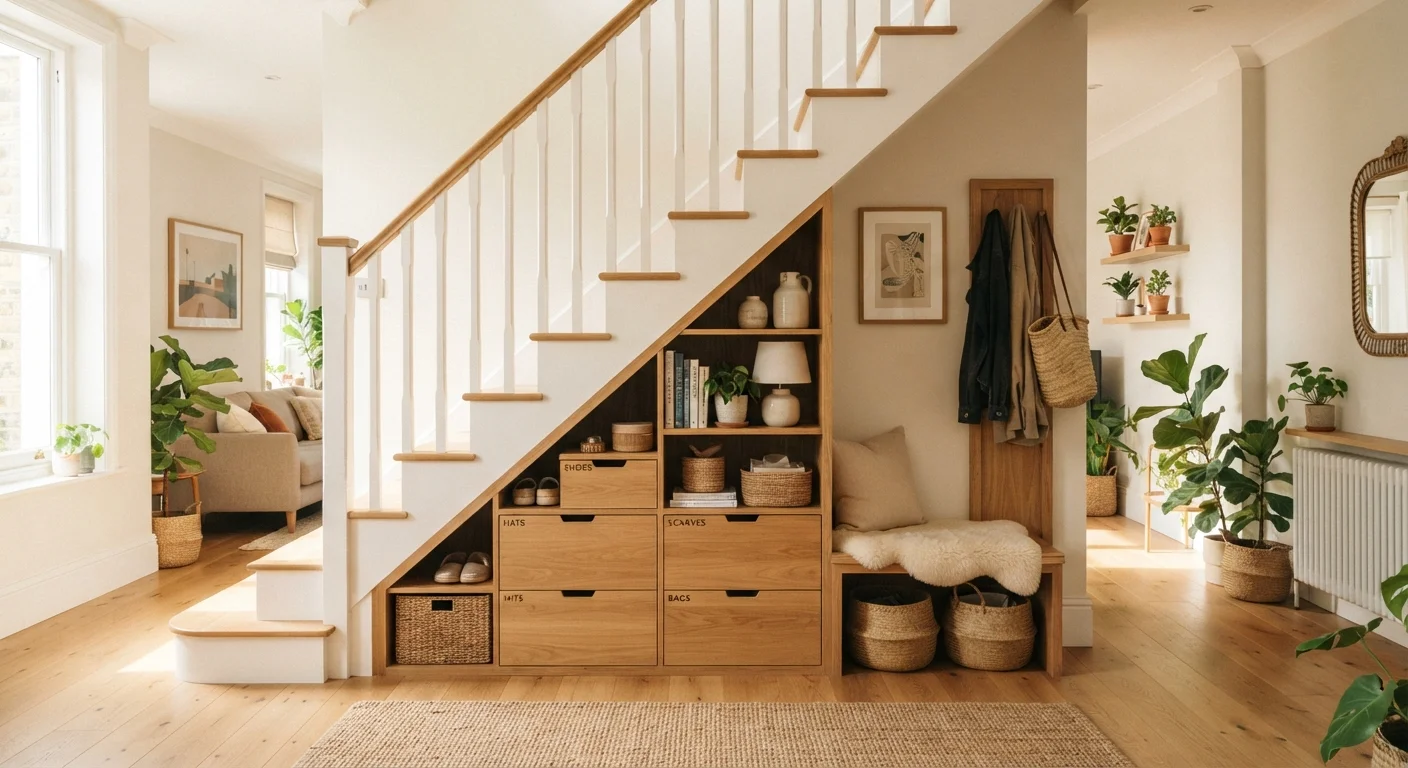
Under-stair space is often sealed off or used as an afterthought dumping ground. Depending on your staircase configuration, the cavity beneath can be substantial — sometimes equivalent to a small walk-in closet. Options range from simple open shelving along the wall to custom-built pull-out drawers fitted into individual risers. If you're handy, shallow pull-out drawers in the lower risers are a moderate DIY project; deeper cavities may warrant a carpenter's help to frame properly. Check local building codes before cutting into any stair structure — some configurations are load-bearing.
Under-stair cavities can rival a small closet in usable volume.
Above Kitchen and Bathroom Cabinets
The gap between the top of upper cabinets and the ceiling is rarely used intentionally. It's an ideal spot for items that are needed only occasionally: seasonal serving platters, extra paper goods, small appliances used a few times a year. Shallow baskets or bins with labels make retrieval straightforward and keep the visual line clean. If the gap is deep enough, a second row of storage is possible, though items at the back become difficult to access without a step stool — factor that into what you store there.
Above-cabinet space suits seasonal items that don't need frequent access.
Behind Cabinet and Pantry Doors
The back of a cabinet door is a reliable small-storage surface that's almost always ignored. Over-the-door organizers — shallow racks with pockets or hooks — can hold spices, cleaning supplies, foil and wrap boxes, or bathroom essentials. These organizers require no drilling in many cases, attaching via the door itself. One consideration: heavier loads can stress hinges over time, so keep weight modest and check that the door closes fully without obstruction. For a comparison of open versus concealed storage trade-offs, our piece on open shelving is worth reading alongside this.
Over-the-door organizers add storage without touching a single wall.
Toe-Kick Drawers in the Kitchen
The recessed strip at the base of kitchen cabinetry — called the toe kick — is typically just a decorative panel covering dead space. In many cabinet configurations, that cavity is large enough to fit a shallow pull-out drawer. These work particularly well for flat items: baking sheets, cutting boards, placemats, or rarely-used lids. Retrofitting toe-kick drawers is a more involved project than the others on this list and generally calls for a cabinetmaker or experienced carpenter, but the payoff in a crowded kitchen can be substantial.
Toe-kick drawers reclaim inches of dead space at the base of every cabinet run.
The Wall Above Door Frames
The short stretch of wall above an interior door frame is a natural display or storage shelf location. A simple floating shelf installed above the door can hold books, decorative objects, or lightweight bins. Because this zone sits above eye level, it suits items you want to store without displaying prominently — or, conversely, things that look good elevated. Wall anchoring matters here: shelves should be secured into studs or with appropriate anchors rated for the intended load. Don't exceed what the hardware is rated for.
A shelf above a door frame adds usable space without claiming any floor area.
Inside Deep Pantry Corners
Corner pantry shelves create blind spots where items disappear and expire unseen. Lazy Susans (rotating turntable inserts) are a well-established fix for corner cabinets, but deep straight shelves benefit from a different approach: pull-out drawers or tiered risers that bring the back of the shelf forward. Categorizing items and keeping taller goods at the back helps too. The goal is to eliminate the habit of stacking in front of forgotten items — a pattern that makes corners functionally useless even when they're technically full.
Corner pantry blind spots are solved by bringing items forward, not stacking in front.
Narrow Gaps Between Appliances and Walls
A two-to-four-inch gap between a refrigerator, washing machine, or stove and an adjacent wall is easy to dismiss. Slim pull-out pantry towers — rolling units sized for these gaps — can hold canned goods, cleaning supplies, or laundry products and slide out on wheels for full access. These are among the most space-efficient storage additions available for a kitchen or utility room. Measure the gap width carefully before selecting a unit, accounting for trim and any slight floor irregularities that might impede rolling.
A slim pull-out tower can transform a two-inch gap into a functional pantry column.
Under Beds and Upholstered Furniture
Bed frames with platform bases or low profiles often block under-bed storage entirely — but many standard frames leave six to twelve inches of clearance. Flat rolling bins or vacuum storage bags (for seasonal linens and clothing) make good use of this zone. Label bins on the front face so contents are identifiable without pulling everything out. In children's rooms especially, under-bed storage for toys and books can meaningfully reduce visual clutter in a small space. Avoid storing anything moisture-sensitive in rooms with humidity issues, as airflow under beds is limited.
Under-bed storage works best with flat, labeled bins that roll out cleanly.
Making the System Stick
Activating a forgotten zone is only half the job. The other half is keeping it usable. A few principles help: store items you use infrequently in harder-to-reach spots (high shelves, deep under-stair cubbies), and keep everyday items accessible. Group by category rather than by container, so you're not hunting through identical bins to find what you need.
Start With One Zone at a Time
Trying to activate every overlooked space at once often leads to abandoned projects halfway through. Pick the single zone that causes the most daily frustration — a chaotic pantry corner, an impassable under-stair closet — and complete that one fully before moving on. A finished, functioning space builds momentum in a way that five half-done ones never does.
If your household includes people with different tidying habits, simple open containers and strategic labelling can reduce friction significantly. For more on organizing around different habits, the article on shared spaces and different standards offers grounded, realistic strategies. And if you're weighing what container format suits each new space, drawer, shelf, or bin breaks down the decision clearly.
Done well, these small interventions compound. A home that uses its forgotten zones intentionally tends to stay more orderly with less daily effort — because everything has a place, and those places actually make sense.