

Key Takeaways
- Maintenance intervals are set by engineers using real wear-rate data, not arbitrary rules.
- Both mileage and elapsed time matter — components degrade even on low-use vehicles.
- Skipping intervals can trigger a cascade of more expensive failures down the road.
- Severe driving conditions often require shorter intervals than the standard schedule.
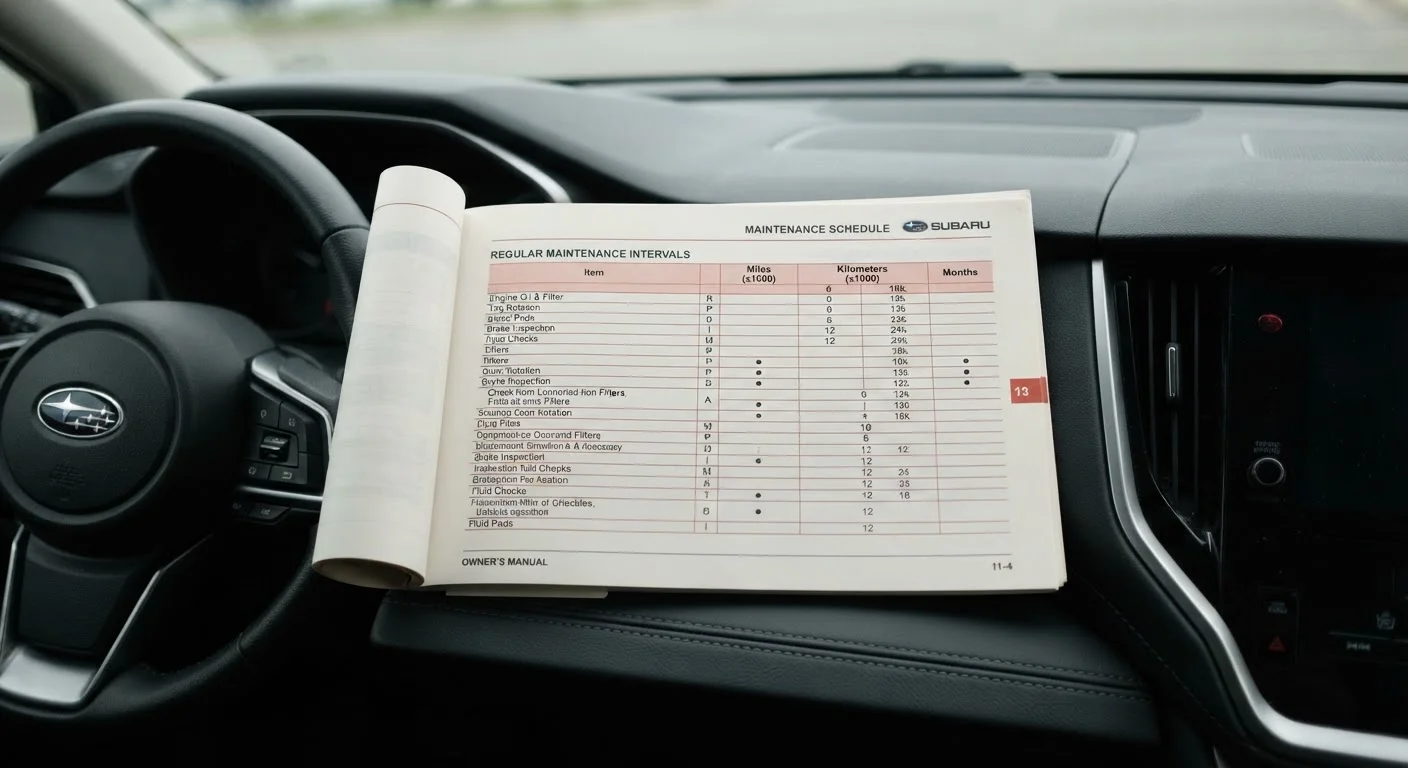
- Your owner's manual, not general advice, is the definitive reference for your specific vehicle.
Scheduled Maintenance Interval
A scheduled maintenance interval is a manufacturer-specified mileage or time milestone at which certain vehicle components should be inspected, serviced, or replaced. These intervals are based on engineering data about how long parts typically last under normal operating conditions. Following them helps prevent breakdowns, protects vehicle systems, and keeps your warranty intact.
Intervals are often expressed as both a mileage threshold and a time limit (e.g., every 5,000 miles or 6 months, whichever comes first) because some fluids and seals degrade through age even without heavy use.
Why Intervals Exist at All
Every component in your vehicle wears at a measurable, predictable rate. Engineers determine these rates through extensive durability testing — running engines, transmissions, and brake systems through thousands of simulated cycles to observe exactly when performance begins to degrade. Scheduled maintenance intervals are the practical output of that research.
The goal is straightforward: replace or service a part before it fails, not after. Reactive repairs — fixing something once it breaks — are almost always more expensive than the preventive service that would have avoided the failure. A fresh air filter costs a few dollars; the fuel economy losses and potential injector damage from a clogged one cost considerably more. Understanding this logic is the first step toward taking your maintenance schedule seriously rather than treating it as an optional suggestion.
Your Owner's Manual Is the Primary Source
General guidance — including common rules of thumb like oil change mileage benchmarks — applies broadly but not universally. Engine design, oil type, climate, and use patterns all influence the appropriate interval for your specific vehicle. Always cross-reference general advice against the schedule your manufacturer published for your make, model year, and engine.
How Engineers Determine the Numbers
Maintenance intervals are not round numbers chosen for convenience. They reflect the point at which a component's protective capacity or structural integrity typically drops below an acceptable threshold under normal operating conditions.
Motor oil is a useful example. As oil circulates through an engine, heat and friction break down its molecular structure and it accumulates combustion byproducts. Lab analysis of used oil samples allows engineers to identify the mileage range at which viscosity and additive protection fall off measurably. The service interval is set conservatively inside that range — providing a safety buffer before real damage occurs.
The same principle applies to brake fluid (which absorbs moisture over time, lowering its boiling point), timing belts (which develop micro-cracks in the rubber under thermal cycling), and spark plugs (whose electrode gap widens incrementally with each ignition event). For a detailed look at what each milestone covers, see our guide to routine maintenance milestones.
~$1,200
Average annual vehicle maintenance cost per AAA data
AAA's annual 'Your Driving Costs' study estimates average routine maintenance costs for a typical sedan, underscoring that consistent upkeep is a predictable, budgetable expense.
2x–4x
Cost multiplier when maintenance is deferred until failure
Industry estimates consistently show that repairs prompted by component failure cost substantially more than the preventive service that would have forestalled them — often two to four times as much.
30%
Estimated fuel economy loss from a severely clogged air filter
The U.S. Department of Energy has noted that a dirty air filter can reduce fuel economy in older carbureted engines; modern fuel-injected engines compensate differently, but performance and emissions are still affected.
Mileage, Time, and Why Both Matter
Many drivers think only in miles, but manufacturers specify intervals using two independent measures: distance driven and time elapsed. Whichever threshold you reach first triggers the service need.
Time matters because chemical degradation doesn't stop when the car is parked. Coolant becomes acidic. Brake fluid absorbs ambient moisture. Rubber components stiffen and crack. A vehicle that covers only 4,000 miles per year still needs annual attention to these systems. Ignoring the time-based component of an interval is one of the more common — and costly — maintenance oversights low-mileage drivers make.
It's also worth noting that driving patterns affect wear rates significantly. Manufacturers typically publish two schedules: a normal schedule and a severe-duty schedule for drivers who frequently tow, idle in heavy traffic, drive short trips, or operate in extreme climates. If your driving fits those conditions, the standard interval may not be sufficient. Our article on seasonal car maintenance explores how environmental factors amplify wear on specific systems.
Check for Both Normal and Severe-Duty Schedules
Most owner's manuals include two maintenance schedules side by side. Read both and honestly assess which describes your driving. If you regularly drive in stop-and-go traffic, tow loads, take frequent short trips, or live in a region with extreme temperatures, the severe-duty schedule likely applies to you — even if your vehicle seems to be performing normally.
The Cost of Skipping Intervals
Deferred maintenance rarely stays contained. Vehicle systems are interdependent, and a neglected component in one area often creates stress in another. Old coolant that becomes corrosive attacks the water pump. A worn serpentine belt that snaps takes the power steering and alternator offline simultaneously. A dirty transmission fluid that isn't replaced accelerates clutch-pack wear.
These cascading failures are the reason service advisors emphasize catching problems early. How neglected maintenance escalates into expensive repairs follows this pattern in detail. Keeping a reliable service record also has a direct financial benefit beyond the car itself — a documented maintenance history is a meaningful factor in resale value and buyer confidence. Our vehicle maintenance log guide outlines the simplest ways to track your service history.
The most practical takeaway: your owner's manual contains the authoritative schedule for your specific vehicle. General industry rules of thumb can be useful context, but the manufacturer's data — derived from your exact engine design — is what should govern your decisions. If your manual is missing, most manufacturers make digital versions available through their websites or customer service lines.