

Key Takeaways
- Most car batteries last three to five years, but conditions like extreme heat or short trips can shorten that lifespan.
- Slow engine cranking is one of the earliest and most reliable signs that a battery is weakening.
- Corroded terminals and a swollen battery case are physical warning signs you can spot without any tools.
- Needing jump-starts more than once in a short period is a strong signal to have the battery tested.
- A simple load test at a repair shop can confirm whether a battery still holds sufficient charge.
Why Battery Health Deserves Attention
A dead battery is one of the most common reasons drivers end up stranded. Unlike a flat tyre or an engine warning light, a failing battery often sends subtle signals weeks before it gives out entirely. Knowing what to look for lets you act on your schedule rather than the battery's.
Most conventional lead-acid batteries last somewhere between three and five years, though factors like climate, driving habits, and how often accessories draw power while the engine is off can all influence that range. Short, frequent trips — common in city driving — prevent the alternator from fully recharging the battery, gradually eroding its capacity over time. If you're heading out on an extended drive, it's worth pairing battery awareness with a broader set of pre-trip checks; the pre-long drive checklist covers exactly that ground.
Test Before You're Stranded
If your battery is three years old or older, consider having it load-tested at your next scheduled service even if you haven't noticed any symptoms. Many shops offer this check at no charge, and it takes just a few minutes. Catching a weakening battery before it fails is far less disruptive than dealing with a no-start situation away from home.
Warning Signs to Watch For
Slow or laboured engine cranking
When you turn the key or press the start button and the engine turns over more slowly than usual — that sluggish, grinding-down sound — the battery is struggling to deliver the current the starter motor needs. This symptom is most noticeable on cold mornings, when both the battery and the engine oil require more energy to get moving. Don't dismiss a single instance, but if it happens repeatedly, treat it as a prompt to have the battery tested.
A sluggish crank on cold mornings is often the battery's first clear distress signal.
Dimming headlights or interior lights
A healthy battery maintains stable voltage whether the engine is running or not. If your headlights appear noticeably dimmer at idle than at speed, or if cabin lights flicker when you activate accessories like the blower motor, the battery may no longer be holding charge effectively. The alternator compensates while driving, which is why brightness often improves when engine revs rise — a reliable clue that the battery itself is the weak link.
Lights that brighten as revs increase point to a battery struggling to hold its charge.
Frequent need for jump-starts
Needing a jump-start once after accidentally leaving the lights on is not necessarily cause for alarm — that's a discharged battery, not a dead one. But if you've needed a jump-start two or more times in a few weeks without an obvious drain left on, the battery is likely unable to retain sufficient charge between uses. Repeated deep discharges accelerate internal degradation, so each cycle makes the next failure more likely and sooner.
Repeated jump-starts without a clear cause signal a battery losing its ability to retain charge.
Visible corrosion on the terminals
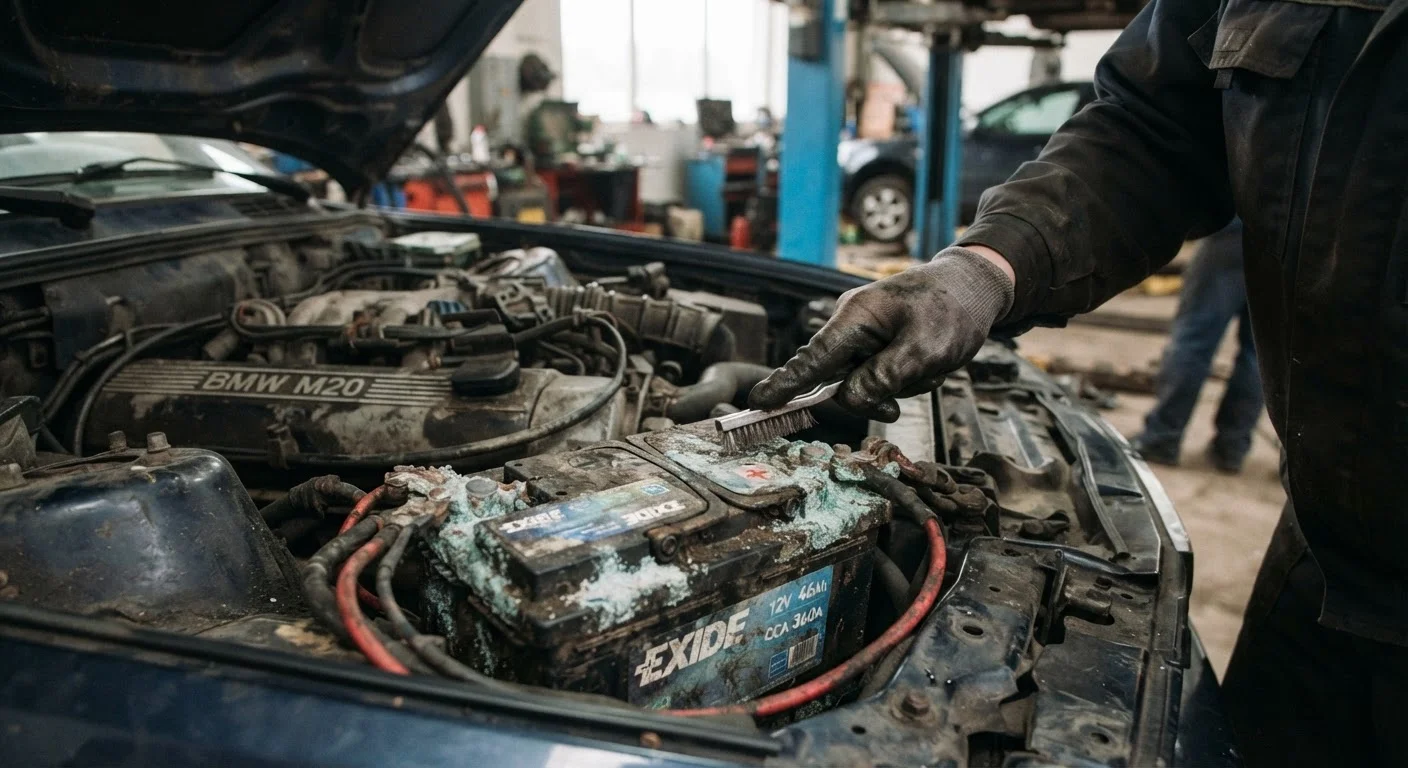
The white, blue, or greenish powdery buildup you sometimes see around battery terminals is corrosion — a byproduct of the chemical reactions inside the battery, particularly as it ages or if the case develops a very slight leak. Moderate corrosion can be cleaned safely, but heavy buildup increases electrical resistance, reducing the effective power reaching your starter and other systems. It also suggests the battery is working harder than it should, which may accelerate wear. A qualified mechanic can assess whether cleaning is sufficient or if replacement is the better course.
Heavy terminal corrosion raises electrical resistance and often signals a battery nearing the end.
A swollen or misshapen battery case
Car batteries can swell when exposed to excessive heat or when they've been overcharged — both of which cause internal gases to build up pressure. A battery case that appears bloated, bulging on the sides, or no longer sits flat is a safety concern, not just a performance one. A swollen battery should be handled carefully and replaced promptly; it can leak battery acid or, in extreme cases, vent harmful gas. This is a situation where a professional's guidance matters.
A swollen battery case is a safety concern — it should be inspected and replaced without delay.
Electrical accessories behaving erratically
Modern vehicles rely on stable voltage for everything from the infotainment system to electronic window regulators and seat adjustments. When the battery's output becomes inconsistent, these systems can glitch — windows moving unusually slowly, the radio resetting, or the clock losing time. If these quirks appear alongside any of the other signs listed here, they're worth factoring into the overall picture rather than writing off as individual software bugs.
Erratic electronics combined with other battery symptoms often point to an underlying power problem.
When Symptoms Might Point Elsewhere
Not every starting or electrical problem traces back to the battery. A faulty alternator, a parasitic drain from a malfunctioning component, or corroded wiring can mimic battery symptoms closely. A load test isolates the battery's condition, but a full charging-system inspection — covering the alternator and voltage regulator — is often worthwhile when the root cause isn't immediately clear. Always have a qualified technician diagnose persistent electrical issues.
What to Do When You Spot the Signs
Recognising a warning sign is only useful if you act on it. Most auto repair shops and many tyre centres can perform a battery load test — a quick procedure that measures how well the battery holds voltage under simulated demand. This gives you a clearer picture than a simple voltage reading alone, which can look acceptable even on a battery that's about to fail under real-world conditions.
Battery issues can sometimes overlap with other electrical faults. Dashboard lights behaving oddly, for example, may point to either the battery or the charging system. Our guide to what your car's warning lights are actually telling you can help you distinguish between the two. If a test confirms the battery is weak, replacement is straightforward — but have the charging system checked at the same time, since a faulty alternator will drain a new battery just as quickly as the old one.