
Visiting Antarctica: The Realities of the World's Most Extreme Travel Destination

Key Takeaways
- Antarctica is accessible only during the austral summer, roughly November through March.
- Most visitors arrive by expedition cruise ship from Ushuaia, Argentina — a multi-day ocean crossing.
- The Antarctic Treaty restricts where tourists can land and how many people can be ashore at once.
- Costs typically start in the thousands of dollars and can reach well above $10,000 per person.
- Weather and sea conditions can change rapidly, altering or cancelling planned landings without notice.
Wildlife encounters that are genuinely unmatched anywhere
Penguins, seals, and whales inhabit a largely undisturbed environment, resulting in close-range encounters that wildlife reserves elsewhere rarely replicate.
Landscapes of extraordinary and unrepeatable scale
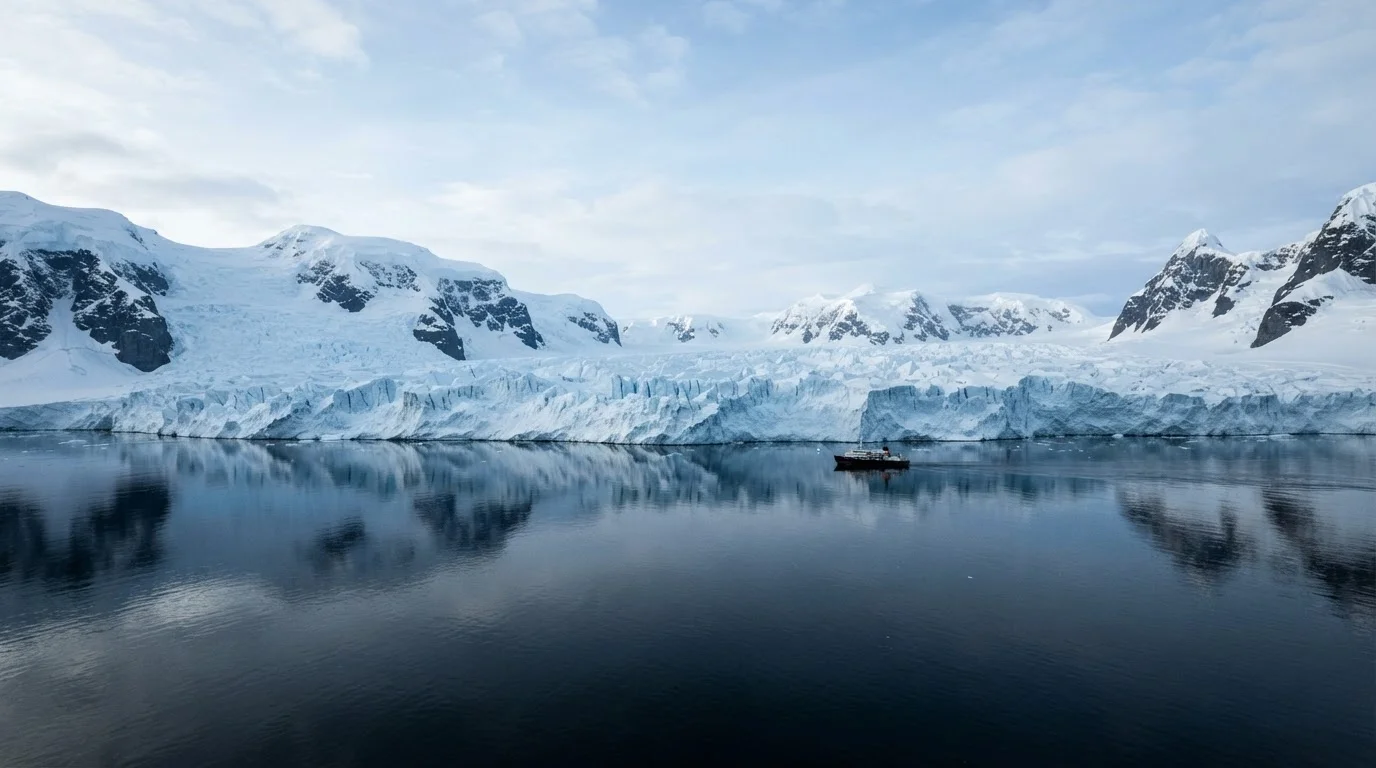
Icebergs, glaciers, and open polar seas create a visual environment that has no real equivalent — photographs consistently fail to convey the actual size of what you're seeing.
Very low visitor density compared to other major destinations
Annual visitor numbers remain in the tens of thousands globally, meaning even popular landing sites feel remote and unhurried by almost any other travel standard.
Operates under strong, internationally enforced environmental rules
IAATO guidelines and Antarctic Treaty protocols create a consistent baseline of environmental protection that most other destinations lack.
Educational depth through onboard naturalists and scientists
Most expedition vessels carry researchers and naturalists who give lectures and accompany landings, adding context that transforms observation into genuine understanding.
High cost places it out of reach for many travelers
Even modest expedition berths represent a significant financial commitment, and the full cost including travel, insurance, and equipment can be substantial.
The Drake Passage crossing is physically demanding
Two days each way through some of the world's roughest seas can be deeply uncomfortable for many travelers, regardless of preparation or medication.
Itineraries are subject to change without warning
Weather, ice conditions, and wildlife rules can cancel or alter planned landings at any point; travelers who need a guaranteed experience will find this genuinely frustrating.
Tourism's environmental footprint remains a real ethical concern
Even with strong industry regulations, the cumulative effect of thousands of annual visitors on a fragile and previously undisturbed ecosystem is a question without a clean answer.
Limited accessibility for travelers with mobility challenges
Zodiac landings on uneven ice and rock, combined with ship movement, make the journey physically demanding and poorly suited to travelers with significant mobility limitations.
Our Verdict
Antarctica rewards those who go in with realistic expectations: it is logistically demanding, genuinely expensive, and subject to conditions no itinerary can fully control. The payoff — scale, silence, and wildlife encounters found nowhere else — is equally genuine. It is not a trip to rush into, but for those who have prepared for the trade-offs, it tends to be among the most memorable journeys of a lifetime.
Best suited to travelers who are comfortable with uncertainty, sea crossings, and limited creature comforts, and who prioritize raw natural spectacle over predictable itineraries.
What Getting There Actually Involves
The journey to Antarctica begins long before you set foot on ice. For most travelers, the gateway is Ushuaia, in Argentine Tierra del Fuego — itself a significant journey from most North American cities. From Ushuaia, expedition vessels cross the Drake Passage, a stretch of ocean between South America and the Antarctic Peninsula known for some of the roughest seas on the planet. The crossing typically takes two days in each direction.
The Drake can be deceptively calm — what sailors call the "Drake Lake" — or it can deliver swells exceeding 30 feet. There is no reliable way to predict which you'll experience, and seasickness is a genuine factor for many passengers. Motion sickness medication is widely recommended, but responses vary considerably from person to person.
Expedition operators generally offer voyages ranging from eight to twenty-plus days, with the shorter options spending more time at sea proportionally. Longer itineraries may reach the Weddell Sea, the Ross Sea, or even the South Georgia and South Sandwich Islands — dramatically different environments with their own logistical complexity. For a sense of what remote southern hemisphere wilderness demands at a more accessible scale, our coverage of what first-time visitors should know about Patagonia provides useful context.
The Pros: Why Antarctica Is Worth Serious Consideration
Despite every logistical hurdle, Antarctica draws travelers back — sometimes repeatedly. The reasons are not abstract.
Wildlife encounters that are genuinely unmatched anywhere
Penguins, seals, and whales inhabit a largely undisturbed environment, resulting in close-range encounters that wildlife reserves elsewhere rarely replicate.
Landscapes of extraordinary and unrepeatable scale
Icebergs, glaciers, and open polar seas create a visual environment that has no real equivalent — photographs consistently fail to convey the actual size of what you're seeing.
Very low visitor density compared to other major destinations
Annual visitor numbers remain in the tens of thousands globally, meaning even popular landing sites feel remote and unhurried by almost any other travel standard.
Operates under strong, internationally enforced environmental rules
IAATO guidelines and Antarctic Treaty protocols create a consistent baseline of environmental protection that most other destinations lack.
Educational depth through onboard naturalists and scientists
Most expedition vessels carry researchers and naturalists who give lectures and accompany landings, adding context that transforms observation into genuine understanding.
Wildlife encounters in Antarctica are genuinely unlike those in nature reserves elsewhere. Penguins, leopard seals, and humpback whales exist in an environment where human presence is rare enough that animals show little fear. Walking among thousands of nesting penguins, with birds brushing past your boots, is a common experience — not an exceptional one.
The scale of the landscape is also difficult to prepare for. Icebergs the size of city blocks, unbroken silence interrupted only by calving glaciers, and 20-plus hours of summer daylight combine into something that resists easy description.
The Cons: Honest Trade-Offs to Understand Before You Commit
No destination this extreme comes without real costs — financial, physical, and logistical.
High cost places it out of reach for many travelers
Even modest expedition berths represent a significant financial commitment, and the full cost including travel, insurance, and equipment can be substantial.
The Drake Passage crossing is physically demanding
Two days each way through some of the world's roughest seas can be deeply uncomfortable for many travelers, regardless of preparation or medication.
Itineraries are subject to change without warning
Weather, ice conditions, and wildlife rules can cancel or alter planned landings at any point; travelers who need a guaranteed experience will find this genuinely frustrating.
Tourism's environmental footprint remains a real ethical concern
Even with strong industry regulations, the cumulative effect of thousands of annual visitors on a fragile and previously undisturbed ecosystem is a question without a clean answer.
Limited accessibility for travelers with mobility challenges
Zodiac landings on uneven ice and rock, combined with ship movement, make the journey physically demanding and poorly suited to travelers with significant mobility limitations.
The financial barrier is significant. Entry-level berths on expedition cruises rarely fall below several thousand dollars, and mid-tier cabins often exceed $10,000 per person before flights to Ushuaia, travel insurance, and gear are factored in. Specialized gear — layered waterproof outerwear, rubber boots for wet landings — adds further expense.
Environmental impact is a growing concern among both scientists and the industry itself. The International Association of Antarctica Tour Operators (IAATO) enforces strict guidelines — limiting shore parties to 100 people at a time, maintaining distances from wildlife, and prohibiting the removal of any material — but the presence of tourism in a fragile ecosystem remains a legitimate ethical question travelers should weigh for themselves.
Travel Insurance Is Not Optional Here
Medical evacuation from Antarctic waters is extraordinarily expensive and logistically complex. Most reputable expedition operators require proof of travel insurance that includes emergency evacuation coverage. Verify your policy's specific provisions carefully before booking, and confirm with your insurer that Antarctic waters are explicitly covered — some standard policies exclude remote or extreme destinations.
Timing, Regulations, and What to Realistically Expect
The Antarctic Treaty System, signed in 1959 and now ratified by over 50 nations, designates the continent as a scientific preserve and bans military activity and resource extraction. Tourism operates within this framework, meaning all operators must comply with site-specific visitor limits and environmental protocols.
~105,000
Annual tourist visitors to Antarctica
According to IAATO, the 2022–2023 season saw approximately 105,000 tourists visit Antarctica — a record at the time, though still a fraction of visitor numbers at most major destinations.
48 hours
Typical one-way Drake Passage crossing time
Most expedition voyages spend roughly two days crossing the Drake Passage in each direction, meaning a significant portion of any trip is spent at sea.
The austral summer window — November through March — is the only viable travel season. Early season (November–December) offers sea ice, newly arrived penguins, and occasional snow cover. Mid-season (January–February) brings the peak of wildlife activity, longer daylight, and somewhat warmer temperatures, though still typically below freezing inland. Late season (February–March) sees whale activity peak as krill populations bloom.
Travelers should understand that no landing is guaranteed. Ice conditions, weather, and wildlife protection rules can result in itinerary changes at any point. Operators are transparent about this, but arriving mentally prepared for flexibility — rather than a fixed checklist of experiences — makes for a more honest relationship with what the continent will and won't deliver.