

| Capital City | Tbilisi |
| Official Language | Georgian |
| Currency | Georgian Lari (GEL) |
| Geographic Region | South Caucasus, at the border of Europe and Asia |
| Documented Historical Monuments | Over 12,000 (Georgian National Agency for Cultural Heritage Preservation) |
| Wine History | Evidence of viticulture dating back approximately 8,000 years (Archaeological and scientific research, widely cited in academic literature) |
Where Exactly Is Georgia — and Why Does It Matter?
There's a moment, common to first-time visitors, when the geography of Georgia finally clicks. You're standing in Tbilisi, the capital, looking at a skyline where a Persian-era fortress sits above Soviet-era apartment blocks, which sit above neighborhoods of ornate wooden balconies. Europe and Asia aren't just nearby — they're layered into the city itself.
Georgia occupies a narrow corridor along the southern flank of the Greater Caucasus mountain range, bordered by Russia to the north, Turkey and Armenia to the south, Azerbaijan to the east, and the Black Sea to the west. That crossroads position isn't incidental to what the country offers travelers — it's the entire story. Trade routes, conquering empires, and migrating cultures have all passed through here, leaving behind a civilization that is genuinely distinct from its neighbors.
| Capital City | Tbilisi |
| Official Language | Georgian |
| Currency | Georgian Lari (GEL) |
| Geographic Region | South Caucasus, at the border of Europe and Asia |
| Documented Historical Monuments | Over 12,000 (Georgian National Agency for Cultural Heritage Preservation) |
| Wine History | Evidence of viticulture dating back approximately 8,000 years (Archaeological and scientific research, widely cited in academic literature) |
For readers who've explored the western Balkans and are curious about what lies further east, Georgia occupies a different register entirely — older in some ways, more eclectic in others. The Balkans primer on this site covers a region with its own fascinating complexity; Georgia is a worthwhile companion curiosity.
What Georgia Is Actually Known For
Experienced travelers tend to describe Georgia with the same few anchors, and they're worth taking seriously rather than dismissing as clichés.
Wine with deep roots
The Kakheti region in the east is considered one of the oldest wine-producing areas in the world, with archaeological evidence of viticulture dating back roughly 8,000 years. Georgian winemakers still use a traditional method involving clay vessels called qvevri, buried underground to ferment and age wine. The resulting amber-colored wines have a tannin structure and earthiness quite different from European styles. Trying them in their home context — at a family-run guesthouse in a vineyard village — is one of those travel experiences that resists adequate description.
Mountain landscapes and ancient churches
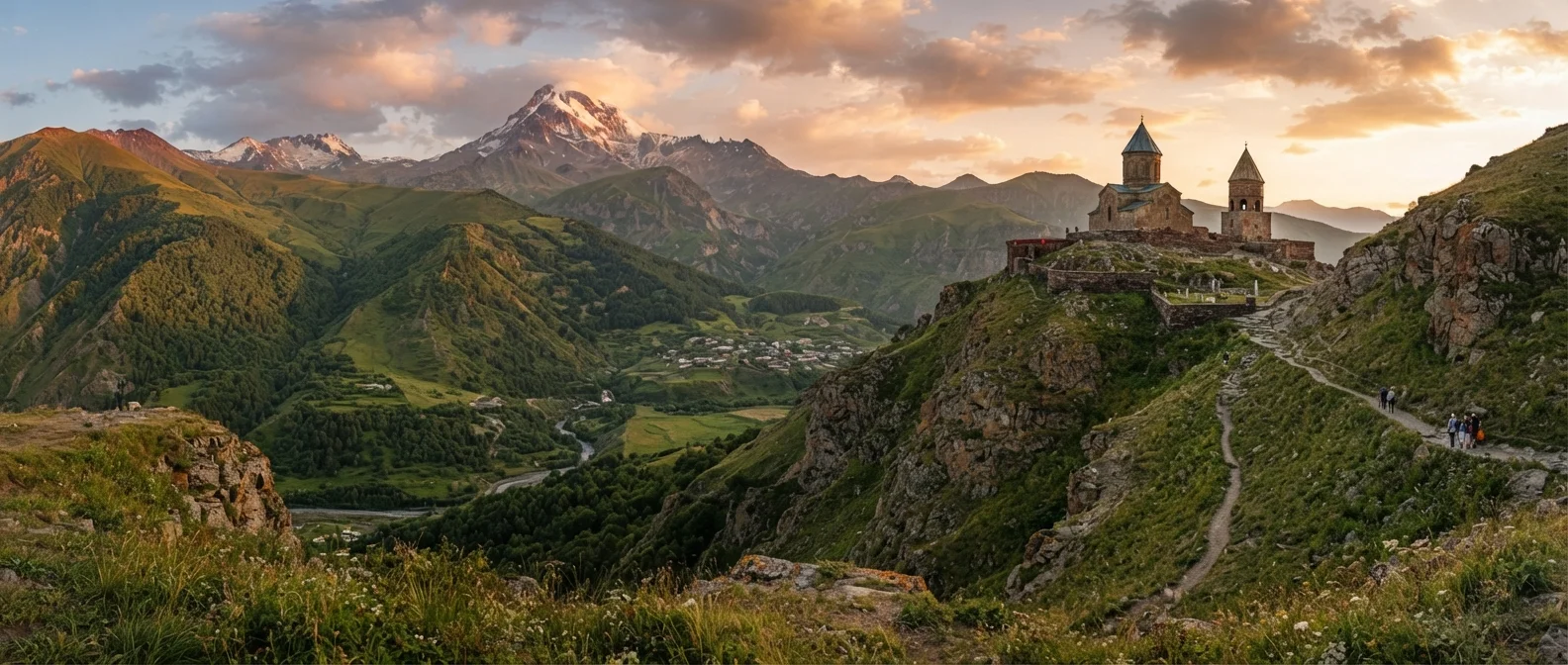
The Kazbegi region near the Russian border delivers what many visitors call the most dramatic scenery they've encountered anywhere in Europe or western Asia. The Gergeti Trinity Church, perched above the Terek River at roughly 2,170 meters, is the image that fills travel feeds — but the broader landscape of glaciers, river gorges, and isolated villages rewards anyone willing to slow down and walk. Georgia has over 12,000 documented historical monuments, many of them early Christian churches and monasteries tucked into mountain folds.
Qvevri
A traditional Georgian clay vessel, sealed with beeswax and buried underground, used to ferment, age, and store wine. The practice is recognized by UNESCO as an Intangible Cultural Heritage.
Supra
A traditional Georgian feast, typically elaborate and multi-course, governed by toasts and guided by a tamada (toastmaster). It is a core expression of Georgian hospitality and social culture.
Tamada
The toastmaster at a Georgian supra, responsible for leading the sequence of heartfelt toasts that punctuate the meal. The role is taken seriously and considered a social honor.
Mkhedruli
The modern Georgian script used in everyday writing. It is one of the few fully unique alphabets still in active use worldwide and is not derived from Greek, Latin, or Cyrillic systems.
Khachapuri
A foundational Georgian dish — bread filled or topped with cheese, often with egg and butter. Regional variations exist across the country, each with distinct shapes and fillings.
Food culture built around the table
Georgian cuisine has a logic of its own: walnut-based sauces, herb-forward salads, slow-braised meats, and the architectural cheese bread known as khachapuri. The concept of supra — a lavish, toast-driven feast presided over by a tamada (toastmaster) — reflects a hospitality culture that treats guests as something close to sacred. Visitors consistently report that meals in private homes or small restaurants feel unlike dining anywhere else in the region.
Practical Orientation for Curious Travelers
Georgia uses the Georgian lari (GEL) as its currency. The Georgian script — Mkhedruli — is one of only 14 alphabets in active use worldwide and looks like nothing you've encountered elsewhere, which can make independent navigation both challenging and genuinely interesting.
Tbilisi's international airport receives direct flights from several European hubs, and overland entry from Armenia and Turkey is straightforward for most Western passport holders, though entry rules, visa requirements, and regional conditions can change. Always verify current entry requirements with your government's official travel advisory and the Georgian embassy or consulate before booking.
Verify Entry Rules Before You Travel
Visa requirements, border crossing availability, and regional travel advisories for Georgia can change with little notice. Check your government's official travel advisory website and confirm current requirements with the Georgian embassy or a consulate in your home country well before your planned departure. Do not rely solely on third-party travel blogs or booking platforms for this information.
Georgia's climate varies dramatically by region. The Black Sea coast around Batumi is humid and subtropical; the eastern plains around Tbilisi are drier and hotter in summer; the high mountain areas can see snow well into spring. Most visitors find May through June and September through October the most comfortable windows, though summer brings crowds to popular mountain areas.
Infrastructure is improving steadily, but road conditions in rural and mountain areas can be unpredictable, particularly after winter. If you plan to explore beyond main towns independently, research road conditions for your specific route and season before travel.