

Key Takeaways
- No single feeding format is universally best — each has genuine nutritional strengths and real limitations.
- Dry food is convenient and shelf-stable but typically lower in moisture, which matters for cats especially.
- Wet food supports hydration and palatability but costs more and spoils quickly once opened.
- Raw diets carry documented food-safety risks and require careful handling and nutritional balancing.
- A veterinarian or board-certified veterinary nutritionist can help tailor the right approach for your individual pet.
Our Verdict
Dry food suits owners prioritizing convenience and dental-scrubbing texture; wet food is a strong choice for pets needing extra hydration or with reduced appetite; raw diets may appeal to highly engaged owners willing to manage safety and formulation carefully. For most pets, the strongest predictor of good health is feeding a nutritionally complete, appropriately portioned diet — not the format itself.
| Best for | Recommended |
|---|---|
| Owners seeking convenience and cost-efficiency | Dry Food |
| Pets with low water intake, kidney concerns, or picky appetites | Wet Food |
| Highly engaged owners comfortable with safe food handling and vet oversight | Raw Diet |
| Pets with complex health needs or life-stage considerations | Vet-guided combination approach |
Understanding What Sets Each Format Apart
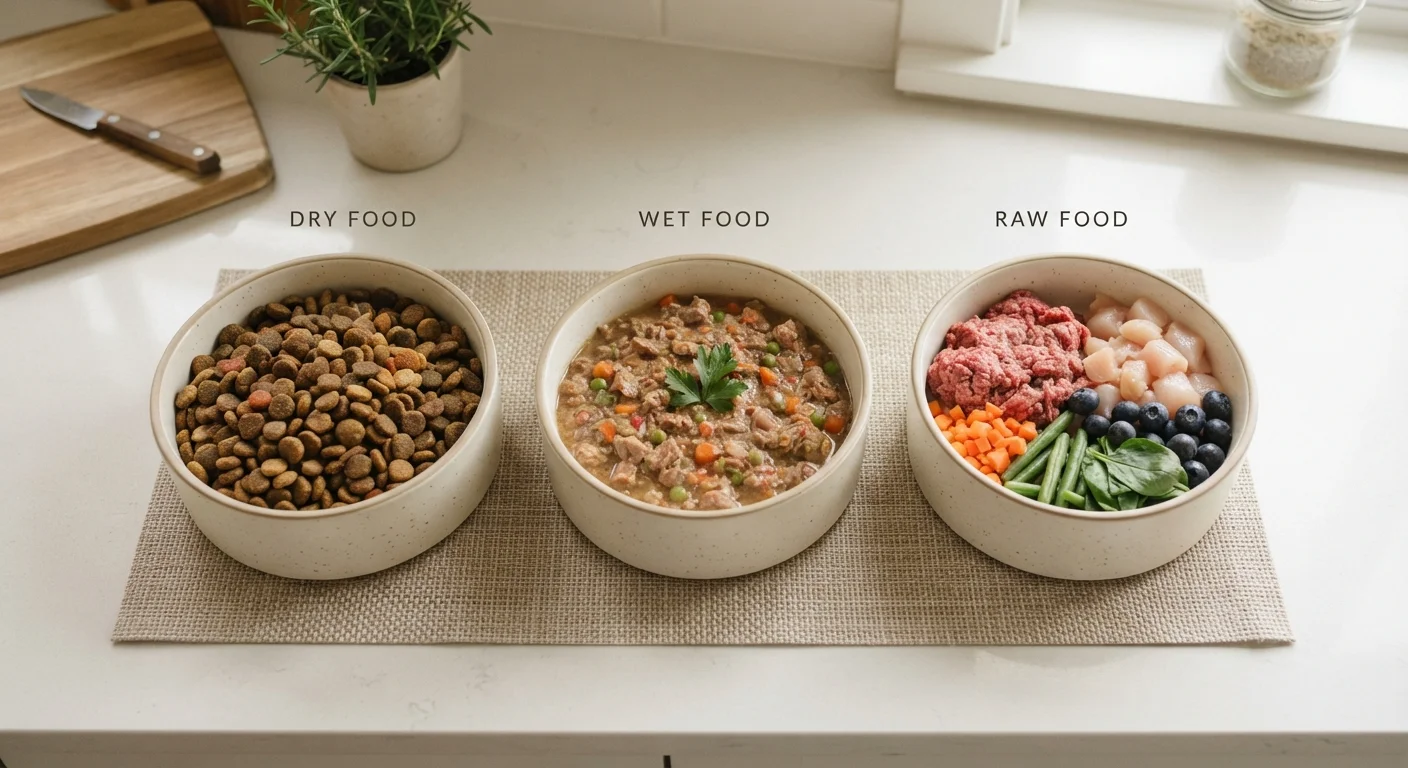
Pet food is broadly grouped into three feeding formats: dry (kibble), wet (canned or pouched), and raw (either commercial frozen or homemade). Each format results from different manufacturing or preparation processes, which directly shapes its nutritional profile, safety characteristics, and day-to-day practicality.
Dry food is made through a process called extrusion — ingredients are cooked under high heat and pressure, then shaped and dried. This produces a calorie-dense, shelf-stable product. Wet food is cooked inside sealed cans or pouches, locking in significantly more moisture. Raw diets — whether whole prey, ground raw, or freeze-dried raw — skip conventional cooking altogether, though freeze-drying does kill some but not all pathogens.
None of these formats is inherently superior. What matters most is whether the food meets your pet's complete nutritional needs, fits your household's practical realities, and aligns with any health considerations your veterinarian has identified. For a broader view of lifelong pet care, see our guide on caring for a pet throughout its life.
Dry Food: Convenience With Trade-Offs
Kibble remains the most widely used pet food format in the United States, largely because of its convenience, shelf life, and lower cost per serving. It's easy to measure, store, and dispense through automatic feeders — practical advantages that matter for busy households.
From a nutritional standpoint, high-quality dry foods formulated to meet AAFCO (Association of American Feed Control Officials) standards provide complete and balanced nutrition for dogs and cats. However, the extrusion process can degrade some heat-sensitive nutrients, which manufacturers typically compensate for by adding them back after processing.
The most significant limitation of dry food is its low moisture content — roughly 10%. Cats in particular evolved as desert-adapted animals that obtain much of their hydration from prey. A cat fed exclusively dry food may have chronically low water intake, which veterinary researchers associate with increased risk of urinary tract issues. Dogs generally adapt better, especially when fresh water is always available.
| Dry Food | Wet Food | Raw Diet | |
|---|---|---|---|
| Moisture Content | Low (~10%) | High (~70–80%) | Variable (~60–75%) |
| Convenience | Very high — shelf-stable, easy to measure | Moderate — refrigerate after opening | Low — requires prep and safe handling |
| Cost | Generally lower per serving | Moderate to high | Often highest, especially commercial raw |
| Food Safety Risk | Low | Low to moderate | Higher — bacterial contamination possible |
| Palatability | Variable; some pets less interested | Often high — appealing aroma and texture | Generally high for many carnivores |
| Nutritional Completeness | AAFCO-complete formulas widely available | AAFCO-complete formulas widely available | Homemade formulas often nutritionally incomplete |
| Dental Texture | Some mechanical abrasion from chewing | Minimal dental benefit | Bones provide abrasion — but carry injury risk |
Dry food's texture does provide some mechanical tooth-scrubbing effect, though the American Veterinary Dental College notes it is not a substitute for active dental care like brushing.
Wet Food: Hydration and Palatability Benefits
Canned and pouched wet foods typically contain 70–80% moisture, making them a meaningful hydration source — particularly useful for cats, senior pets with reduced thirst drive, or animals recovering from illness. The higher water content also means fewer calories per gram compared to dry food, which can help with weight management when portioned carefully.
70–80%
Moisture in canned/wet pet food
According to the Association of American Feed Control Officials (AAFCO), wet pet food typically contains significantly more moisture than dry kibble, which can support daily hydration in pets.
~10%
Moisture in dry kibble
Dry extruded pet foods typically retain only around 10% moisture after processing, which is why water intake is especially important for cats fed primarily kibble.
Wet food is often more palatable to finicky eaters, largely due to its texture and stronger aroma. For pets with dental disease, difficulty chewing, or reduced appetite, it can be a practical bridge to maintaining caloric intake.
The practical downsides are real: opened cans must be refrigerated and used within a day or two; wet food costs more per calorie than kibble; and the softer texture offers minimal dental texture benefit. Portion control also requires more attention, since calorie density varies widely across formulas.
When choosing wet food, reading labels critically matters. Our companion article on what pet food labels actually tell you walks through how to interpret guaranteed analysis panels and ingredient lists.
Raw Diets: Appeal, Evidence, and Real Cautions
Raw feeding — including prey-model raw, commercial frozen raw, and freeze-dried raw formats — has grown in popularity among pet owners seeking a diet closer to what animals might eat in the wild. Proponents often cite improved coat condition, better digestion, and higher energy as observed benefits. However, the scientific evidence supporting measurable health advantages over nutritionally complete cooked diets remains limited and mixed.
Raw Diets and Household Safety Risks
Both the U.S. Food and Drug Administration (FDA) and the American Veterinary Medical Association (AVMA) caution that raw meat-based diets can carry Salmonella, Listeria, and other pathogens — posing risks not just to pets but to people in the household, especially young children, elderly individuals, or immunocompromised family members. Safe handling, dedicated prep surfaces, and thorough handwashing are essential if you pursue this feeding style.
A well-formulated raw diet can provide excellent nutrition, but achieving that balance at home is harder than it looks. Many homemade raw diets assessed in veterinary nutrition research have been found to be deficient in key nutrients including calcium, phosphorus, and certain vitamins. Commercial raw products vary considerably in quality and safety testing. If you're seriously considering raw feeding, working with a board-certified veterinary nutritionist (DACVN) to formulate or vet the recipe is strongly advisable.
It's also worth consulting common pet nutrition myths examined for a clear-eyed look at what the evidence actually says about raw feeding claims.
Transitioning Between Food Types Slowly
When shifting your pet from one diet format to another, a gradual transition over 7–10 days reduces the risk of digestive upset. Start by mixing a small amount of the new food with the current diet, then increase the proportion daily. Sudden changes can cause vomiting or diarrhea even if the new food is nutritionally sound.
This article is for general informational purposes only and is not a substitute for veterinary advice. Always consult a licensed veterinarian or board-certified veterinary nutritionist before making significant changes to your pet's diet.