

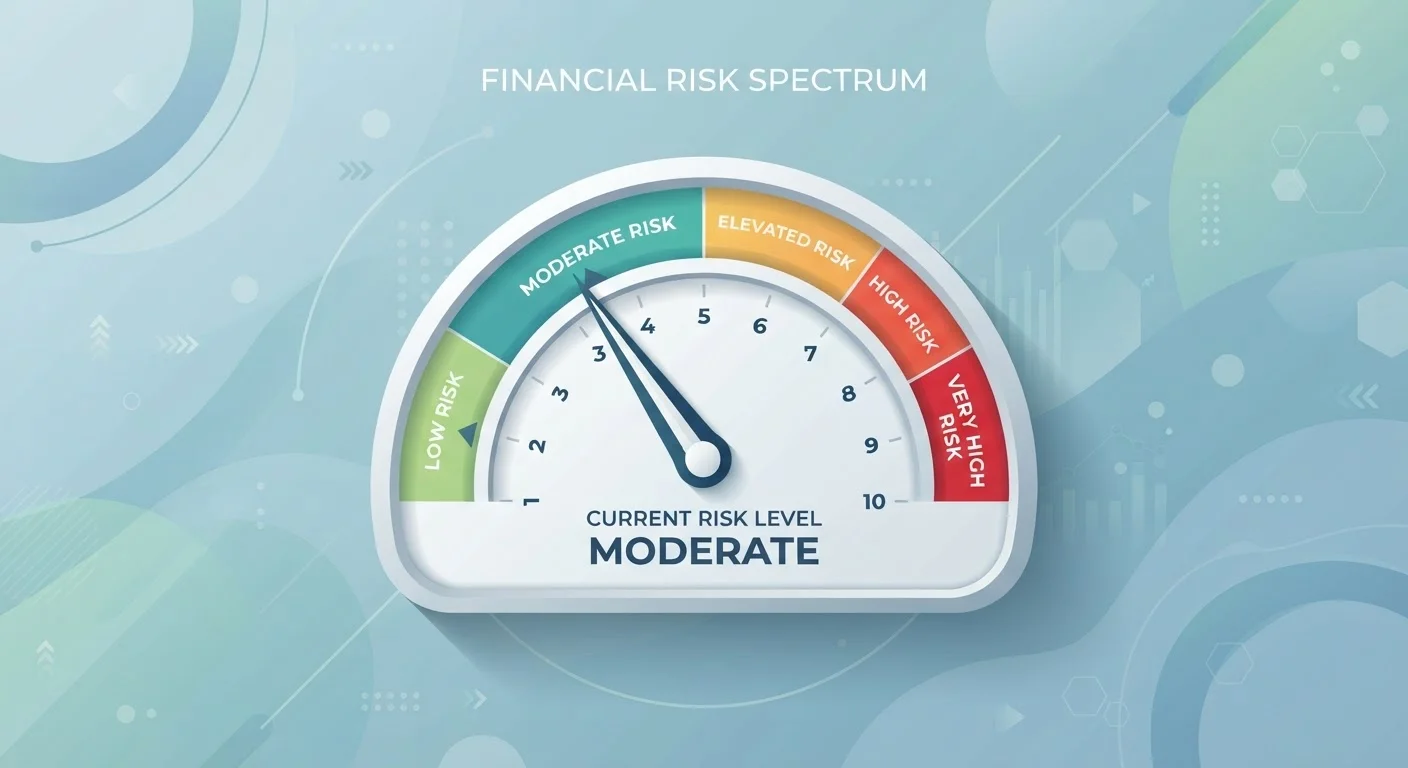
Key Takeaways
- Risk tolerance combines emotional comfort with volatility and your actual financial capacity to absorb losses.
- Your investment timeline is one of the strongest predictors of how much risk is appropriate for you.
- Higher potential returns generally come with higher risk — there is no free lunch in investing.
- Risk tolerance can and does change over time as your life circumstances evolve.
- Understanding your risk tolerance helps you build a portfolio you can stick with through market ups and downs.
Risk Tolerance
Risk tolerance is the degree of uncertainty in investment returns that a person is willing and able to accept. It reflects both your emotional comfort with seeing your portfolio lose value temporarily and your practical financial capacity to absorb potential losses without derailing your goals. It's not a fixed personality trait — it changes with your age, income, financial responsibilities, and investment timeline.
Financial professionals often distinguish between 'risk tolerance' (psychological comfort with volatility) and 'risk capacity' (objective financial ability to absorb loss). Both should inform your investment strategy.
Why Risk Tolerance Is More Than a Quiz Result
Most people first encounter the term "risk tolerance" when opening a brokerage or retirement account — usually in the form of a short questionnaire asking how they'd react if their portfolio dropped 20% overnight. That's a useful starting point, but it captures only part of the picture.
Risk tolerance has two distinct layers. The first is psychological: how much volatility can you handle emotionally without making impulsive decisions? The second is financial: how much can you objectively afford to lose without jeopardizing your essential goals? Both dimensions matter. Someone with high emotional tolerance for risk but minimal savings and an imminent goal — like buying a home next year — has low practical risk capacity, regardless of how calm they feel about market swings.
Understanding this distinction is foundational. Before exploring what kinds of investments might be appropriate, it helps to first understand the difference between saving and investing — because risk is largely irrelevant to money parked in a savings account, and very relevant to money placed in the market.
Risk Tolerance vs. Risk Capacity: A Key Distinction
You might feel emotionally comfortable with investment swings, but if your financial situation doesn't support absorbing losses — say, you have minimal savings or near-term cash needs — your risk capacity is still low. A sound investment strategy accounts for both. Overweighting psychological comfort while ignoring practical limits is a common source of financial missteps.
The Key Factors That Shape Your Risk Tolerance
Several variables interact to determine where someone falls on the risk spectrum:
- Time horizon: How long before you need the money? Investors with decades until retirement can generally withstand more short-term volatility because they have time for markets to recover. Those needing funds within a few years have less room for error.
- Income stability: A reliable income stream makes it easier to ride out portfolio dips without liquidating investments. Irregular income or limited emergency savings raises financial risk capacity concerns.
- Existing financial obligations: Supporting dependents, carrying significant debt, or having limited liquid savings all reduce the practical ability to absorb investment losses.
- Investment goals: Growing wealth for retirement decades away invites a different risk profile than saving for a home down payment in three years.
- Emotional response to loss: Research in behavioral finance consistently shows that losses feel roughly twice as painful as equivalent gains feel rewarding — a phenomenon called loss aversion. Investors who are highly loss-averse often benefit from a more conservative portfolio, even if their timeline technically supports more risk.
2x
How much more painful losses feel than equivalent gains
Behavioral economists Daniel Kahneman and Amos Tversky documented this asymmetry in their foundational research on loss aversion and prospect theory.
~60%
U.S. adults who own stock market investments
According to Gallup polling, roughly six in ten American adults report having money invested in stocks, including through retirement accounts.
30+ years
Typical investing horizon for a 35-year-old saving for retirement
A 35-year-old targeting retirement at 65 or later has a long runway — one reason financial guidance often supports a higher equity allocation at younger ages.
How Risk Tolerance Translates Into Investment Choices
Once you have a clearer sense of your risk tolerance, it shapes how you allocate money across different asset types. In general terms:
- Lower risk tolerance tends to favor bonds, money market funds, and stable-value assets that offer modest returns with less volatility.
- Moderate risk tolerance often leads to a balanced mix of stocks and bonds, aiming for growth while cushioning against large swings.
- Higher risk tolerance may support a portfolio weighted more heavily toward equities (stocks), including sectors or markets with greater growth potential — and greater potential for loss.
It's worth noting that higher potential returns always come with higher potential risk. No investment strategy eliminates risk; it can only be managed and distributed. This is the core principle behind diversification — spreading investments across asset types to avoid concentration in any single area.
Risk tolerance also directly affects retirement planning. If you're contributing to a 401(k) or IRA, understanding your tolerance helps you choose appropriate fund allocations. For a deeper look at account types, see our guide on tax-advantaged retirement savings options.
Use Life Events as a Prompt to Reassess
Marriage, children, a new job, a windfall, or approaching retirement are all natural trigger points to revisit your investment allocation. Your risk tolerance at 30 may not be appropriate at 50 — and that's expected, not a failure. Many employer-sponsored retirement plans offer tools to help you review and adjust your allocation periodically.
Reassessing Over Time — and Avoiding Common Mistakes
Risk tolerance isn't static. Life changes — a growing family, a career shift, an inheritance, or approaching retirement — all warrant a review of your investment strategy. Most financial professionals suggest revisiting your risk profile after any major life event or at regular intervals, such as annually.
One of the most common and costly mistakes investors make is choosing a risk level based on a bull market mindset — assuming strong recent returns will continue — and then panicking when the market falls. This pattern of buying high and selling low destroys wealth. A portfolio calibrated to your genuine risk tolerance is one you're more likely to stay invested in during downturns, which is often the key to long-term results.
If you're just getting started and feel uncertain about investing altogether, it may help to address some of the common investing myths that hold people back. Many barriers to starting are based on misunderstandings rather than real risk.
This article is for general informational and educational purposes only and does not constitute personalized financial, investment, tax, or legal advice. Consult a qualified, licensed financial adviser before making investment decisions based on your individual circumstances.