

Key Takeaways
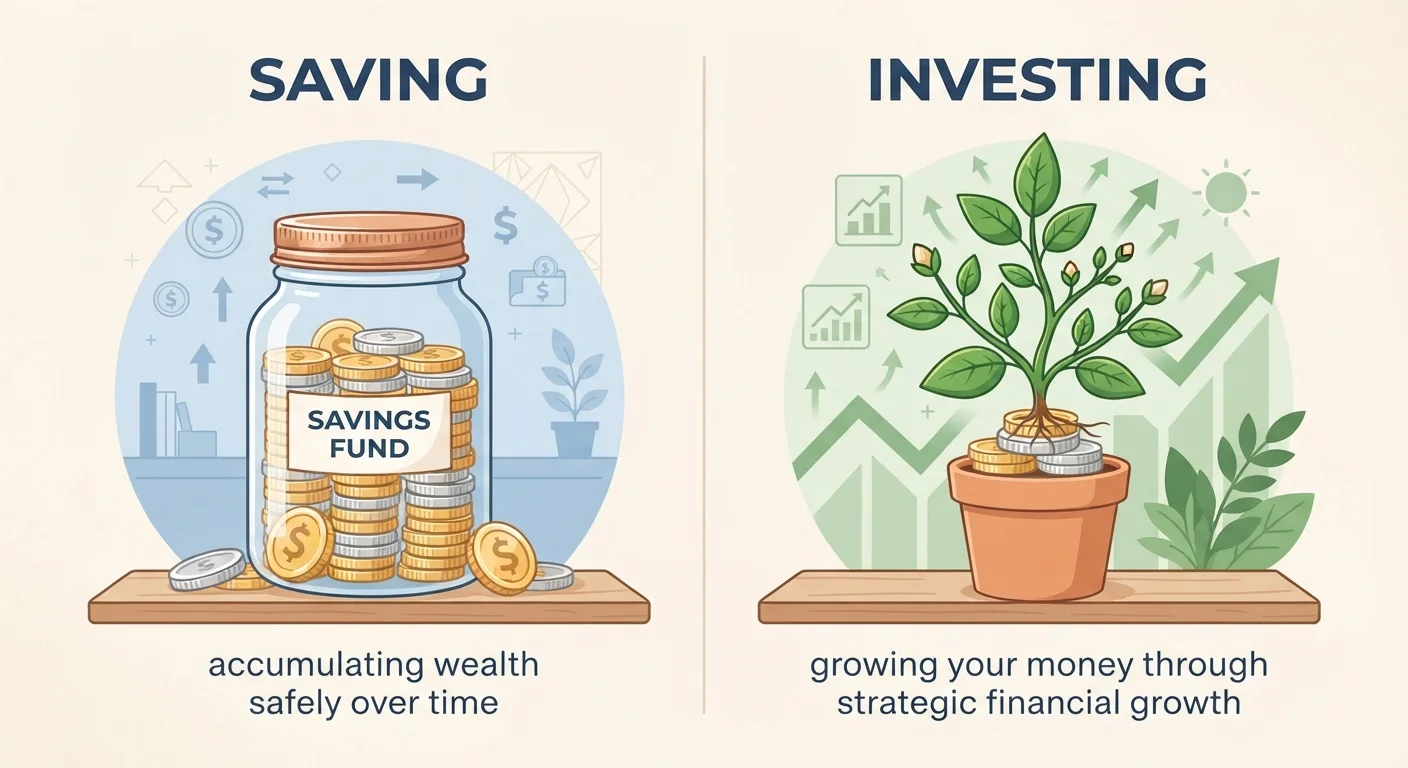
- Saving preserves money with minimal risk; investing grows money but carries the possibility of loss.
- Savings are best for short-term goals and emergencies; investments suit long-term objectives.
- Both saving and investing are necessary — they complement, not replace, each other.
- Starting to invest earlier generally allows more time for compounding growth to work.
- Your personal timeline and risk tolerance should guide how you balance the two.
Saving vs. Investing
Saving means setting aside money in a secure, accessible place — like a bank account — where the principal is protected and available when needed. Investing means putting money to work in assets such as stocks, bonds, or funds, with the expectation of growth over time but with the acceptance of some risk. Both are tools for building financial health, but they serve different goals and timelines.
In finance, saving is generally associated with low-risk, liquid instruments (e.g., high-yield savings accounts, money market accounts), while investing involves assets whose value can fluctuate and is typically measured over multi-year horizons.
Two Different Tools for Your Money
Many people use "saving" and "investing" interchangeably, but the two serve very different financial functions. Confusing them — or using only one — can leave gaps in your financial plan. Think of it this way: saving is your financial safety net, while investing is your financial engine.
Saving means storing money somewhere stable and accessible. A basic savings account, a high-yield savings account, or a certificate of deposit (CD) are common examples. Your principal — the amount you put in — is generally protected. The trade-off is modest returns, often at or below the rate of inflation over time.
Investing means allocating money into assets — stocks, bonds, real estate, index funds — that can grow in value over time. That growth potential comes with a corresponding risk: the value of investments can fall as well as rise. Understanding how compound interest works helps clarify why time in the market matters so much for long-term investors.
~56%
Americans who own stocks directly or through funds
According to Gallup polling, roughly 56% of U.S. adults report owning stocks, either directly or through accounts such as 401(k)s and IRAs.
3–6 months
Recommended emergency fund coverage
Financial educators broadly recommend keeping three to six months of essential living expenses in liquid savings before prioritizing investment contributions.
~2–5%
Typical high-yield savings account APY range
High-yield savings account rates vary with the federal funds rate; while higher than standard accounts, returns have historically trailed long-term market averages.
When to Save and When to Invest
The right approach depends on your timeline and the purpose of the money.
Save when:
- You need the money within one to three years
- You're building or maintaining an emergency fund
- The funds must be available on short notice without risk of loss
Invest when:
- Your goal is five or more years away (retirement, a child's education, long-term wealth)
- You already have adequate liquid savings
- You can tolerate short-term value fluctuations in exchange for long-term growth
For a closer look at how these priorities interact in practice, see our breakdown of emergency funds vs. investment accounts.
Match the Account to the Goal
Before putting money anywhere, ask yourself: 'When will I need this?' If the answer is within two to three years, prioritize a savings account or similar low-risk option. If the timeline stretches a decade or more, explore investment vehicles suited to long-term growth. Mixing up these priorities is one of the most common — and correctable — money mistakes.
The Risk and Return Trade-Off
One of the most important principles in personal finance is that risk and potential return are linked. Savings accounts carry very low risk — your balance won't drop — but the interest they earn rarely keeps pace with inflation. Over decades, money left only in savings can lose purchasing power.
Investments carry more risk, but historically diversified portfolios have outpaced inflation over long periods. That said, past performance does not guarantee future results, and all investing involves the possibility of loss.
“The stock market is a device for transferring money from the impatient to the patient.”
— Warren Buffett, Investor and Chairman of Berkshire Hathaway
This trade-off is why most financial planners recommend a layered approach: stable savings for near-term needs, investments for long-term goals. Many people also benefit from tax-advantaged accounts designed specifically for long-term investing — see our guide to retirement account types for a clear explanation of options like 401(k)s and IRAs.
If you're held back by uncertainty about whether investing is right for you, it's worth reading about common investing myths that often discourage people from starting.
This article is for general informational and educational purposes only. It does not constitute personalized financial, investment, tax, or legal advice. Consult a qualified financial professional before making decisions about your own financial situation.