

Key Takeaways
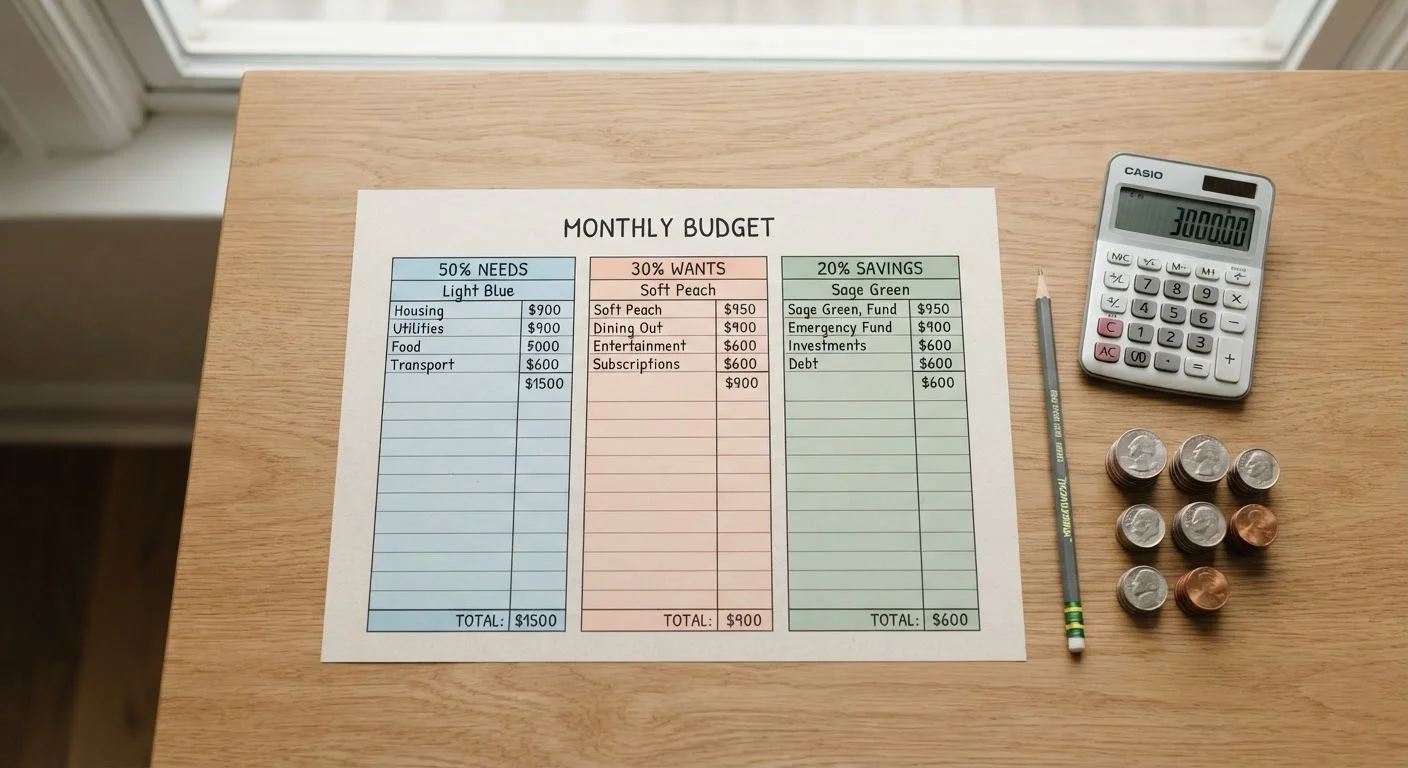
- The 50/30/20 rule divides after-tax income into needs, wants, and savings or debt repayment.
- Needs include essentials like rent, groceries, utilities, and minimum loan payments.
- Wants cover discretionary spending such as dining out, subscriptions, and entertainment.
- The 20% savings bucket should address both emergency funds and longer-term financial goals.
- The rule works best as a starting framework — it may need adjustment for higher-cost areas or lower incomes.
- Several alternative budgeting methods exist if this split doesn't fit your situation.
The 50/30/20 Rule
The 50/30/20 rule is a budgeting guideline that divides your after-tax income into three categories: 50% toward needs, 30% toward wants, and 20% toward savings and debt repayment. It was popularized by U.S. Senator Elizabeth Warren and her daughter Amelia Warren Tyagi in their 2005 book "All Your Worth." The rule is designed to give people a simple, memorable structure for managing money without requiring detailed expense tracking.
The percentages apply to net income — your take-home pay after taxes and payroll deductions — not gross income. This distinction matters because applying the rule to gross income would consistently overstate available funds.
How the Three Categories Break Down
The rule works by sorting every dollar of your monthly take-home pay into one of three buckets before you spend anything. Here's what each category includes:
- 50% — Needs: Housing costs (rent or mortgage), utilities, groceries, health insurance premiums, minimum debt payments, and basic transportation. These are expenses that, if skipped, carry real consequences such as eviction, loss of coverage, or damaged credit.
- 30% — Wants: Dining out, entertainment, travel, clothing beyond basics, subscriptions, and hobbies. These improve quality of life but are genuinely optional.
- 20% — Savings and debt repayment: Emergency fund contributions, retirement account deposits, and any debt payments above the minimum. This is the category most likely to be underfunded when budgets aren't intentional.
If you're new to budgeting entirely, the plain-language budgeting starter guide offers a broader foundation before applying any percentage framework.
34%
Americans with no emergency savings
A Bankrate survey found approximately one-third of U.S. adults reported having no emergency savings, illustrating why the 20% savings bucket in this framework targets this gap directly.
~33%
Median U.S. housing cost burden
The U.S. Census Bureau consistently reports that a substantial share of renters spend more than 30% of income on housing alone, which can push the 'needs' bucket above the 50% guideline for many households.
20%
Savings rate recommended by framework
Financial educators generally agree that saving at least 15–20% of income over a working lifetime supports adequate retirement preparedness, aligning with the rule's 20% allocation.
Where the Rule Works — and Where It Struggles
The 50/30/20 rule's greatest strength is also its greatest weakness: simplicity. For someone overwhelmed by detailed expense categories, having only three buckets lowers the barrier to starting. It also makes trade-offs visible — if needs creep above 50%, it immediately signals a structural problem rather than a willpower failure.
However, the rule makes several assumptions that don't hold universally:
- Cost of living varies dramatically. In cities where median rent consumes 40–50% of a modest income on its own, the 50% ceiling for all needs is unrealistic without significant lifestyle changes.
- Lower incomes are more constrained. For households with limited discretionary income, the 30% wants category may need to shrink substantially to keep needs covered and savings funded.
- It doesn't distinguish savings goals. Lumping an emergency fund, retirement contributions, and extra debt payments into one 20% bucket provides no guidance on prioritization.
Treat the Percentages as a Diagnostic Tool
If your real numbers don't match the 50/30/20 targets, don't abandon the framework — use the gaps as data. A needs category running at 60% tells you housing or fixed costs need addressing. A wants category near zero might indicate unsustainable restriction. The goal is a realistic picture, not a perfect split.
For a more granular alternative, zero-based budgeting and the envelope method assign specific purposes to every dollar — useful if you need tighter control.
Putting the Rule Into Practice
Applying the 50/30/20 rule starts with knowing your actual take-home pay. If your income varies month to month, use a conservative average. Then:
- Calculate 50%, 30%, and 20% of that number.
- List your fixed and variable essential expenses and check whether they fit under the 50% ceiling.
- Total your discretionary spending and compare it to 30%.
- Confirm that at least 20% is flowing toward savings, retirement, or debt reduction.
Gaps between targets and reality are informative, not shameful. Common budgeting myths often cause people to quit when their numbers don't fit neatly — in practice, the categories are starting points to refine over time.
Once you have a working version, habits that keep a budget working long-term can help make the monthly review feel routine rather than burdensome. For a practical step-by-step on building out the full monthly picture, see setting up a monthly budget from scratch.
This article is for general informational and educational purposes only. It is not personalized financial advice. Consult a qualified financial professional for guidance tailored to your specific circumstances.