

Key Takeaways
- Your credit score directly affects the interest rate lenders offer on a car loan.
- Even a small difference in interest rate can mean hundreds or thousands of dollars over a loan's life.
- Lenders typically group borrowers into credit tiers, with each tier carrying different rate ranges.
- Reviewing your credit report before applying can help you spot errors that may be dragging your score down.
- Shopping multiple lenders within a short window limits the impact on your credit score.
Credit Score & Auto Loan Terms
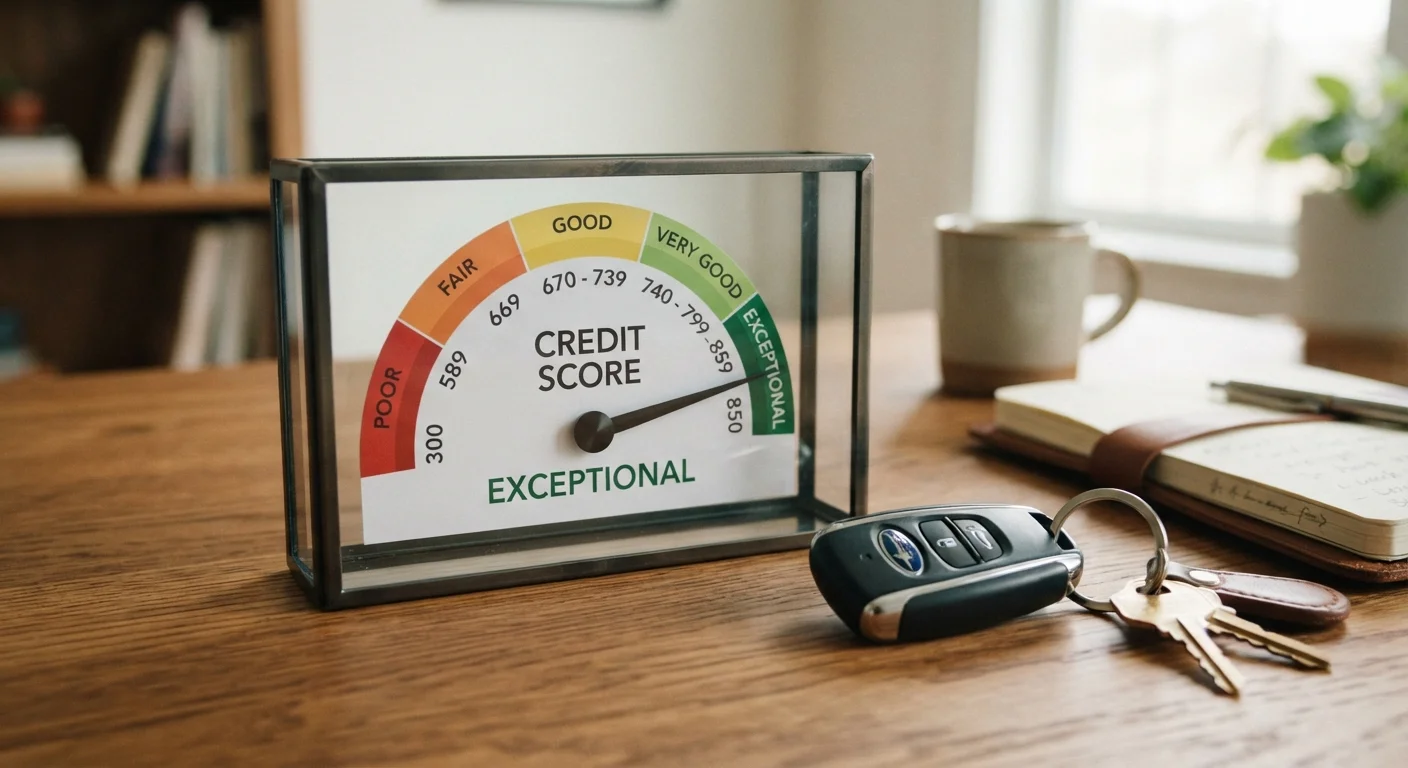
A credit score is a three-digit number that summarizes your history of borrowing and repaying debt. When you apply for a car loan, lenders use this number to gauge how risky it is to lend to you. A higher score generally means lenders view you as more reliable, which typically results in a lower interest rate and more favorable repayment conditions. A lower score signals greater perceived risk, often leading to higher rates or stricter terms.
Auto lenders often use industry-specific credit scores — such as FICO Auto Score 8 or 9 — rather than the general consumer FICO score, so the number a lender sees may differ slightly from the score you check yourself.
Why Lenders Care About Your Credit Score
When a lender evaluates your auto loan application, they are essentially asking one question: how likely is this person to repay? Your credit score distills years of borrowing behavior into a single number, giving lenders a standardized way to assess that risk quickly. Credit scores measure several factors, including payment history, the amount you owe relative to your available credit, the length of your credit history, and the mix of credit types you carry.
From a lender's perspective, a higher score signals that you've consistently met your obligations in the past, making it more reasonable to expect you'll do so again. A lower score doesn't automatically disqualify you, but it does signal greater uncertainty — and lenders typically price that uncertainty into the rate they offer.
Auto-Specific Credit Scores Exist
Many auto lenders use a version of the FICO score tailored specifically to vehicle financing, such as FICO Auto Score 8. These scores weight certain behaviors — like previous auto loan payment history — more heavily than a general consumer score does. As a result, the score a lender pulls may differ from the score you see through your bank or credit card app. For a broader understanding of how scores are constructed, see our credit scores explainer.
How Credit Tiers Translate to Loan Rates
Lenders generally sort applicants into credit tiers — broad groupings such as super-prime, prime, near-prime, subprime, and deep subprime. Each tier corresponds to a range of credit scores and a range of interest rates. The exact boundaries and rates vary by lender, but the pattern is consistent: the higher your tier, the lower the rate you're likely to be quoted.
~5%+
Typical APR gap between top and subprime tiers
Industry data consistently shows that borrowers in the lowest credit tiers pay significantly higher interest rates than prime borrowers — often five percentage points or more above the best available rate.
3 bureaus
Credit bureaus that compile your report
Equifax, Experian, and TransUnion each maintain independent credit files; lenders may check one or more, and your score can vary slightly between them.
To understand how these terms work together — principal, interest rate, loan length, and monthly payment — see our guide to how car financing actually works. Knowing the mechanics helps you see exactly why a rate difference of even one or two percentage points compounds meaningfully over a four- or five-year loan term.
What Affects Your Score Before You Apply
Several factors within your control influence where your score lands before you walk into a dealership or contact a lender. Payment history carries the most weight: consistently paying bills on time is the single strongest positive signal you can send. Credit utilization — how much of your available revolving credit you're using — is another major factor. Keeping utilization low is one of the more actionable ways to improve your score in a relatively short period.
It's also worth checking your credit report for errors before applying. Inaccurate negative entries — such as a late payment you never actually missed — can suppress your score unjustly. You're entitled to request your credit reports from each of the three major bureaus and dispute any inaccuracies you find.
Check Your Report Before You Apply
Request your credit reports from all three major bureaus and review them carefully for errors before submitting any loan applications. Disputing inaccuracies — such as incorrectly reported late payments or accounts that don't belong to you — can take time, so start this process several months before you plan to buy. Entering the market with an accurate, clean report gives you the best shot at the rate your history actually warrants.
Shopping Smart and Knowing Your Terms
Once you understand how your credit score shapes the offers you'll receive, you can approach the financing process more strategically. Getting pre-approved by multiple lenders before committing lets you compare annual percentage rates (APR), loan lengths, and any fees attached to the loan. Familiar yourself with key borrowing terms — such as APR, origination fees, and prepayment penalties — so you're evaluating the true cost of each offer, not just the monthly payment figure.
You may also want to consider whether a fixed or variable rate structure makes more sense for your situation. Fixed and variable auto loans carry different trade-offs in terms of predictability and risk. Whatever path you choose, entering the process with a clear picture of your credit standing gives you a realistic baseline for the terms you're likely to see — and a stronger position from which to negotiate.
This article is for general informational purposes only and does not constitute financial or legal advice. Consult a qualified financial professional for guidance specific to your situation.