

Key Takeaways
- Oil pressure takes several seconds to build after a cold start, leaving metal parts momentarily under-lubricated.
- Cold engine oil is thicker and flows more slowly, which is why oil viscosity ratings matter for your climate.
- The majority of engine wear occurs during cold starts, not during sustained highway driving.
- Modern fuel-injected engines do not need extended idling to warm up — gentle driving is more effective.
- Short, frequent cold starts are harder on an engine than fewer, longer drives.
Cold Start
A cold start occurs when you start a car engine that has been sitting long enough to cool to ambient temperature — typically after several hours or overnight. At this point, engine oil has drained down from upper components and the metal parts have contracted slightly due to cooling. The engine must work harder during these first moments than at any other time.
Engineers define a "cold start" more precisely as any startup occurring before the engine coolant reaches normal operating temperature, typically around 195–220°F (90–104°C) for most modern gasoline engines.
The First Seconds: Where the Stress Begins
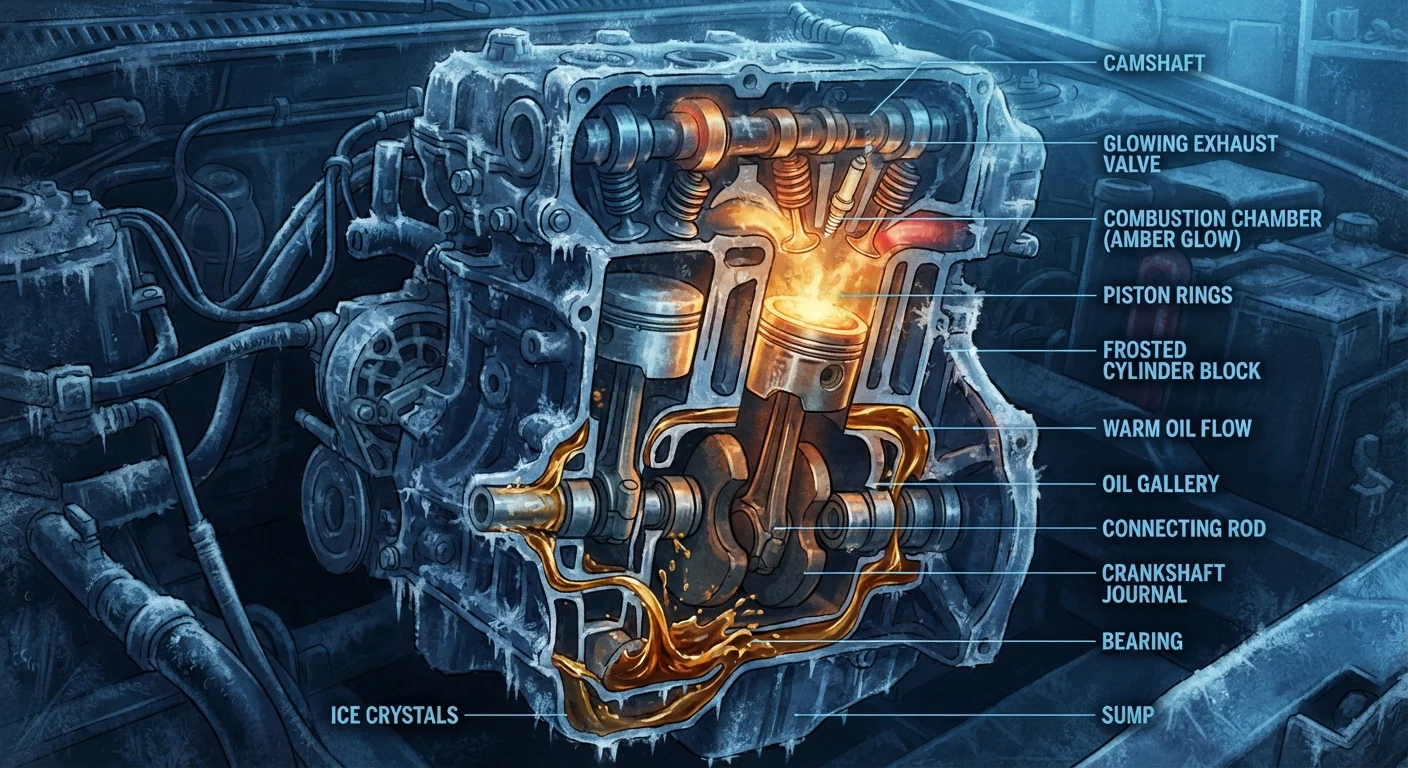
The instant you turn the key or press the start button, your engine fires into motion — but its lubrication system hasn't caught up yet. Oil settles into the pan at the bottom of the engine when the car sits idle, and it takes several seconds for the oil pump to draw that oil up and circulate it through narrow passages to bearings, camshafts, and cylinder walls.
During those first few seconds, metal components are moving against each other with minimal oil film between them. This brief window accounts for a disproportionate share of total engine wear over a vehicle's lifetime. The crankshaft bearings, camshaft lobes, and cylinder walls are particularly vulnerable until full oil pressure is established.
Cold oil compounds the problem. At low temperatures, engine oil thickens and resists flow. A 5W-30 oil, for example, is engineered to flow reasonably well at cold temperatures — the "5W" indicates its cold-weather viscosity behavior — but it still moves more slowly than it will once the engine warms up. Understanding oil viscosity grades can help you choose the right oil for your climate and driving patterns.
~75%
Engine wear attributed to cold starts
Industry engineering literature frequently cites that the majority of total engine wear occurs during startup and the initial warm-up phase rather than during sustained operation.
30–60 sec
Minimum idle time before driving gently
Most automakers and engineers recommend allowing a modern fuel-injected engine at least 30 to 60 seconds of idle before placing it under load.
195–220°F
Normal engine operating temperature range
Most gasoline passenger car engines are designed to run efficiently within this coolant temperature range, at which oil viscosity and component clearances are optimized.
What the Engine Is Doing to Compensate
Modern engines are designed with cold starts in mind, and several systems activate automatically to manage the transition. The engine control unit (ECU) — essentially the car's onboard computer — enriches the fuel mixture during a cold start. A richer mixture means more fuel relative to air, which helps combustion happen reliably when combustion chamber temperatures are low.
This richer mixture has a side effect worth knowing: excess fuel can wash past the piston rings and strip oil from cylinder walls, adding to early wear. It also explains why a cold engine running at idle produces slightly different exhaust characteristics than a warm one.
Simultaneously, the cooling system's thermostat remains closed, trapping coolant within the engine block to help it reach operating temperature faster. The engine essentially runs in a contained loop until it's warm enough to open that valve and circulate coolant through the radiator.
Remote Starters and Cold Starts
Remote starters allow the engine to warm up before you enter the vehicle, which does reduce cabin discomfort. However, an engine warming at idle still takes longer to reach full operating temperature than one driven gently under light load. If you use a remote starter, keep warm-up idle time reasonable — a few minutes is generally sufficient for most conditions — and still drive conservatively for the first portion of your trip.
Metal Clearances and Why Temperature Matters
Engine components are machined to extremely tight tolerances, but those tolerances assume the engine is at operating temperature. When cold, metal contracts. Pistons, rings, and cylinder bores each have slightly different thermal expansion rates, so at low temperatures, the fit between them is subtly off from its designed specification.
This means more blowby — combustion gases sneaking past the piston rings — and slightly less efficient power transfer until everything expands to its correct running dimensions. It's one more reason the first few minutes of operation are mechanically demanding.
This is also why short, frequent cold starts are more taxing on an engine than fewer, longer trips. Each cold start resets the lubrication and thermal cycle. Vehicles used primarily for very short commutes — never fully warming up — can accumulate wear faster and develop issues like moisture in the oil more readily. For a fuller picture of how seasonal conditions affect your vehicle, see our guide to seasonal car maintenance.
Protect Your Engine at Every Cold Start
Use the oil viscosity grade specified in your owner's manual for your climate — the cold-temperature rating directly affects how quickly oil reaches engine components after startup. After starting, allow 30–60 seconds of idle, then drive gently for the first few minutes. Avoid aggressive acceleration until the temperature gauge reaches its normal range.
Driving Habits That Protect Your Engine at Startup
The most important thing you can do after a cold start is avoid high engine loads for the first few minutes. Let the car idle for 30–60 seconds, then drive gently — keeping RPMs low — until the temperature gauge moves toward its normal position. This allows oil to reach all surfaces and the engine to warm through use rather than through idling, which is actually more efficient at raising temperature.
Extended idling in cold weather is a habit many drivers carry from older carbureted vehicles, which genuinely needed it. Modern fuel-injected engines do not. In fact, prolonged idling keeps the engine cooler than light driving would, prolonging the sub-optimal cold-start phase. This is one of the car maintenance myths worth setting aside.
Regular oil changes matter more than many drivers realize in this context. As oil ages, it loses viscosity stability and its cold-flow characteristics degrade. Fresh oil of the correct grade for your climate gives your engine the best chance of quick lubrication on startup. New car owners especially should pay attention to this — it's among the habits covered in our article on what new car owners often get wrong.
This article is for general informational purposes. Always consult your vehicle's owner's manual and a qualified mechanic for maintenance decisions specific to your car.