

Key Takeaways
- Seat selection and boarding-time preparation are the highest-leverage decisions you make before departure.
- Aligning your sleep to destination time — not departure time — cuts jet lag recovery significantly.
- Cabin air is extremely dry; consistent water intake matters more than any single in-flight comfort item.
- Brief movement every 60–90 minutes reduces discomfort and supports healthy circulation on long flights.
- Your first 24 hours on the ground largely determines how quickly your body resets to the new time zone.
Before You Board: Decisions That Shape the Whole Flight
The moment you click "confirm" on a long-haul booking, a countdown starts — and how you use it matters. Seat selection is where most experienced travelers put disproportionate effort, and for good reason. A window seat gives you wall support and control over when your neighbor needs to pass; an aisle seat sacrifices that but lets you move freely without negotiating. Bulkhead rows offer legroom but usually no under-seat storage and a hard tray table. Exit rows involve an agreed responsibility for emergency assistance — think this through honestly before selecting them.
Pack your carry-on as if your checked bag will be delayed. A change of clothes, any prescription medication, a small toiletry kit, and your sleep aids belong in the cabin with you, not in the hold. Loose, layered clothing — natural fabrics over synthetics where possible — helps you adapt to temperature swings in the cabin without overpacking.
Check in online as soon as the window opens if seat selection wasn't included in your fare. And read through the planning habits experienced travelers rely on before departure day — the small logistics that feel trivial at home can genuinely unravel a 14-hour flight.
Pack Your Sleep Kit Where You Can Find It
Don't bury your eye mask and earplugs at the bottom of your bag. Put them in an outer pocket or a small pouch you can grab immediately after takeoff. The first hour of a long-haul flight often has the best sleeping conditions — window shades down, activity low — and fumbling through luggage wastes it.
Managing Sleep and Circadian Timing
The common mistake is treating in-flight sleep as optional rest — something nice if it happens. On a flight crossing six or more time zones, it's closer to a strategic tool. The goal isn't just to sleep; it's to sleep at the right time relative to where you're going.
If you're flying eastward (say, New York to London), you want to sleep during the flight's overnight hours in London time, even if that means staying awake for the first few hours after takeoff. Westward travel is generally more forgiving — you gain hours rather than losing them. Tracking this mentally is easier than it sounds: most flight maps show destination local time.
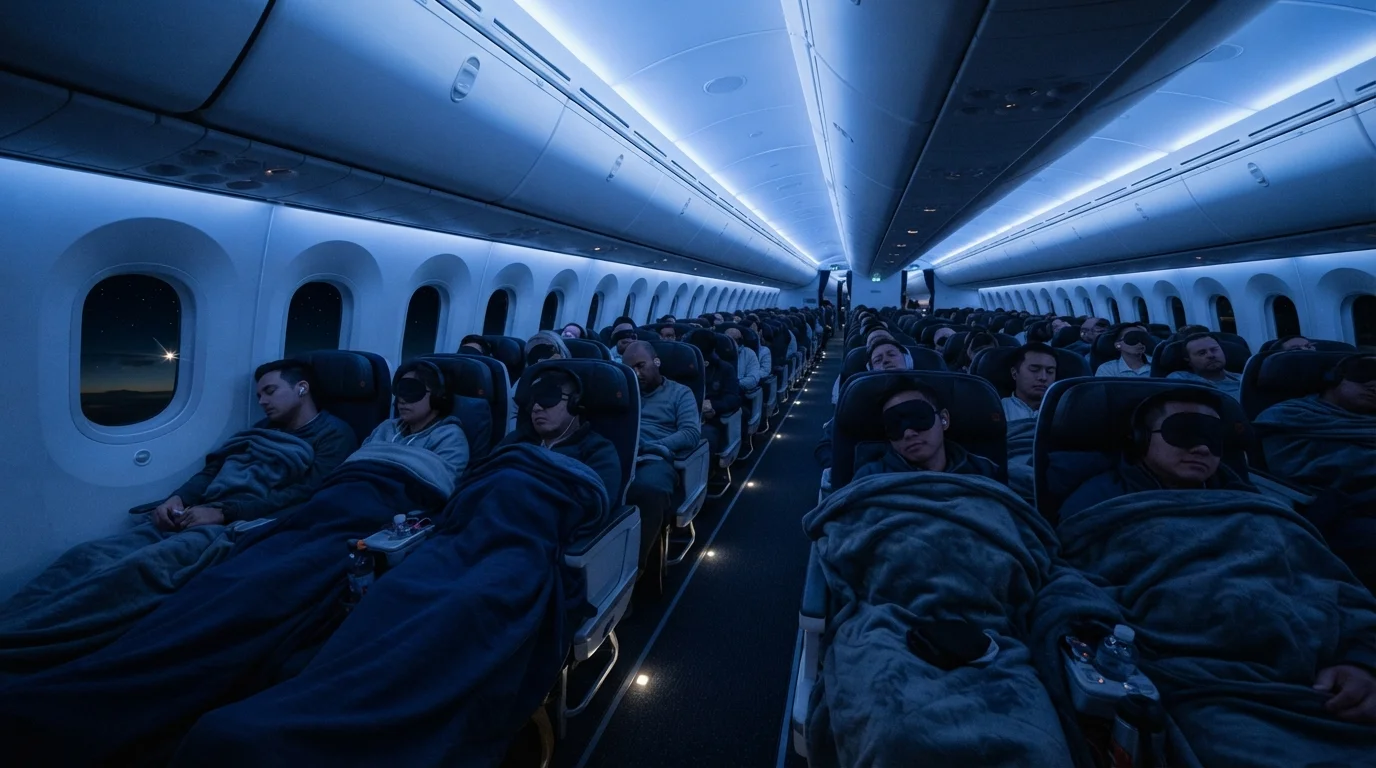
A sleep mask and noise-canceling headphones or foam earplugs are the two most effective tools for creating sleep conditions mid-flight. The cabin rarely goes fully dark, and ambient noise is constant. Whether you use a travel pillow depends on how you sleep upright — some people find neck pillows helpful; others find them disorienting. Experiment on shorter flights first.
Set your watch to destination time the moment you board, and make every decision — when to sleep, when to eat — based on that clock, not where you departed from.
Circadian adaptation begins with behavioral cues. Aligning your in-flight choices to destination time primes your body's internal clock earlier, which is associated with faster jet lag recovery.
If you can't sleep on the flight but need to, try staying awake for the full day before departure rather than napping — arriving on the plane genuinely tired is underrated.
Sleep pressure — the biological drive to sleep built up through wakefulness — is one of the most reliable tools for falling asleep in unfamiliar, uncomfortable conditions like an aircraft seat.
Hydration, Food, and Cabin Air
Airplane cabin air is pressurized to simulate altitudes of roughly 6,000–8,000 feet and is noticeably drier than typical indoor environments — often with humidity below 20%. That dryness accelerates dehydration, which worsens fatigue, headaches, and skin discomfort. The straightforward fix is consistent water intake: aim for water with every meal service and whenever you feel thirsty, rather than waiting for the cart to reach you. Bring an empty refillable bottle to fill after security.
Alcohol and caffeine both accelerate fluid loss and can fragment sleep — not a useful combination at altitude. That said, one drink with a meal won't derail a 15-hour flight for most adults. Moderation, not abstinence, is the realistic framing here.
In-flight meals tend to be high in sodium, which compounds fluid retention. If you know you're sensitive to bloating or digestive discomfort in the air, eating lightly before boarding and being selective with the meal service is a reasonable approach. Bringing a small snack — something protein-forward — gives you an option when the cart timing doesn't suit your hunger or sleep schedule.
<20%
Typical in-flight cabin humidity
Commercial aircraft cabins often maintain relative humidity below 20%, significantly drier than typical indoor environments, according to aviation health research.
6,000–8,000 ft
Equivalent altitude of pressurized cabin air
Most long-haul aircraft maintain cabin pressure equivalent to this altitude range, which can affect oxygen levels and contribute to fatigue.
Movement, Circulation, and Physical Comfort
Sitting still for 10-plus hours has real physical consequences. Deep vein thrombosis (DVT) — the formation of blood clots in the legs — is a recognized risk on very long flights, particularly for people with certain health conditions. This is worth taking seriously, not fearfully: brief movement every 60–90 minutes is widely recommended by aviation health bodies as a general precaution. A walk to the galley and back counts.
Compression socks are commonly recommended for long-haul passengers, especially those who stand for long periods in daily life, have a history of circulation issues, or are pregnant. If any of those apply to you, ask a healthcare provider before flying — this is one area where general information should give way to personal guidance.
Simple in-seat exercises — ankle rolls, calf raises, seated stretches — help when the seatbelt sign is on. Airlines often include these in their safety card or in-flight wellness content. Use them. The small awkwardness of doing ankle circles mid-row is nothing compared to arriving at your destination stiff and sore for days.
DVT Risk Is Real — Know Your Personal Context
While DVT risk from a single flight is low for most healthy adults, it rises meaningfully for people with clotting disorders, recent surgery, pregnancy, or certain medications. If any of these apply to you, consult a healthcare provider before a long-haul flight — not after. General movement tips are not a substitute for individual medical guidance in higher-risk situations.
Mental Load and Staying Sane in a Sealed Tube
Long-haul flights are one of the rare modern contexts where you're largely unreachable and have uninterrupted time. Some people find this anxiety-inducing; others find it unexpectedly restorative. Either way, managing the mental experience is as important as the physical.
Download entertainment before you board — streaming libraries vanish without Wi-Fi, and in-flight systems vary widely in quality. A mix of something engaging (a film or show you've looked forward to) and something low-key (a podcast or audiobook) covers different energy states across a long flight. Bring a book or e-reader as a screen break.
If flying itself causes you anxiety, the guidance on managing health and wellbeing while traveling has useful framing for preparation and coping strategies. Breathing exercises and grounding techniques are widely documented tools for managing in-flight anxiety — they don't require an app or a prescription, and they work.
“The body is not designed to cross multiple time zones in a single day. The good news is that with the right behavioral cues — light, meals, sleep timing — it adapts faster than most people expect.”
— Dr. Charles Czeisler, Sleep researcher, Division of Sleep Medicine, Harvard Medical School
Landing Ready: The First 24 Hours at Your Destination
How you handle the first day on the ground shapes the next several. The most consistent advice from frequent long-haul travelers: get on local time immediately. Eat meals when locals eat, resist the midday nap if it's daytime, and aim to sleep at a local bedtime even if you're not tired. Forcing the rhythm is uncomfortable for a day or two, but it's faster than letting your body drift back to home time.
Light exposure matters more than most people realize. Morning sunlight at your destination helps anchor your circadian clock to the new zone. A brief outdoor walk in the morning — even 15–20 minutes — is worth more than most supplements marketed for jet lag. Melatonin is sometimes discussed in this context; any use should be discussed with a healthcare provider, as timing, dosage, and suitability vary by individual.
Before you get swept into full activity, give yourself a recovery buffer. This is part of the broader logic behind good trip planning — not scheduling your most demanding day immediately after a red-eye. For more on building this kind of resilience into your itinerary from the start, see the complete trip planning reference.