

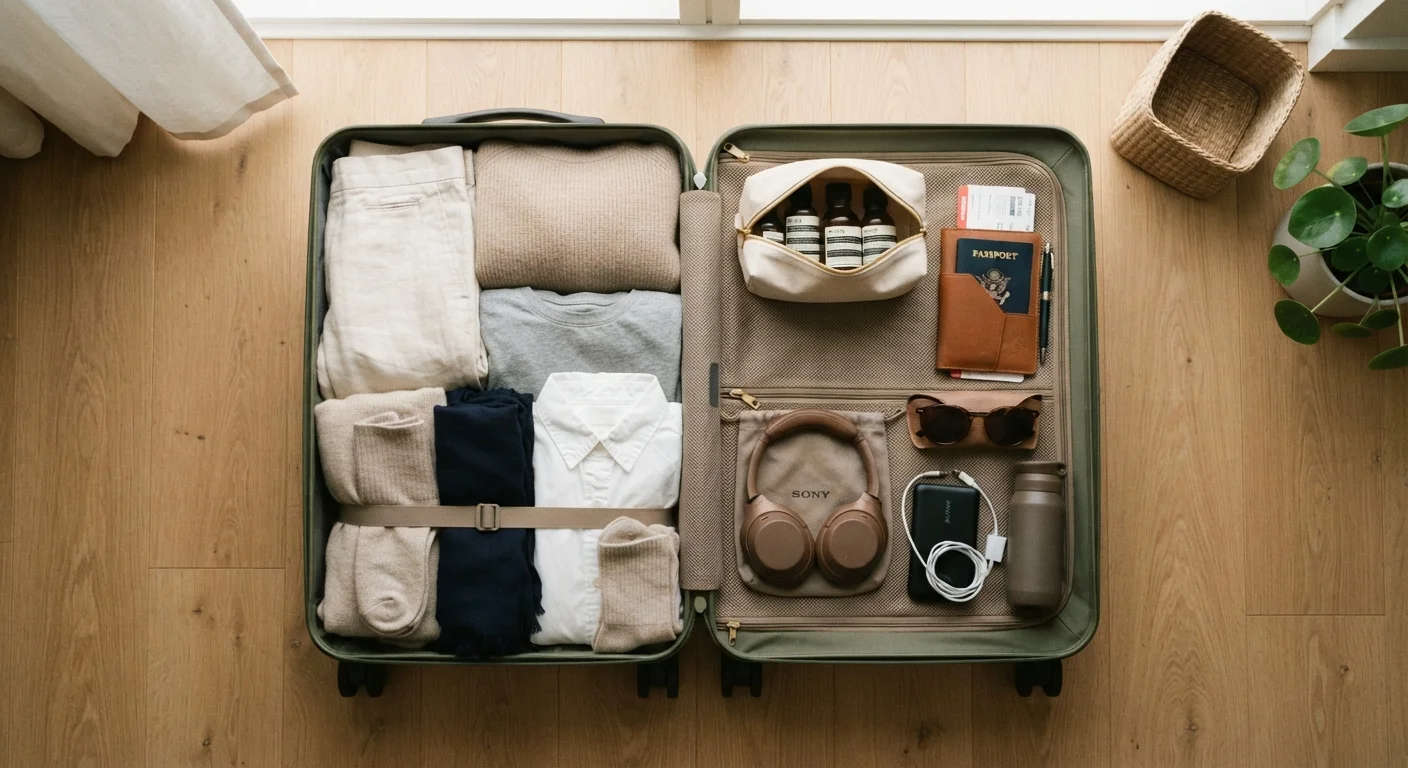
Key Takeaways
- A capsule wardrobe built around three neutral colors eliminates the need for excess clothing.
- Rolling clothes and using compression cubes can roughly halve the space your clothing occupies.
- Most airlines' standard carry-on allowance (around 20–22 liters) is workable for 14 days with the right strategy.
- Toiletries are the most common source of wasted space — decanting and buying locally saves significant room.
- Wearing your bulkiest items on travel days frees up critical bag space for everything else.
What you will need
Why Carry-On Only Changes Your Trip
There's a particular kind of freedom that comes from walking off a plane and heading straight to the exit — no baggage carousel, no checked-bag fees, no delayed luggage anxiety. Plenty of experienced travelers have discovered that packing for two weeks in a single carry-on isn't about deprivation; it's about clarity. You bring only what earns its place.
The skill is genuinely learnable. It requires some upfront planning, but the payoff compounds across every leg of your journey. Faster airport transitions, easier public transit, more flexibility to change accommodation on the fly — it all flows from that one disciplined decision at home. For everything that happens before you zip the bag, the pre-departure planning checklist is worth a read alongside this guide.
Before you start, confirm your airline's carry-on size and weight limits. These vary — sometimes significantly — between carriers and fare classes. What counts as a personal item on one airline may be a carry-on on another.
What you will need
Building a Capsule Wardrobe That Actually Works
The wardrobe is where most packing plans succeed or fall apart. A capsule wardrobe works because every piece coordinates with at least two others, which means you can create many combinations from a small number of items.
Start by anchoring your palette. Choose two neutral base colors — navy and stone, or black and olive, for example — and one accent. Every clothing item you pack should fit within that range. This isn't a style constraint; it's a logistics strategy. A shirt that only works with one specific pair of pants is a luxury a carry-on traveler can't afford.
A functional two-week capsule typically includes: five to six tops (a mix of casual and slightly dressier), two to three bottoms, one versatile mid-layer (a lightweight merino cardigan or zip fleece), one pair of comfortable walking shoes worn on travel days, one pair of sandals or dress shoes packed flat, underwear and socks for seven days (plan to do laundry once), and a single packable rain jacket. Merino wool and synthetic-blend fabrics resist odor, dry overnight, and compress well — qualities that matter at this scale.
Merino Wool: Worth the Investment
Merino wool tops can be worn two to three times before needing a wash without retaining odor — a practical advantage for carry-on travel. They also transition well between casual and slightly dressed-up settings, which reduces how many tops you need to pack overall.
Step-by-Step: Packing the Bag
With your items selected, the packing process itself follows a repeatable logic. The goal is to use every cubic inch intentionally. This is also where the habits of experienced travelers come into sharper focus — the method matters as much as the gear.
Audit your clothing selections before anything enters the bag
Lay every item you're considering on a flat surface. Then remove anything you haven't worn in the last two months, anything that requires special care, and anything that only works as a single outfit. If an item doesn't pair with at least two other things in the pile, it doesn't travel.
Handle toiletries before clothing
Toiletries are a space trap. Decant shampoo, conditioner, and body wash into 3.4 oz (100 ml) containers, or plan to buy basics locally. A solid shampoo bar eliminates the liquids question entirely. Restrict your toiletry bag to what fits in a single quart-sized zip bag. Medications, a small first-aid kit, and sunscreen are non-negotiable; everything else is optional.
Roll or fold-and-bundle your clothing
Rolling works well for casual knits, t-shirts, and synthetic fabrics — it reduces wrinkles and compresses volume. Bundle packing (wrapping garments around a central core) works better for dress shirts or items prone to creasing. Use packing cubes to group categories: one cube for tops, one for bottoms, one for undergarments. Label or color-code them so you're not unpacking everything to find a sock.
Load the bag in layers: heaviest to lightest
Place your heaviest items — shoes (in a reusable bag or shower cap to protect clothing), packing cubes, and toiletry bag — closest to the bag's back panel (the side resting against your back when carried). Mid-weight items like folded bottoms go in next. Lightest items, a packable jacket, and chargers go on top. This distribution keeps the bag stable and your back comfortable.
Use dead space intentionally
Stuff socks inside shoes. Tuck a power bank or small camera inside a rolled jacket. Thread a belt along the interior perimeter of the bag. Every hollow space is usable. This is the difference between a packed bag and an optimized one.
Wear your bulkiest items on travel day
Your thickest-soled shoes, jeans or heavier pants, and your mid-layer should be on your body when you board — not in your bag. This alone can free up two to three liters of space. If you're carrying a personal item (a daypack or tote), use it for in-flight items: book, headphones, snacks, and your travel documents wallet.
Don't Overload Your Personal Item
It's tempting to treat your personal item (daypack or tote) as overflow storage for your carry-on, but airline staff increasingly check both at boarding. Stuffing a second bag to capacity can result in being asked to gate-check one of them. Keep your personal item genuinely personal: documents, in-flight essentials, and a light layer.