
The Silk Road Cities of Uzbekistan: Samarkand, Bukhara, and Khiva Explained

Key Takeaways
- Samarkand, Bukhara, and Khiva are all UNESCO World Heritage Sites with well-preserved medieval architecture.
- Each city has a distinct character: Samarkand is monumental, Bukhara is lived-in, and Khiva is a preserved open-air museum.
- Uzbekistan has modernized its visa process significantly, making entry far easier for many nationalities than it once was.
- The best travel window is spring (April–May) or autumn (September–October) to avoid extreme summer heat.
- All three cities are connected by train, including a high-speed rail link, making overland travel practical.
Silk Road Cities of Uzbekistan
Samarkand, Bukhara, and Khiva are three ancient Central Asian cities that served as major trading and cultural hubs along the Silk Road — the network of overland routes connecting China, the Middle East, and Europe for over a millennium. Today they are UNESCO World Heritage Sites renowned for their staggering Islamic architecture, medieval old towns, and layered histories spanning Persian, Mongol, Timurid, and Russian empires. Together, they form the core of what most travelers experience when visiting Uzbekistan.
The term 'Silk Road' was coined by 19th-century German geographer Ferdinand von Richthofen; the routes themselves were far older, active from roughly the 2nd century BCE through the 15th century CE.
Samarkand: The City That Stopped the World
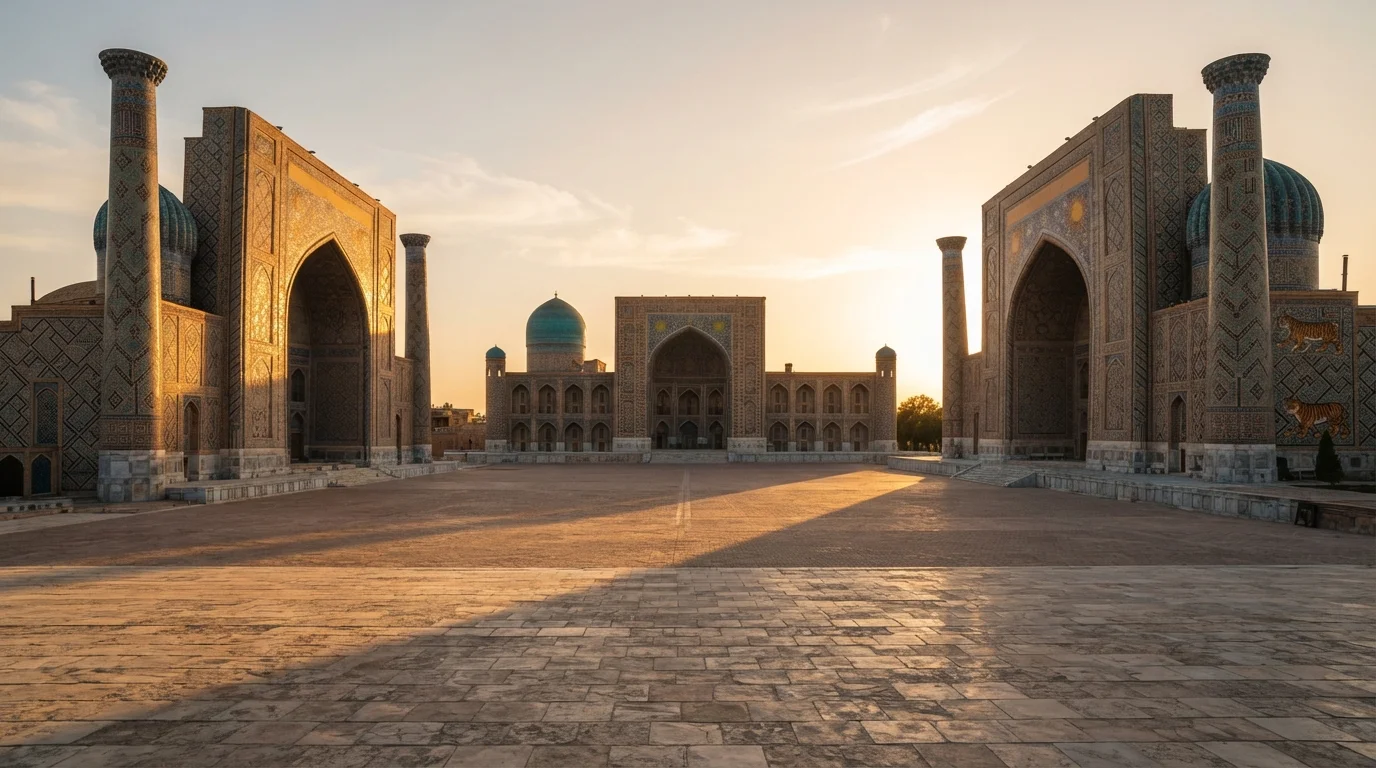
Standing in Registan Square for the first time is a quietly humbling experience. Three towering madrassas — their facades covered in geometry so precise it feels mathematical — frame a courtyard that once echoed with the footsteps of scholars, merchants, and conquerors. Samarkand has been doing this to visitors for centuries.
Founded over 2,500 years ago, the city reached its zenith under Timur (also known as Tamerlane) in the 14th and 15th centuries, when he made it the capital of a vast empire and filled it with architecture plundered from — or inspired by — every corner of his domain. The result is a skyline dominated by turquoise domes that catch light differently at every hour: the Shah-i-Zinda necropolis, a corridor of dazzling tiled mausoleums; the Gur-e-Amir, Timur's own tomb; and Bibi-Khanym Mosque, which was, at its construction, one of the largest mosques in the Islamic world.
Modern Samarkand is a mid-sized Uzbek city of roughly half a million people, and the historic monuments coexist with residential neighborhoods, busy markets, and a functioning university. Visitors who venture beyond the main sites will find locally owned tea houses and workshops where artisans still produce the hand-printed silk for which the region was historically famous.
Timing Your Visit to Registan Square
The square is most dramatically lit in the hour before sunset, when the tilework glows a deep cobalt. However, organized light shows take place on some evenings and can draw large crowds. If peaceful contemplation is your goal, aim for early morning on a weekday, when the site is typically quieter and the light is softer.
Bukhara: A City Still Living Inside Its History
If Samarkand is the spectacular headline, Bukhara is the absorbing long read. Its old city — a dense, walkable tangle of mud-brick lanes, bazaar domes, and caravanserais — is arguably the best-preserved medieval urban fabric in Central Asia. The monuments here are ancient even by the Silk Road's standards: the Samanid Mausoleum dates to the 10th century, making it one of the oldest intact Islamic structures in the region.
What sets Bukhara apart for many travelers is the sense that it is genuinely inhabited. Families live in courtyards behind wooden-carved gates; neighborhood mosques still hold daily prayers; and the Lyab-i-Hauz pond — once a communal gathering spot banned under Soviet rule — has returned to life as a place where locals and tourists alike sit in the evening shade. The city has around 140 registered architectural monuments, but it rewards slow walking and unplanned turns as much as it does structured sightseeing.
Bukhara's Soviet-Era Legacy
Uzbekistan was part of the Soviet Union until 1991, and Bukhara — like all three Silk Road cities — shows visible traces of that era alongside its ancient fabric. Soviet-era apartment blocks stand at the edges of the old city, and some monument restorations from that period are now considered controversial for prioritizing appearance over historical accuracy. Travelers will encounter this complexity firsthand, and it adds a genuinely interesting dimension to the experience.
Bukhara also carries a complex layered identity: it was a major center of Jewish culture for over a millennium, home to the Bukharan Jewish community whose members have dispersed globally but left behind synagogues and a distinctive artistic tradition still visible in the city's craft workshops.
Khiva: The Open-Air Museum at the Edge of the Desert
Khiva is the most remote and, to many eyes, the most surreal of the three cities. Its inner walled city, the Ichan-Kala, is so completely preserved that it can feel less like a living town and more like a stage set — though people do still live and work within its earthen walls. Arriving at the Ata Darwaza gate after the long journey west from Bukhara, travelers often describe a distinct sense of having stepped across a threshold in time.
The city's centerpiece is the unfinished Kalta Minor minaret — a squat, turquoise-tiled tower that was meant to be the tallest minaret in the Islamic world before the khan who commissioned it died and construction halted. It now stands as an unexpectedly poetic monument to ambition. The Juma Mosque, supported by 218 carved wooden columns collected from earlier structures, is equally distinctive.
2,500+
Years of continuous settlement in Samarkand
Samarkand is one of the oldest continuously inhabited cities in Central Asia, with archaeological evidence of settlement dating back over two and a half millennia.
140+
Registered architectural monuments in Bukhara
UNESCO recognizes Bukhara's historic centre as an exceptional example of well-preserved medieval Islamic urban planning.
~1.5 hrs
High-speed train time: Samarkand to Bukhara
The Afrosiyob high-speed rail service, operating at speeds up to 155 mph, has dramatically changed overland travel between Uzbekistan's two most visited Silk Road cities.
Because Khiva sees fewer visitors than Samarkand or Bukhara, it retains a quieter atmosphere, particularly in the early mornings and evenings when day-trippers have cleared out. Staying overnight inside the Ichan-Kala — several guesthouses operate within the walls — is widely considered among the more memorable lodging experiences in Central Asia.
Planning a Practical Silk Road Journey
Most visitors structure their Uzbekistan trip around the Tashkent–Samarkand–Bukhara–Khiva corridor, spending two to three nights in each city. The high-speed Afrosiyob train between Tashkent and Samarkand (about two hours) and on to Bukhara makes that portion straightforward. Khiva requires more logistical planning — an overnight train from Bukhara to Urgench and a taxi transfer, or a domestic flight, are the most common approaches.
Accommodation ranges from Soviet-era hotels to beautifully restored caravanserais converted into boutique guesthouses. Food is built around plov (a rice and meat dish considered Uzbekistan's national dish), lagman noodles, samsa pastries, and spectacular fresh melons and pomegranates in season. Uzbek hospitality is genuine and often spontaneous — accepting an invitation for tea is rarely a bad decision.
Travelers should dress modestly when visiting mosques and mausoleums — covered shoulders and knees are expected — and carry cash for bazaars and smaller restaurants. Photography is generally welcomed at monuments, though it is always polite to ask before photographing local people. For entry requirements, health precautions, and the latest travel advisories, check official sources such as travel.state.gov well before departure.
“The towns of Central Asia are not ruins — they are places where the past is still being negotiated with the present, one restored tile at a time.”
— Colin Thubron, Travel writer and author of 'The Lost Heart of Asia'