

Key Takeaways
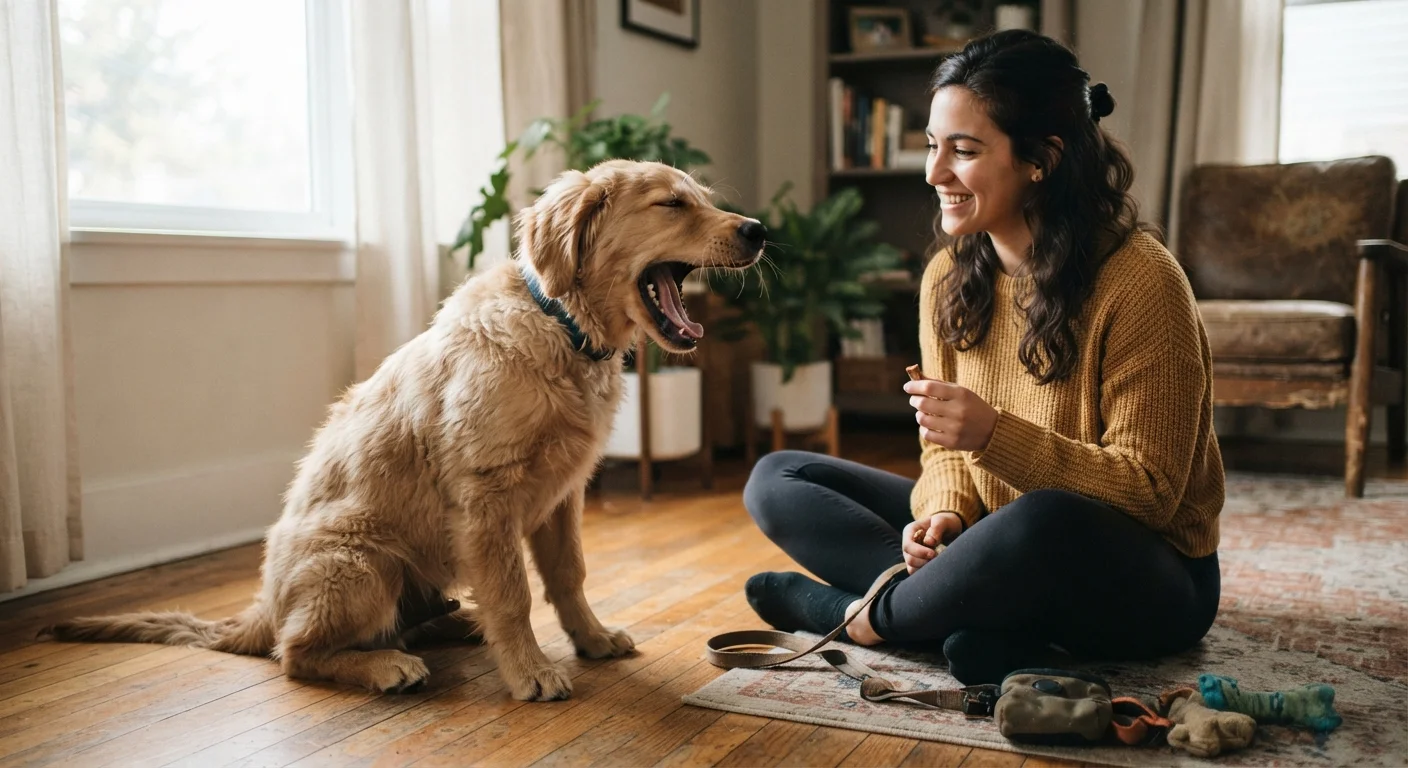
- A dog yawning during training is most often a calming signal, not a sign of sleepiness.
- Yawning can indicate stress, confusion, or that the training session is too long or intense.
- Recognizing yawning as communication helps you adjust your approach before frustration builds.
- Short, positive training sessions reduce the likelihood of stress signals appearing.
- Pairing yawn recognition with other body language cues gives a fuller picture of your dog's state.
Calming Signals in Dogs
Calming signals are a set of subtle body language cues dogs use to communicate stress, discomfort, or a desire to de-escalate tension. Yawning is one of the most common calming signals and can mean your dog feels pressured, confused, or overwhelmed — not necessarily sleepy. Norwegian dog trainer and behaviorist Turid Rugaas popularized this concept and identified over 30 distinct signals dogs use in everyday social communication.
Calming signals are rooted in canine ethology — the scientific study of animal behavior in natural contexts. They function as appeasement gestures directed at both humans and other dogs.
Yawning Is a Language, Not Just a Reflex
Most owners assume a yawning dog is simply tired. In a training context, that assumption can lead you to push harder when your dog actually needs a break — or a completely different approach. Dogs use yawning as one of many calming signals: deliberate communicative behaviors meant to express or reduce social tension.
When your dog yawns mid-session, it is often responding to perceived pressure. That pressure might come from your tone of voice, a repeated command they don't fully understand, or simply the duration and intensity of the session itself. The yawn is your dog's way of saying, "I'm finding this difficult," or "I need a moment."
Understanding this distinction is the foundation of more effective, compassionate training. For a broader look at how dogs and other pets communicate through their bodies, see our body language reference guide.
“If you learn to read the calming signals your dog uses, you will be able to understand your dog far better and communicate much more effectively. Yawning is one of the clearest signals dogs have.”
— Turid Rugaas, Norwegian dog trainer and author of 'On Talking Terms with Dogs: Calming Signals'
Common Reasons Dogs Yawn During Training
Yawning during a training session can stem from several overlapping causes. Identifying which one applies to your dog helps you make targeted adjustments.
- Stress or anxiety: If your dog is uncertain about what's expected — or senses frustration in your voice — yawning is a self-soothing and appeasement response. It signals discomfort without aggression.
- Mental fatigue: Training requires intense cognitive effort. Dogs, especially younger or less experienced ones, can reach their processing limit faster than owners expect. Yawning here signals cognitive overload.
- Session length: Sessions that run too long are one of the most common triggers. Most dogs benefit from training sessions of five to ten minutes, repeated across the day rather than all at once.
- Confusing cues: Inconsistent hand signals, varying verbal commands, or jumping between skills can leave dogs struggling to decode what you want. Confusion often manifests as calming signals, including yawning.
- Ambient stressors: Distracting environments — a new location, loud noises, or unfamiliar people nearby — can elevate your dog's baseline stress and make calming signals appear earlier than usual.
End Every Session on a Win
When you notice your dog yawning, don't simply stop the session abruptly. Ask for one easy behavior your dog knows reliably — like a sit — then reward and end. This ensures your dog's last experience of training that day is a positive one, which helps maintain their enthusiasm for future sessions.
Yawning rarely appears in isolation. Watch for clusters of calming signals together — yawning paired with lip-licking, looking away, or slow blinking is a stronger indicator that your dog needs a reset. Our article on chronic stress signs in pets outlines when these patterns may warrant professional guidance.
How to Respond When You See the Yawn
The right response depends on context, but a few principles apply consistently:
- Pause, don't punish. Never correct a dog for displaying a calming signal. These are honest communications, and suppressing them removes your ability to read your dog's state.
- Simplify the task. Ask for a behavior your dog knows confidently — a sit, a hand touch — and reward it. End the sequence on a positive note before taking a break.
- Shorten future sessions. If yawning appears early and often, reduce session length and increase frequency instead. Multiple short sessions outperform one long, draining one.
- Check your own energy. Dogs are highly attuned to human emotional states. If you're tense, hurried, or frustrated, your dog will feel it. Taking a breath and lowering your own arousal often visibly relaxes a dog within seconds.
5–10 min
Recommended training session length for most dogs
Professional trainers and animal behaviorists generally recommend keeping individual sessions to five to ten minutes to prevent mental fatigue and maintain engagement.
30+
Distinct calming signals identified in dogs
Behaviorist Turid Rugaas documented over 30 calming signals in her foundational research on canine communication, with yawning among the most frequently observed.
Understanding your dog's full emotional vocabulary — not just yawning — makes every interaction more productive. Our guide to what your pet's body language is telling you covers the broader picture of canine emotional expression.
Building Training Sessions That Reduce Stress Signals
Prevention is more effective than reaction. Structuring training thoughtfully from the start significantly reduces how often calming signals appear — and makes the experience genuinely enjoyable for both of you.
Keep sessions short and frequent. Use high-value reinforcement consistently, and vary the skills you practice to maintain engagement without overloading any single behavior chain. Train in a calm environment before gradually introducing distractions as your dog's confidence grows.
Pay attention to the sequence of your sessions: always begin with something easy, build to the challenge, then return to something easy before ending. This arc keeps your dog in a positive emotional state throughout.
If yawning and other stress signals persist despite these adjustments, consider consulting a certified professional dog trainer or veterinary behaviorist. Persistent stress signals can sometimes point to deeper anxiety that benefits from professional support — and in rare cases, frequent unexplained yawning may have a physical component worth discussing with your vet.
This article is for general educational purposes and does not constitute veterinary or professional behavioral advice. If you have concerns about your dog's health or behavior, consult a qualified veterinarian or certified animal behaviorist.