

| Primary function of tail signals | Communicating emotional state and social intent |
| Friendly greeting tail position | Vertical (upright), often with a curved tip |
| Warning tail signal | Rapid side-to-side lash or puffed tail |
| Fear/anxiety tail position | Low or tucked between the legs |
| Affiliative (bonding) tail gesture | Tail wrapped around another cat or person |
| Piloerection cause | Involuntary nervous system response to fear or agitation |
Why the Tail Is Your Cat's Emotional Broadcast
Cats communicate constantly — not through words, but through posture, ear angle, whisker position, and, most expressively, their tails. The tail acts as a real-time emotional readout, shifting position, tension, and movement as your cat's mood changes. Unlike a dog's wagging tail, which most people instinctively interpret as happiness, a cat's tail signals require a closer look to decode accurately.
Understanding tail language is one of the most practical skills a cat owner can develop. It helps you recognize when your cat wants interaction, when it needs space, and when something may be wrong. For a broader view of how body posture fits into the picture, see our full pet body language reference.
| Primary function of tail signals | Communicating emotional state and social intent |
| Friendly greeting tail position | Vertical (upright), often with a curved tip |
| Warning tail signal | Rapid side-to-side lash or puffed tail |
| Fear/anxiety tail position | Low or tucked between the legs |
| Affiliative (bonding) tail gesture | Tail wrapped around another cat or person |
| Piloerection cause | Involuntary nervous system response to fear or agitation |
Common Tail Positions and What They Signal
Each tail position carries a specific meaning. Here is a plain-language breakdown of the most common ones:
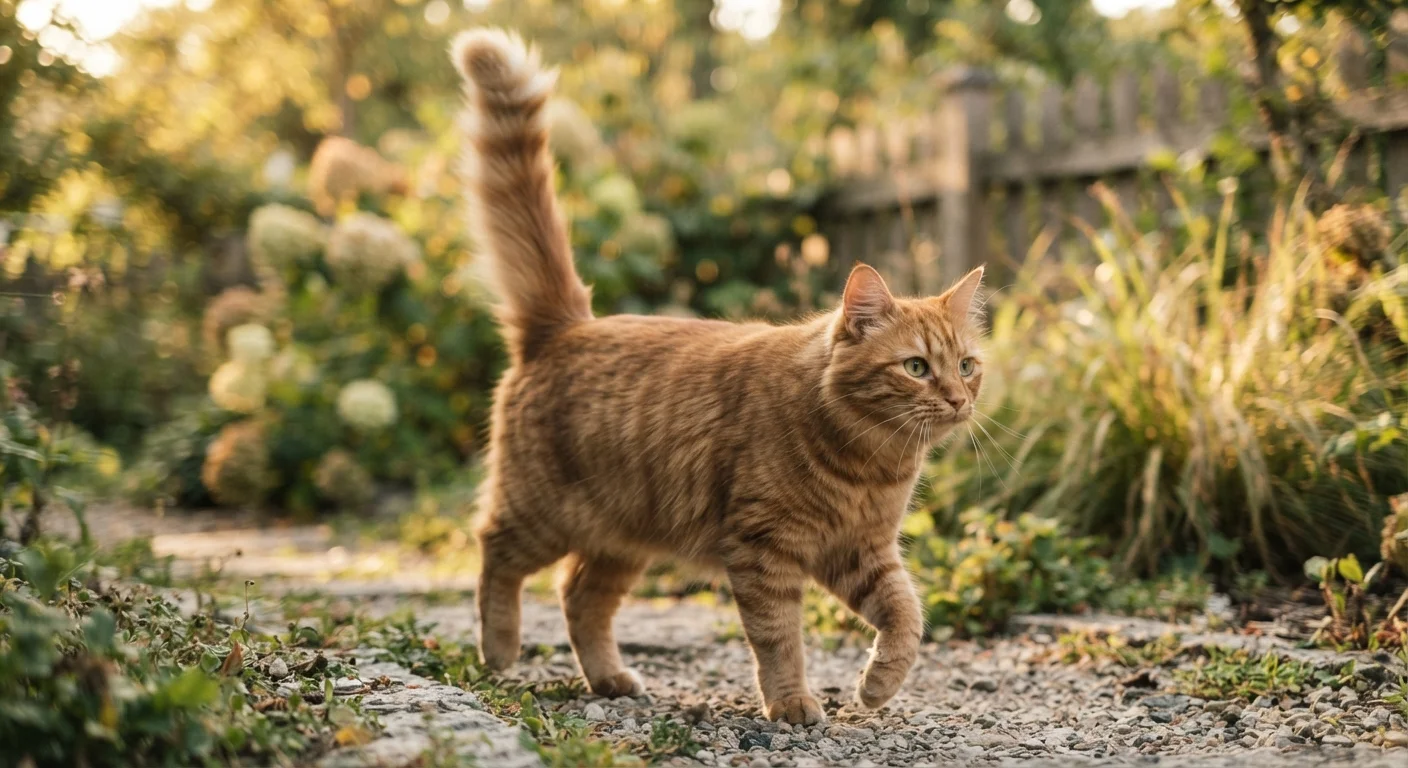
- Tail held high and vertical
- This is a confident, friendly greeting signal. A cat approaching you with its tail straight up is saying it feels safe and is happy to engage. The tip may curl slightly forward — a sign of particular enthusiasm.
- Tail vertical with a hook or question-mark curve at the tip
- A playful, curious cat. Often seen when a cat approaches a person or another pet it likes but is also gently gauging the situation.
- Tail held low or tucked between the legs
- Submission, fear, or anxiety. A cat holding its tail this way is uncomfortable and is signaling it does not want confrontation. Give the cat space and try to identify and remove any stressors.
- Tail puffed up (piloerection)
- The hair along the tail stands on end, making it appear much larger. This happens when a cat is frightened or highly agitated. It is an involuntary response driven by the nervous system. Do not attempt to pick up or pet a puffed-tail cat.
- Tail lashing or whipping side to side
- Unlike the slow wag of a content dog, a fast, forceful side-to-side lash in cats signals irritation or arousal. If you are petting your cat and the tail starts lashing, stop and give it a moment.
- Slow, gentle sway while lying down
- Mild interest or light alertness — often seen when a cat is watching something move. The cat is engaged but relaxed.
- Tail wrapped around another cat or a person
- A social, affiliative gesture. It is essentially a feline hug and a sign of trust and comfort.
Piloerection
The involuntary erection of hair caused by tiny muscles at the base of each follicle contracting. In cats, it makes the tail appear dramatically larger and usually signals fear or intense agitation.
Affiliative behavior
Actions that promote social bonding and friendly relationships between individuals. Tail-wrapping and head-bunting are common affiliative behaviors in cats.
Arousal (behavioral)
A heightened state of alertness or emotional activation — not necessarily aggressive, but indicating that a cat is intensely stimulated. High arousal calls for caution and de-escalation.
Baseline behavior
The normal, everyday patterns of behavior that are typical for a specific individual animal. Knowing your cat's baseline makes it easier to notice meaningful changes in signals or posture.
Reading the Whole Picture
Tail position is most accurate when read alongside other signals. A tail held high while ears are pinned flat tells a different story than a tail held high with forward-pointing ears and relaxed whiskers. Context always matters.
Pay attention to these additional cues together with tail position:
- Ear angle: Forward ears generally indicate curiosity or friendliness; flattened ears suggest fear or aggression.
- Pupil size: Dilated pupils in normal lighting can mean excitement, fear, or overstimulation.
- Body posture: A crouched, low body paired with a lashing tail is a clear warning to back off.
- Vocalizations: Hissing, growling, or chirping add important emotional context to tail signals.
The more you observe your individual cat's baseline behavior, the easier it becomes to recognize when something is off. Changes in tail carriage that persist — such as a cat that suddenly holds its tail at an unusual angle or stops using it normally — can occasionally indicate pain or injury and are worth mentioning to your veterinarian.
For more on how animals broadcast their inner states, see what your pet's body language is actually telling you.
When Tail Changes May Mean a Health Issue
Persistent changes in tail position or movement — such as a limp tail, a tail held consistently at an odd angle, or a cat that appears sensitive when the tail is touched — can be signs of nerve damage, injury, or pain rather than a behavioral signal. These changes warrant a veterinary evaluation. This article is for general educational purposes and is not a substitute for professional veterinary advice.