

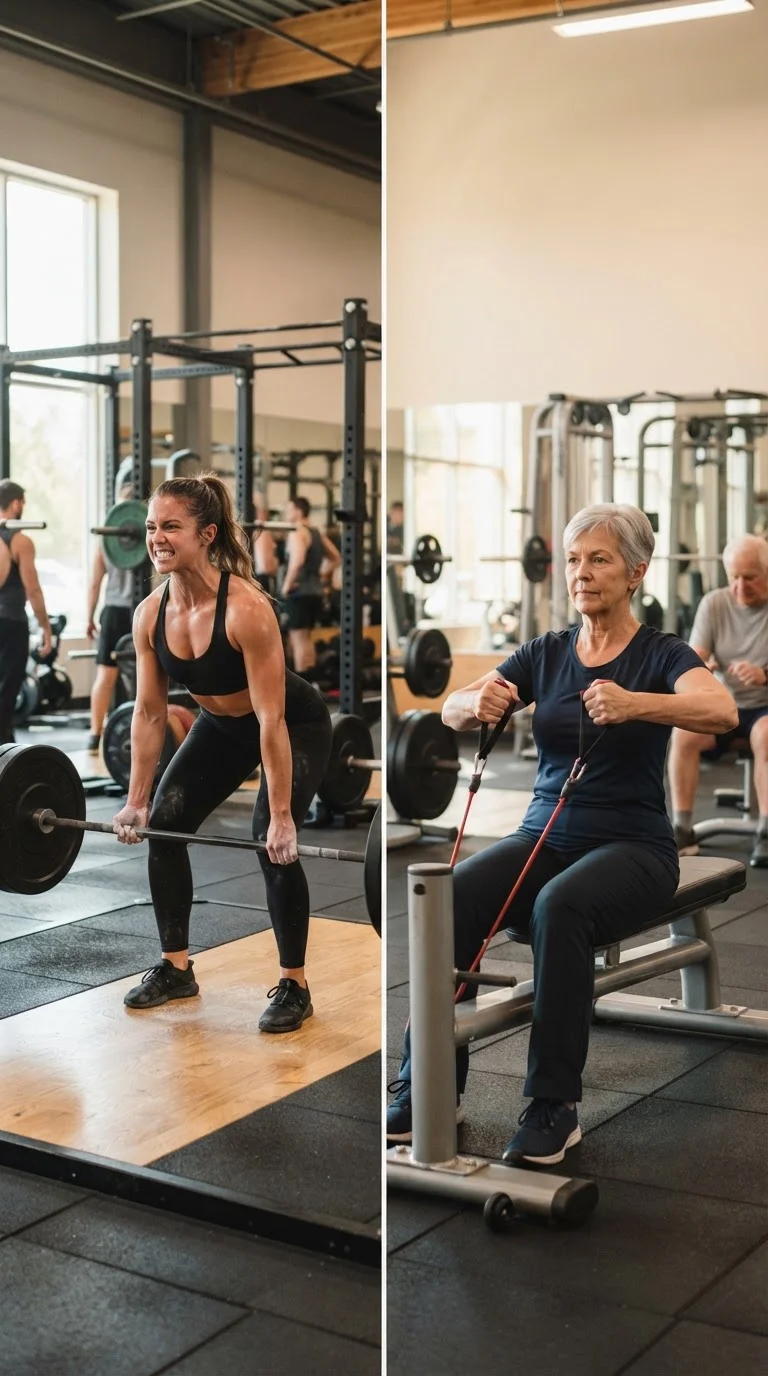
Key Takeaways
- Muscle mass naturally declines with age, making resistance training increasingly important after 30.
- Training goals shift from building size and performance in younger decades to preserving function and bone density later.
- Recovery time lengthens with age, requiring more intentional rest and programming adjustments.
- Joint health and mobility become central training considerations from the 40s onward.
- It is never too late to begin or return to strength training — benefits are well-documented at every decade.
Why Age Changes Everything About How You Should Train
Strength training is often discussed as a single practice, but the biological reality is that your musculoskeletal system changes substantially across your lifespan. What serves a 25-year-old athlete well may underserve — or even injure — a 60-year-old with different recovery capacity, hormonal milieu, and joint wear. Understanding those shifts is not about lowering expectations; it is about training smarter.
The foundation is a process called sarcopenia — the gradual, age-related loss of muscle mass and strength that begins in most people around their mid-30s and accelerates after 60. Research consistently shows that resistance exercise is among the most effective tools for slowing this process. But the approach that maximises those benefits looks quite different depending on which decade you are in.
What happens physiologically when you begin exercising provides essential context — the body adapts to resistance stimulus at every age, but the speed, magnitude, and nature of those adaptations change over time.
Your 20s: Build the Foundation While Adaptation Is Fastest
The late teens through mid-20s represent peak anabolic capacity — meaning the body responds to resistance training with the greatest speed and magnitude. Testosterone, growth hormone, and insulin-like growth factor (IGF-1) are all at or near lifetime highs, supporting both muscle protein synthesis and bone mineral density accrual.
This decade is the physiological window to build peak bone mass, which matters enormously later: higher peak bone density in young adulthood is associated with lower fracture risk decades down the line. Strength training during this period can also establish neuromuscular patterns — the coordination between nerves and muscles — that persist and prove protective throughout life.
Practically, this means the 20s are well-suited for higher training volumes and heavier progressive loading. Recovery is faster, and the system tolerates more training stress. The priority should be learning proper movement mechanics under load, since technique errors ingrained early become harder to correct and increase injury risk later.
Peak bone mass built in the 20s provides a protective buffer that pays dividends for decades.
Your 30s: Maintain Momentum as Hormonal Output Begins to Shift
For many people, the 30s bring no dramatic performance decline — but subtle hormonal changes begin. Testosterone levels in men typically start a slow, gradual decline around 30. Women experience their own hormonal fluctuations, particularly toward the late 30s as perimenopause can begin. Metabolic rate also tends to slow modestly, and recovery between sessions may take slightly longer than in the 20s.
This is also the decade when life demands — career, family, schedule — compete most aggressively with training time. The risk is not physical decline so much as de-training due to inconsistency. Maintaining two to three resistance sessions per week, even at moderate volume, is sufficient to preserve the muscular base built earlier.
Nutrition becomes increasingly relevant: adequate dietary protein supports muscle protein synthesis as anabolic hormone levels begin to taper. General guidance from dietitians and sports medicine organisations points toward consistent protein distribution across meals rather than one large intake, though individual needs vary and a registered dietitian can provide personalised direction.
Consistency in the 30s matters more than intensity — maintaining muscle is the primary goal.
Your 40s: Prioritise Joint Health and Recovery as Much as Load
The 40s typically mark a more perceptible shift. Connective tissue — tendons, ligaments, and cartilage — becomes somewhat less elastic and takes longer to recover from heavy loading. Hormonal changes are more pronounced for women approaching or entering menopause, with declining estrogen accelerating bone loss and reducing some protective effects on joints. Men continue their gradual testosterone decline.
Training in this decade should not become timid, but it should become more deliberate. Warming up thoroughly before sessions is no longer optional — it is a genuine injury-prevention measure. Exercise selection may shift toward movements that load joints through comfortable, controlled ranges of motion rather than maximal range under heavy load.
This is also the decade to take mobility training seriously alongside strength work. Restricted hip or shoulder mobility doesn't just limit performance; it forces compensatory patterns that stress adjacent structures. Addressing mobility proactively reduces cumulative wear.
In the 40s, how you train — warm-up, form, recovery — matters as much as what you lift.
Your 50s: Bone Density and Functional Strength Take Centre Stage
Sarcopenia accelerates in the 50s, and for women who have passed through menopause, the rate of bone mineral density loss increases significantly due to estrogen withdrawal. The World Health Organization and major bone health organisations identify resistance training as a primary non-pharmacological strategy for maintaining bone density and reducing osteoporosis risk — it creates mechanical stress on bone that stimulates remodelling and strengthening.
Functional strength — the ability to carry groceries, rise from a chair, climb stairs without assistance — becomes a meaningful training target alongside aesthetic or performance goals. Exercises that mimic real-world movement patterns (squats, hinges, carries, step-ups) are especially valuable here.
Volume may need to be modulated downward compared to peak training years, but intensity should not be eliminated. Research suggests that muscles at this age still require meaningful challenge — defined as working close to momentary muscular fatigue — to stimulate adaptation. Training exclusively with very light loads is not as effective for maintaining muscle mass or bone density.
Bones respond to mechanical load — resistance training remains one of the best tools against bone loss.
Your 60s and Beyond: Consistency, Safety, and Longevity of Function
Evidence is unambiguous that resistance training in the 60s, 70s, and older is both safe and effective for most people. Studies consistently show older adults can make meaningful gains in muscle mass, strength, and balance even when beginning for the first time in later life. The caveat is that programming must account for longer recovery windows, greater injury risk from falls or improper loading, and any co-existing health conditions.
Balance training becomes a critical companion to strength work. Falls are a leading cause of injury and loss of independence in older adults, and resistance training that targets the lower body and core — combined with balance-specific exercises — is associated with reduced fall risk. This represents perhaps the most direct link between a training habit and quality of independent life.
For those starting later or returning after a long gap, a gradual, structured return to activity is essential. Clearance from a healthcare provider is especially advisable when managing chronic conditions such as cardiovascular disease, arthritis, or osteoporosis. Working with a qualified fitness professional experienced with older adults can significantly reduce the risk of setbacks.
Starting strength training in your 60s or later still produces measurable, meaningful gains in strength and function.
Putting It All Together Across Your Lifespan
No single training template fits every decade. What the evidence supports is a consistent commitment to resistance exercise paired with an evolving strategy — progressively adjusting volume, intensity, recovery time, and exercise selection as your body's needs and capacities change.
Combine Strength with Cardio for Whole-Body Benefit
Resistance training and cardiovascular exercise are not competing priorities — they address complementary aspects of health. Evidence supports combining both in a balanced weekly routine across all age groups. As you age, both remain important: cardio supports heart and metabolic health, while strength training protects muscle, bone, and functional capacity.
Pairing strength work with attention to mobility versus flexibility becomes increasingly valuable from the 40s onward, since joint range of motion and movement quality directly influence how safely and effectively you can load muscles. Similarly, those returning after a gap should review principles for rebuilding fitness safely after inactivity before jumping back in.
This article is for general informational purposes only and does not constitute medical or fitness advice. Consult a qualified healthcare provider or certified fitness professional before beginning or significantly modifying any exercise program, especially if you have existing health conditions or have been inactive for an extended period.