

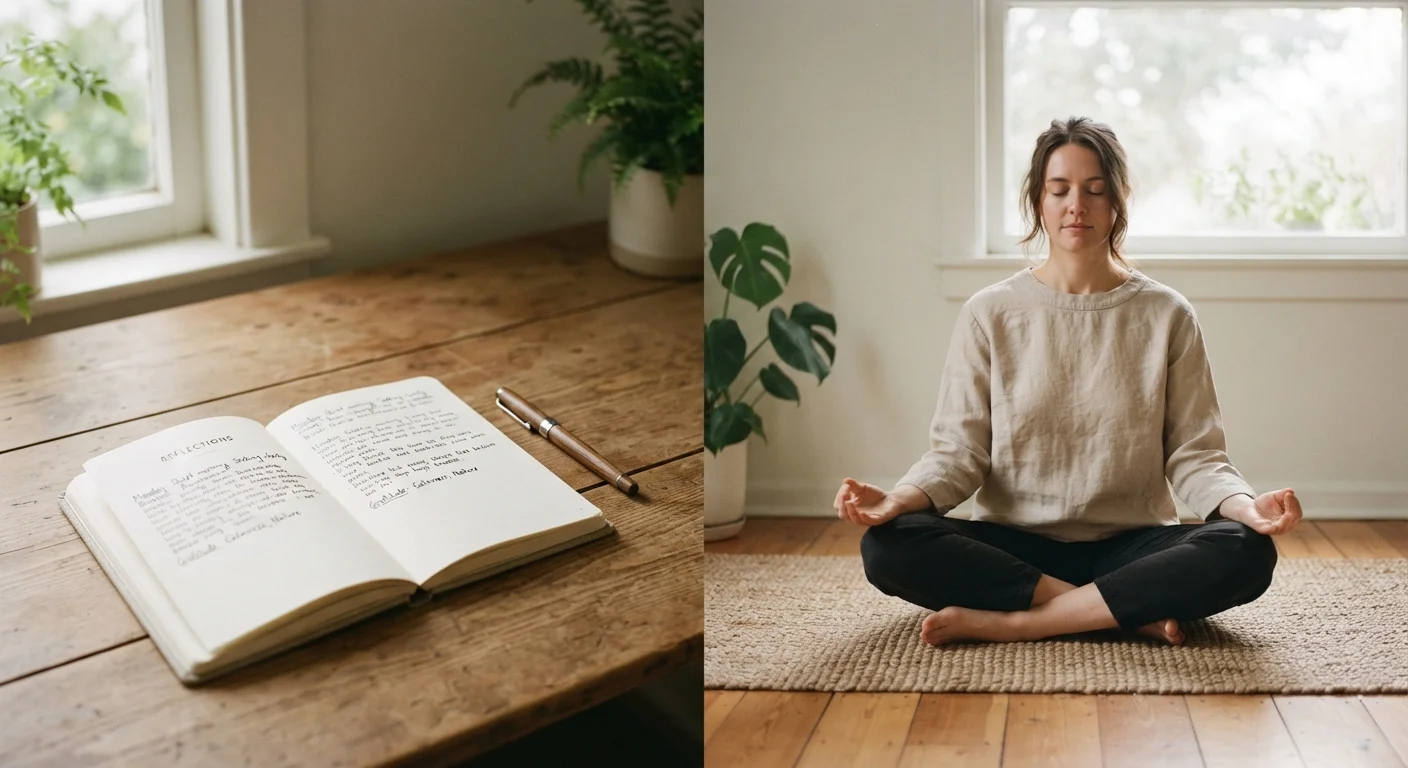
Key Takeaways
- Journalling externalises thoughts through writing, making patterns and emotions easier to examine.
- Meditation trains the mind to observe thoughts without judgment, building present-moment awareness.
- Research supports both practices for reducing stress and improving emotional regulation.
- Your temperament, goals, and daily rhythm can guide which practice — or combination — fits best.
- Neither practice replaces professional mental health care for clinical conditions.
Option A
Journalling
The active, expressive path to inner clarity.
Best for: People who process thoughts and emotions through writing and prefer a structured, tangible outlet.
Option B
Meditation
The still, observational path to present-moment awareness.
Best for: People seeking to quiet mental chatter, reduce stress responses, and cultivate non-reactive awareness.
If you process emotions best by putting thoughts into words
Journalling
Writing creates a concrete record of your inner life, helping you identify patterns, work through conflict, and track emotional shifts over time.
If you want to reduce anxiety and stress in the moment
Meditation
Focused breathing and mindful attention have well-documented effects on the body's stress response, offering rapid grounding for an overactive mind.
If you struggle to sit still or find silence uncomfortable
Journalling
The act of writing keeps the hands engaged and provides a clear task, making it a more accessible entry point for restless or highly verbal thinkers.
If you want to build long-term emotional resilience and equanimity
Meditation
Consistent meditation practice is associated with lasting changes in how the brain processes emotional stimuli, supporting steadier responses over time.
If you want the broadest self-awareness toolkit
Both
Journalling and meditation address different dimensions of self-knowledge; many people find the two practices reinforce each other when used together.
What Each Practice Actually Does
Both journalling and meditation are widely recommended for mental wellness — yet they work through very different mechanisms. Understanding those mechanisms helps you choose the practice that genuinely fits your life, rather than defaulting to whichever one you've heard about most. If you're new to thinking about emotional wellness generally, our introduction to emotional awareness provides a helpful foundation.
Journalling is an active, expressive practice. You translate internal experience — thoughts, feelings, memories, worries — into written language. That translation process is itself meaningful: research in cognitive psychology suggests that labelling emotions in words (a process sometimes called affect labelling) can reduce their emotional intensity and improve clarity. Therapeutic journalling approaches, such as expressive writing, have been studied for their potential to support emotional processing after stressful events.
Meditation, by contrast, is largely a receptive practice. Rather than externalising thoughts, you observe them arising and passing without necessarily engaging with their content. Most meditation forms — including mindfulness meditation — train attention and awareness, strengthening the capacity to notice mental events without being swept away by them. This distinction matters: journalling asks you to engage with your inner world; meditation asks you to witness it.
| Criterion | Journalling | Meditation |
|---|---|---|
| Core mechanism | Externalising & processing thoughts | Observing thoughts without engagement |
| Activity type | Active, expressive | Receptive, still |
| Primary skill built | Self-reflection & emotional articulation | Present-moment attention & non-reactivity |
| Time to start | Minimal — pen and paper suffice | Minimal — no equipment needed |
| Learning curve | Low; guided prompts can help | Moderate; instruction aids technique |
| Best evidence base | Expressive writing, gratitude journalling | Mindfulness-based programmes (e.g. MBSR) |
| Rumination risk | Possible without structure | Lower with mindfulness approach |
What the Evidence Shows
Neither practice is a cure-all, and it's important to distinguish well-supported findings from hype. That said, both have meaningful research backing.
For journalling, psychologist James Pennebaker's foundational work showed that expressive writing about emotionally significant experiences was associated with improvements in mood and, in some studies, physical health markers. More recent research suggests that structured journalling — such as gratitude journalling or cognitive reframing — can support positive affect and reduce rumination, though effect sizes vary and individual responses differ.
For meditation, a substantial body of evidence — including meta-analyses of randomised controlled trials — supports mindfulness-based interventions for reducing symptoms of anxiety, depression, and stress. The evidence is strongest for structured programmes such as Mindfulness-Based Stress Reduction (MBSR). Neuroimaging studies suggest regular practice is associated with functional changes in brain regions linked to attention and emotional regulation, though this field is still developing.
~40%
Reduction in anxiety symptoms
Meta-analyses of mindfulness-based interventions have reported average anxiety symptom reductions of roughly 38–40% compared to control conditions, per reviews published in journals such as JAMA Internal Medicine.
15–20 min
Typical effective journalling session
Pennebaker's foundational expressive writing studies used sessions of approximately 15–20 minutes over several consecutive days to observe measurable effects on mood and wellbeing.
8 weeks
Duration of standard MBSR programme
The widely studied Mindfulness-Based Stress Reduction programme, developed at the University of Massachusetts Medical School, runs over an 8-week structured course.
It's also worth noting that digital tools exist for both practices. For a balanced perspective on whether apps are a useful supplement, see our look at digital mental health apps.
Choosing the Right Fit — or Using Both
The honest answer is that the best practice is the one you'll actually do consistently. A few considerations worth reflecting on:
- If you're highly verbal and find that talking or writing things out brings relief, journalling is likely a natural fit. Even 10–15 minutes of free writing can yield insight.
- If you're drawn to stillness or want to interrupt a cycle of anxious over-thinking, meditation's observational quality may offer what journalling cannot — space between stimulus and response.
- If you tend to ruminate (cycling repeatedly through the same worries), unstructured journalling can sometimes reinforce rumination rather than resolve it. Structured prompts or mindfulness-based approaches may serve you better.
- If you're time-pressed, both practices can be adapted to short windows. Even brief, consistent practice tends to outperform sporadic longer sessions.
Many people find the practices complementary: meditating first to settle the mind, then journalling to explore what surfaces. There's no rule against combining them. What matters is intentionality — approaching either practice with genuine curiosity rather than obligation.
Both Practices Work Alongside Professional Care
Journalling and meditation are evidence-informed wellness practices, not clinical treatments. For persistent anxiety, depression, trauma, or other mental health conditions, they may complement — but should not replace — care from a licensed mental health professional. If you're unsure where to start, talking openly about mental health can be a meaningful first step.
This article is for general informational purposes only and is not a substitute for professional mental health advice, diagnosis, or treatment. If you are experiencing persistent emotional difficulties, please consult a qualified mental health professional.