

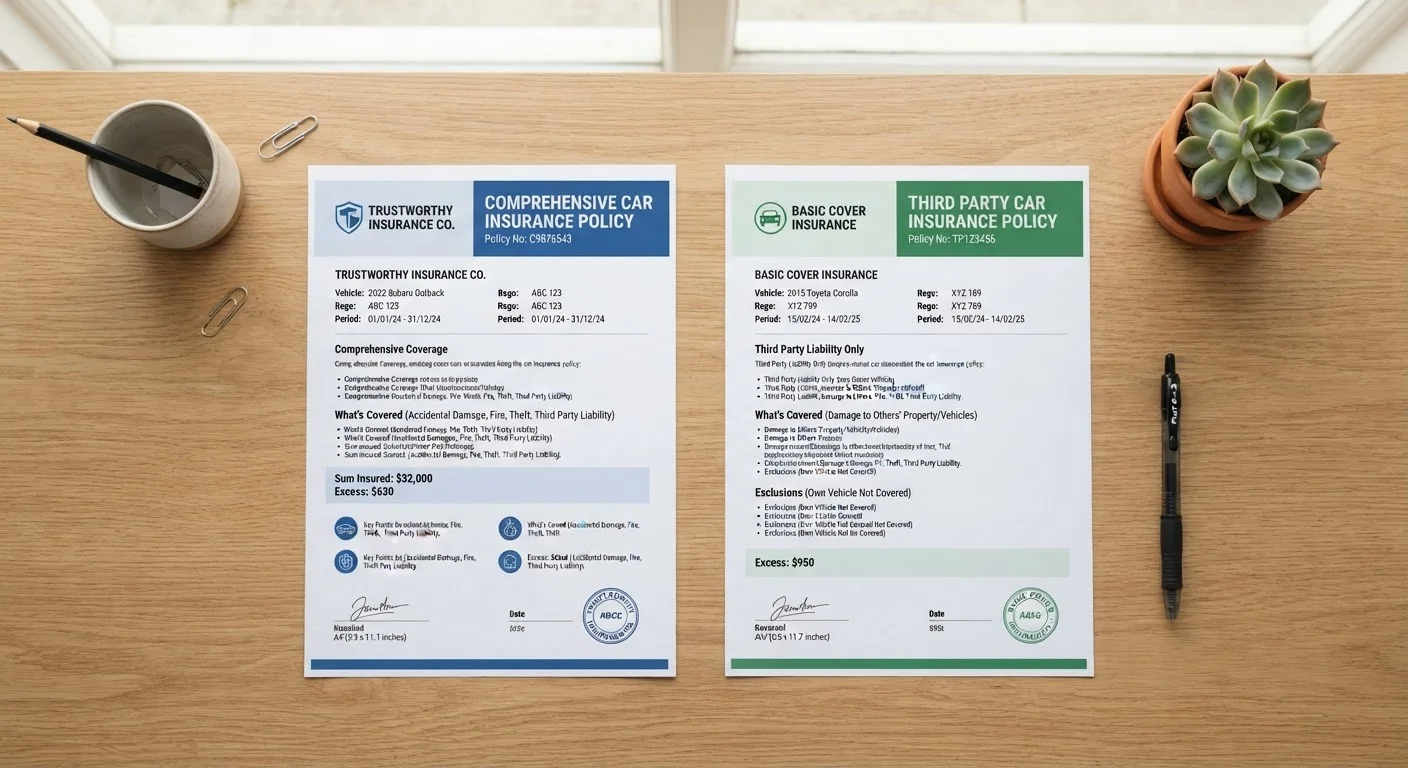
Key Takeaways
- Third-party insurance covers damage you cause to other people and their property, not your own vehicle.
- Comprehensive insurance adds protection for your own car, including theft, weather damage, and collisions.
- Neither policy type guarantees every possible scenario is covered — exclusions always apply.
- Your vehicle's age, value, and how you use it are key factors in deciding which level makes sense.
- State laws generally require some form of liability coverage, but comprehensive is typically optional.
Option A
Comprehensive Car Insurance
The broader, all-around protection option.
Best for: Drivers who want coverage for damage to their own vehicle, not just liability to others.
Option B
Third-Party Car Insurance
The essential, liability-focused baseline.
Best for: Drivers primarily concerned with covering damage or injury they cause to others.
If you drive an older vehicle with a low market value
Third-Party Car Insurance
When the cost of comprehensive premiums approaches or exceeds the vehicle's value, paying for broader coverage may not be financially practical.
If you're financing or leasing your vehicle
Comprehensive Car Insurance
Lenders and lessors typically require comprehensive coverage to protect their financial interest in the vehicle.
If you want protection from theft, weather events, or fire
Comprehensive Car Insurance
Third-party policies do not cover damage to your own vehicle from non-collision events — comprehensive is specifically designed to address these risks.
If you need to meet only the minimum legal requirement in your state
Third-Party Car Insurance
Most U.S. states mandate liability coverage as the floor, and a basic third-party policy typically satisfies that requirement.
The Core Distinction: Who Is Actually Protected?
The most important question to ask about any car insurance policy is: whose losses does it actually pay for? That question cuts right to the heart of the difference between comprehensive and third-party coverage.
Third-party insurance — often called liability insurance in the United States — protects other people from you. If you cause a collision that damages another driver's car or injures a pedestrian, your third-party policy covers their repair bills and medical costs up to your policy limits. It does not pay to fix your own vehicle or cover your own medical expenses.
Comprehensive insurance extends that protection to include your own vehicle. It covers damage from collisions (sometimes bundled with a separate collision component), theft, vandalism, fire, flooding, hail, and animal strikes — depending on your specific policy's terms. It essentially adds a layer of financial protection for events that affect your car, not just those you cause to others.
It's worth noting that in the U.S., "comprehensive" is technically one component of a fuller policy that often pairs it with collision coverage. Understanding how your insurer structures these elements matters when reading any policy. Common car insurance myths — such as assuming "full coverage" means everything is covered — can lead to gaps in protection.
| Criterion | Comprehensive Insurance | Third-Party Insurance |
|---|---|---|
| Covers damage to your own vehicle | Yes (collision + comprehensive perils) | No |
| Covers damage you cause to others | Yes | Yes |
| Covers theft of your vehicle | Yes | No |
| Covers weather or fire damage | Yes | No |
| Meets typical state legal minimum | Yes (exceeds it) | Yes (meets it) |
| Usually required for financed vehicles | Yes | No |
| Premium cost (general) | Higher | Lower |
| Deductible applies | Yes | Not typically |
What Each Policy Leaves Out
Neither coverage type is a blank check. Both come with exclusions, limits, and conditions that are often buried in fine print.
Third-party-only policies typically exclude: damage to your own car (regardless of fault), theft of your vehicle, personal injury to yourself, and any event that isn't directly caused by you to someone else.
Comprehensive policies — despite the name — generally exclude: mechanical breakdowns, tire wear, personal belongings stolen from inside the car, and intentional damage. Deductibles also apply, meaning you pay a portion of every claim out of pocket.
~80%
U.S. drivers with comprehensive coverage
According to the Insurance Research Council, roughly 80% of insured U.S. drivers carry comprehensive coverage as part of their policy.
1 in 8
Drivers uninsured in the U.S.
The Insurance Research Council estimates that approximately one in eight U.S. drivers is uninsured, which underscores the real-world relevance of liability protection.
The phrase "comprehensive" can be misleading. It means broader than third-party, not unlimited. Carefully reviewing the declarations page of any policy — the summary document listing exactly what is and isn't covered — is the only reliable way to know what you've actually purchased.
How to Think About the Right Level for Your Situation
Deciding between these two coverage levels is fundamentally a financial and practical calculation, not a one-size-fits-all answer.
A general framework many financial educators suggest: compare the annual premium cost of comprehensive coverage against the vehicle's current market value, minus your deductible. If the math doesn't clearly favor comprehensive, a third-party-only approach may make more sense — particularly for older, high-mileage vehicles.
Other factors worth weighing include:
- Where you park: High-theft or flood-prone areas shift the risk calculus toward comprehensive.
- Your financial cushion: If you couldn't absorb the out-of-pocket cost of replacing your car, comprehensive provides a meaningful safety net.
- Lender requirements: Financed or leased vehicles almost always require comprehensive coverage as a loan condition.
- How much you drive: Higher mileage and more time on the road increases accident exposure.
This is general information about how insurance products are structured — not personalized financial or legal advice. For decisions specific to your circumstances, consult a licensed insurance professional who can evaluate your full situation.
State Minimum Requirements Vary Widely
Every U.S. state sets its own minimum liability coverage requirements, and a handful operate under no-fault insurance systems that change how claims are handled. Some states also mandate personal injury protection (PIP) or uninsured motorist coverage as part of the minimum. Always check your specific state's Department of Insurance website to confirm what is legally required where you live.
This article is for general informational purposes only and does not constitute personalized insurance, financial, or legal advice. Coverage terms vary by state and insurer. Always review your policy documents carefully and consult a licensed insurance professional for guidance tailored to your needs.